
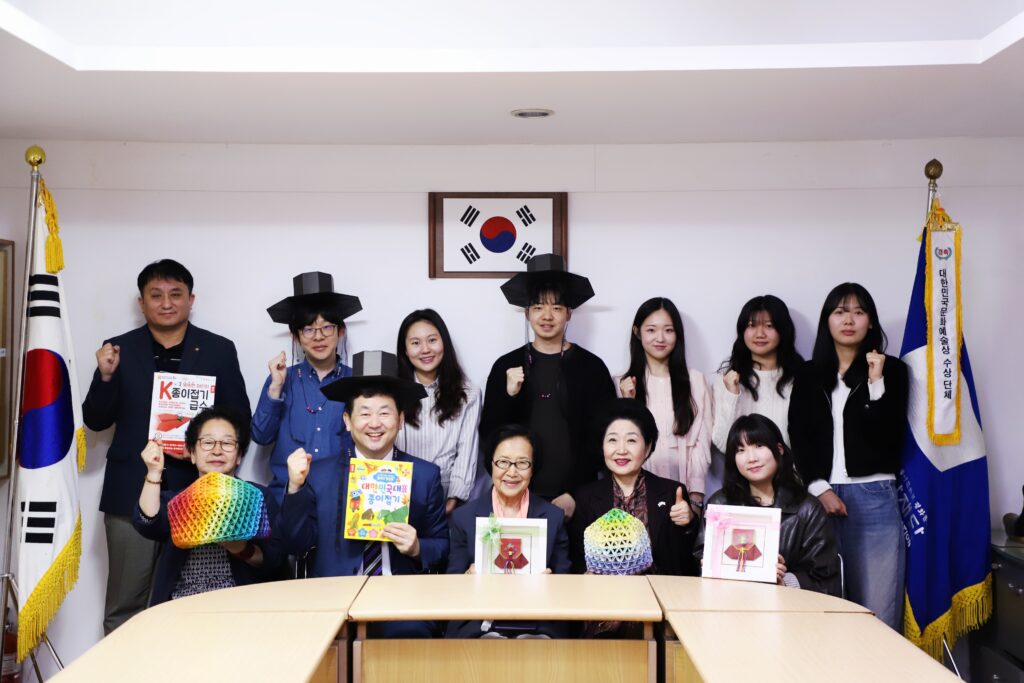
The Voluntary Agency Network of Korea (VANK), led by Director Park Gi-tae, and the Korea Paper Culture Foundation and the World Jong Ie Jupgi Organization, chaired by Noh Young-hye, held a strategy seminar on April 20, 2026, at the foundation’s conference room in Jangchung-dong, Jung-gu, Seoul, on promoting the global recognition of “K-Jong ie jupgi (Korea Jong ie jupgi: Paper Folding)” and its inclusion in overseas dictionaries.
The two organizations have continued to promote a campaign to globalize K-style paper folding since signing a memorandum of understanding in April 2022. VANK has focused on expanding online content, and since November last year has been actively carrying out a campaign to have “jong ie jupgi” listed in overseas dictionaries.
At the seminar, youth researcher Lee Sei-yeon presented an action plan to establish the independent identity of Korea’s paper folding culture and introduced VANK’s “Jong ie jupgi Overseas Dictionary Registration Project.” She said, “In the current international linguistic system, paper folding is uniformly referred to as ‘origami,’ raising the possibility that Korea’s paper folding is perceived as part of Japanese culture,” adding that “the structural issue lies in the lack of language data that separately explains and accumulates Korea’s paper folding tradition.”
She continued, “Although paper folding is a universal cultural practice that has developed across various cultures, ‘origami’ is effectively used as a global standard term, creating a narrative structure centered on a specific culture,” and noted that “this can lead to an imbalance in cultural representation, making it necessary to move toward a more inclusive framework that encompasses diverse paper folding traditions.”
Lee also introduced the current status of VANK’s campaign to register the term in major overseas online dictionaries. So far, request letters have been sent to 15 overseas online encyclopedias and language dictionaries, and five institutions have officially responded that internal editorial reviews are under way. “More than half of 18 major overseas dictionaries describe paper folding from a Japan-centered perspective, meaning Korea’s paper folding culture is not sufficiently reflected,” she said, emphasizing that “increasing the actual usage frequency of ‘jong ie jupgi’ in English-speaking contexts is a prerequisite to changing this structure.”
She stressed that “dictionary registration ultimately depends on usage data,” explaining that “standardization becomes possible only when consistent usage is accumulated across English-language texts in diverse contexts.” She added that “it is not temporary exposure but the long-term and stable accumulation of usage data that provides the basis for dictionary inclusion.”
Citing Google Trends analysis, she said that “the search volume for ‘jong ie jupgi’ is very low compared to ‘origami,’ and in responses generated by AI, the concept often appears unclear or mixed with unrelated images,” adding that “this demonstrates the instability of AI recognition caused by a lack of relevant corpus and contextual data.”
She also emphasized that “inconsistencies in spelling are the biggest obstacle to building a corpus,” adding that “standardizing the English spelling as ‘jong ie jupgi’ is both the starting point and an essential condition for all related campaigns.”
Finally, she proposed a joint action plan by VANK and the foundation called the “AI Diplomat Project.” “Participants, including members and instructors of the World Jong Ie Jupgi Organization, should act as AI diplomats by producing content using generative AI and accumulating it as data,” she said, adding that “the accumulation and spread of such content can lead to a structure that effectively automates corpus building.”
Kwon So-young, a researcher at VANK, introduced the organization’s major initiatives, providing a comprehensive overview centered on its ambassador training programs, as well as its national policy proposal platform “Woollim,” policy communication platform “Yeollim,” global participation platform “Weform,” and cooperation with domestic institutions.
She explained that through its ambassador training programs, VANK is working with major government agencies, including the Ministry of Foreign Affairs, the Ministry of Culture, Sports and Tourism, and the Korea Heritage Service, to foster youth and young adults as digital diplomats, metaverse diplomats, and global ambassadors for Korea. Based on this, the organization is continuing efforts to reshape Korea’s national image as “the center of Asia,” “a gateway to Northeast Asia,” and “a country that shares dreams and friendship with the world.”
Kwon added that “Woollim” serves as a participatory platform where citizens can propose policies in areas such as history, culture, tourism, and diplomacy, acting as a bridge between the government and the public. “Yeollim,” she said, functions as an open platform that transparently shares government policies and content while allowing citizens to freely express their views. Meanwhile, “Weform” enables public participation in global issues by allowing users to propose policies and contribute opinions on international agendas, providing a channel for direct civic engagement in global discourse.
Miriam Chung, an honorary professor at the University of Oxford, said, “When looking at cultural vocabulary registered in the Oxford Dictionary, China has around 2,000 entries and Japan about 1,000, while Korea has no more than about 150.” She added that “while China and Japan have a balanced range of cultural terms covering both traditional and modern culture, Korea’s entries are relatively concentrated on modern culture, making its traditional culture less visible in the global linguistic system.”
She noted in particular that “if traditional cultural elements such as paper folding continue to be subsumed under the single term ‘origami’ without being established as independent cultural concepts, it becomes difficult to properly convey the historical and cultural context of Korea’s paper folding.” She emphasized that “dictionary inclusion is a crucial process that determines how a country’s culture is defined and recognized within the global knowledge system,” calling for strategic vocabulary development and sustained efforts to ensure balanced representation of Korea’s traditional culture.
Noh Young-hye, chair of the Korea Paper Culture Foundation, pointed to challenges in cultural recognition within the generative AI environment and stressed the need for new response strategies. “There are still cases where generative AI fails to clearly distinguish between Korea’s paper folding and origami,” she said, explaining that “this stems from limitations in training data and conceptual definitions.”
She added, “At the same time, AI continuously learns and evolves based on user input, so it must be actively utilized,” emphasizing that “through VANK’s AI Diplomat Project, it is important for citizens to participate as content creators and continuously input and spread accurate information and context about Korea’s paper folding.”
Park Gi-tae, head of VANK, underscored the influence of language and terminology on cultural perception, highlighting the strategic value of paper folding. “In the past, gochujang was translated into expressions familiar to Western audiences, such as ‘red hot pepper paste,’ which failed to fully convey its historical and cultural context,” he said. “Now, the original term ‘gochujang’ is used as is, allowing Korea’s cultural identity to be fully expressed.” He added, “Words shape the framework of thought and perception, and once established, they can last for hundreds or even thousands of years. What something is called ultimately determines how it is understood.”
He also noted that “as global attention is focused on Korea through the Korean Wave, including BTS, paper folding should be expanded beyond a simple craft or pastime into content that embodies Korea’s history and culture,” adding that “this will allow people around the world to experience Korea’s culture and values directly through paper folding, rather than through Japan or China.”
The seminar continued with presentations by VANK youth researchers on ideas for promoting jong ie jupgi globally.
Lee Hyun-woo proposed creating short-form promotional videos using AI video tools. He emphasized the need to combine iconic Korean locations and symbolic keywords to develop paper folding into cultural storytelling content. By incorporating historical and traditional spaces alongside everyday narratives, he said, viewers can be guided to recognize the term “jong ie jupgi” more naturally, making it an effective strategy for conveying Korean cultural context even in short video formats.
As an example, he suggested content combining the historical symbolism of Dokdo with the resilience of hanji paper. By shaping Dokdo with hanji and expressing it through paper folding, the structure would visually demonstrate resistance to bending, symbolizing national pride and conveying the strength and meaning of Korean-style paper folding.
Kim Ryung-eun proposed producing children’s paper folding videos using K-content. She explained that combining well-known Korean content with paper folding processes can naturally attract interest and participation through familiar characters and music. Such content, she noted, can encourage voluntary engagement from global audiences beyond language barriers, especially as children come to recognize “jong ie jupgi” as a distinct term through familiar visual and play-based experiences. “In the long term, this could contribute to expanding recognition of Korean terminology in the global linguistic environment,” she said.
Choi Ju-eun proposed a strategy to expand “K-jong ie jupgi” through social media, emphasizing the importance of designing content that encourages participation. “Platforms like Instagram are key channels for content diffusion, so it is essential to create structures that allow users to actively participate and share,” she said. She cited the example of distributing paper folding templates based on popular Korean animation, noting that “integrating familiar characters and elements can naturally attract attention and participation.” She suggested creating designs that incorporate traditional cultural elements such as gat and hanbok, making them easy for users to follow and share.
Ma Ji-yun highlighted the need to design systems that encourage people to voluntarily use and record “jong ie jupgi” in order to promote its global spread. She pointed to the growing trend of personalized travel records among younger generations, where individuals create their own travel pamphlets or illustrations to document experiences. “The fact that traditional travel pamphlets are increasingly discarded shows the potential for new content planning that repurposes them,” she said.
She proposed participatory content that transforms discarded travel pamphlets into personalized souvenirs. This would involve using paper obtained at travel destinations to fold landmarks such as Gyeongbokgung Palace or N Seoul Tower, and creating short-form videos that connect the activity to real travel experiences. “Travel content has strong characteristics of documentation and shareability, making it highly suitable for hashtag-based diffusion,” she said, adding that “in this process, ‘jong ie jupgi’ functions not simply as a translated term but as a language describing a specific experience.”
Following the seminar, the two organizations announced plans to apply the “AI Diplomat Program” to the field of paper folding, which has evolved from traditional daily culture into areas such as education, mathematics, science, and art. They aim to train AI diplomats among 400,000 members worldwide involved in paper folding. They also plan to continue efforts to standardize the English spelling of jong ie jupgi, expand global awareness, and promote its inclusion in overseas dictionaries.