
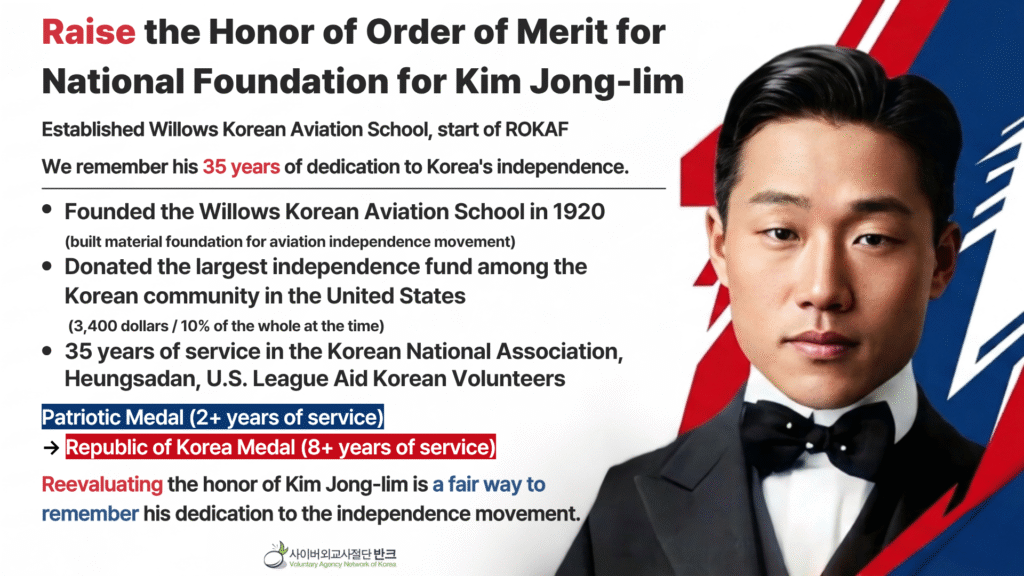
VANK announced that it will launch a global campaign calling for an upgrade in the Order of Merit for National Foundation awarded to Kim Jong-lim, who established a Korean aviator training school in Willows, California, in 1920 and laid the human and ideological foundations of the Republic of Korea Air Force. He is currently recognized with the fifth-class National Medal.
In Korea’s independence movement history, the Willows Korean Aviation School is officially recognized by the Republic of Korea Air Force as its origin. However, the contributions of Kim Jong-lim, who made the establishment of the school possible, have not been fully reflected in the national honors system. The founding charter of the school, announced on July 25, 1920, states that its purpose was “to train aviators for the war of independence of the homeland.” Kim Jong-lim provided the entire material foundation for the school with his own personal assets.
Kim devoted more than 35 years to the independence movement, from joining the Gongnip Hyophoe (Cooperative Association) in 1907 until Korea’s liberation in 1945. After the organization was reorganized into the Korean National Association in 1909, he served in roles such as acting legal officer. In 1913, he was appointed a Hamgyeong Province committee member of the Heungsadan. In 1919, he donated $3,400—the largest single contribution—to a fundraising campaign for Korea’s independence among Korean Americans, accounting for about 10 percent of the total amount raised. In 1940, he served as an executive committee member of the U.S. League Aid Korean Volunteers, supporting anti-Japanese armed resistance efforts in China. Following the outbreak of the Pacific War, he enlisted in the U.S. National Guard and fought against Japan, while also serving as chairman of the Korean Dongjihoe in North America and continuing his activities in independence organizations until liberation.
Among his 35 years of service, his most significant contribution was the establishment of the aviation school in 1920. He provided 40 acres of land, purchased two aircraft, built a runway, and covered the full monthly operating cost of $3,000 from his own funds. This went beyond financial support, representing the actual construction of the material foundation for an aviation-based independence movement.
According to the general criteria for evaluating independence merit honors, first- to third-class awards typically require at least eight years of activity, while the fifth-class National Medal requires at least two years. Kim’s 35 years of service far exceed these standards. His record—including the largest single donation to independence funds and full financial support for the aviation school—also meets the criteria set out in Article 3 of the Awards and Decorations Act in terms of both merit and impact on the nation and society, providing grounds to reconsider the gap between his contributions and his current fifth-class recognition.
There are precedents for reassessing honors awarded to independence activists. Yu Gwan-sun’s rank was raised from the third-class Independence Medal in 1962 to the first-class Republic of Korea Medal in 2019, while General Hong Beom-do, who received the second-class Presidential Medal in 1962, was additionally awarded the first-class Republic of Korea Medal in 2021. These cases demonstrate efforts to achieve historical fairness through reassessment, forming a key basis for the argument that Kim Jong-lim’s recognition should be similarly reviewed.
From the perspective of fairness, the need for reassessment is also clear. General Noh Baek-rin, who served as principal of the Willows aviation school, was awarded the second-class Presidential Medal. If the principal of the school received a second-class honor, it is difficult to justify why the individual who established the school itself—by providing land, aircraft, and full operating funds—remains at the fifth-class level. Compared with the higher-class honors awarded to independence leaders in the United States, such as Syngman Rhee and Ahn Chang-ho, Kim’s current classification appears unbalanced.
Park Gi-tae, head of VANK, said, “Just as the elevation of honors for Yu Gwan-sun and General Hong Beom-do represented the realization of historical justice, the reassessment of Kim Jong-lim should be carried out under the same principle.” He added, “As long as the dedication of the figure who laid the foundation of the Republic of Korea Air Force remains in the shadows of history, our society’s evaluation of the independence movement cannot be considered complete.”
Kwon So-young, a researcher at VANK leading the campaign, said, “The evaluation of contributions to the independence movement should be based on the duration and substance of one’s efforts. If 35 years of dedication and full financial support for the aviation school result in a fifth-class honor, it signals not a problem with the individual, but a limitation in the evaluation system’s ability to properly reflect the weight of such contributions.”
Kim Han-il, president of the San Francisco & Bay Area Korea Center, said, “Kim Jong-lim’s dedication is not just history in textbooks, but part of the lived experience of the Korean American community’s independence movement. Raising his honor is not simply about recognizing one individual, but about ensuring that history fairly remembers the countless Korean Americans who supported the independence movement far from their homeland.”
VANK plans to carry out the campaign through the national policy proposal platform “Woollim,” encouraging citizens around the world to join a petition calling for the upgrade of Kim Jong-lim’s state honor. The organization also aims to raise awareness, both domestically and internationally, about the historical significance of the aviation independence movement and the need for fairness in evaluating independence activism.