
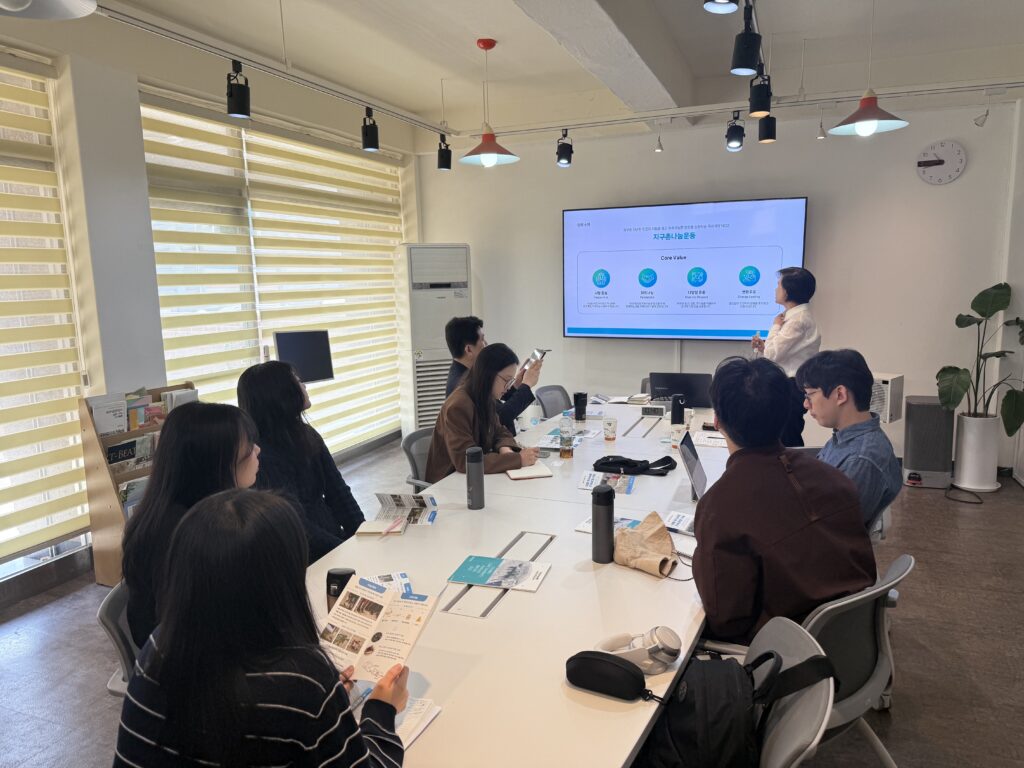
Cyber Diplomacy Organization VANK and Global Civic Sharing held a “Global Environment and Climate Ambassador Training Strategy Seminar” on April 27, 2026, at the VANK office in Bomun-dong, Seongbuk-gu, Seoul.
The seminar was organized to explore the role of youth in addressing the global challenge of the climate crisis and to discuss a new talent development model that combines civilian diplomacy with international development cooperation.
Global Civic Sharing is an international development NGO that supports the self-reliance of local communities, mainly in Asia and Africa, and promotes sustainable development that takes climate change and environmental issues into account. As an organization with special consultative status with the United Nations Economic and Social Council, it carries out a range of development cooperation projects based on collaboration with the international community.
At the seminar, Lee Young-joo, head of external cooperation, introduced the organization’s major projects at home and abroad and highlighted the structural link between the climate crisis and poverty.
“Climate change has the greatest impact on vulnerable countries and communities, and its effects are ultimately directly tied to poverty,” Lee said. “Global Civic Sharing supports self-sustaining growth and independence by strengthening the capacities of people in developing countries, while continuing efforts to address various challenges facing humanity, including climate, environment, and education, in an integrated way.”
Kwon So-young, a researcher at VANK, then introduced the organization’s key initiatives, providing a comprehensive overview of its activities. She focused on programs to train Korea promotion ambassadors, as well as the national policy proposal platform “Woollim,” the policy communication platform “Yeollim,” the international agenda participation platform “Weform,” and VANK’s cooperation with domestic institutions.
Kwon explained that through its ambassador training programs, VANK works with major government agencies, including the Ministry of Foreign Affairs, the Ministry of Culture, Sports and Tourism, and the Korea Heritage Service, to nurture youth as digital diplomats, metaverse diplomats, and global ambassadors for Korea. Based on these efforts, she emphasized that VANK continues to promote changes in the country’s image and brand so that Korea can establish itself as “the center of Asia,” “a gateway to Northeast Asia,” and “a country that shares dreams and friendship with the world.”
She also introduced “Woollim” as a participatory platform where citizens can directly propose policies in areas such as history, culture, tourism, and diplomacy, serving as a channel for communication between the government and the public. “Yeollim,” she said, functions as an open platform that transparently shares relevant policies and content from government ministries with the public, allowing for the free exchange of diverse opinions. In addition, “Weform” was described as a participation-based platform that enables users not only to propose policies on global issues but also to present opinions on agendas at international conferences, providing a pathway for citizens to take part in shaping global discussions.
Park Gi-tae, head of VANK, said, “Until now, VANK has trained digital diplomats, Korea promotion ambassadors, and AI diplomats to promote Korea’s history and culture accurately and uphold the nation’s values. Now, based on that experience and passion, we will expand our efforts beyond the nation to protecting the planet. In particular, we plan to take the lead in addressing shared global challenges such as climate, environment, and biodiversity.” He added, “Young people who have worked to promote Korea will now broaden their roles by using digital platforms and global networking skills to communicate with people around the world and naturally take part in responding to the climate crisis.”
Koo Seung-hyun, a researcher at VANK, said, “Through cooperation between VANK and Global Civic Sharing, we will connect Korea’s strengthened national brand with the participation of global Korean Wave fans to build a foundation for more citizens to join efforts to address the climate crisis.”
Following the seminar, the two organizations planned to jointly promote the “Global Environment and Climate Ambassador Project.” The project aims to identify and appoint youth as environment and climate ambassadors and to establish a participatory ESG model based on their social media activities and practical engagement.
In particular, the project will focus on biodiversity practices and pay attention to regions facing population decline, promoting activities to research and document the unique ecological resources of each area. Through this, the initiative aims to create a virtuous cycle in which young people not only gain a deeper understanding of local natural environments but also become aware of the social issues those regions face.
In particular, the project will focus on biodiversity practices and pay attention to regions facing population decline, promoting activities to research and document the unique ecological resources of each area. Through this, the initiative aims to create a virtuous cycle in which young people not only gain a deeper understanding of local natural environments but also become aware of the social issues those regions face.
With this partnership, the two organizations plan to expand youth-led climate action and build a practice-based framework that connects local communities with the global stage.