
VANK has found that 10 major overseas government agencies, international organizations and reference databases, including the U.S. Department of State and NASA, continue to list the East Sea exclusively as the “Sea of Japan,” raising concerns that the disputed naming could be further entrenched through generative artificial intelligence.
VANK, led by Director Park Gi-tae, said Aug. 14 that it examined 10 overseas websites and databases that are likely to be used as sources for generative AI training data, including the U.S. Department of State, NASA, the U.N. Food and Agriculture Organization (FAO) and Encyclopedia Britannica. The group compared textual descriptions with maps and other images on the sites and assessed the risk of the errors being reproduced by AI based on search engine optimization (SEO), answer engine optimization (AEO) and AI optimization (AIO).
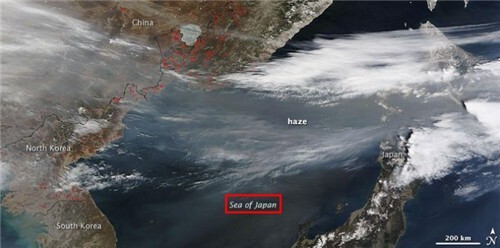
The U.S. Department of State’s travel information page for South Korea, for example, says the country “is bordered by the Sea of Japan to the east,” without mentioning the East Sea. NASA’s Earth Observatory likewise uses “Sea of Japan” exclusively in both the text and map accompanying satellite imagery describing the Korean Peninsula and surrounding waters.
VANK said the problem is particularly significant because official government websites and other authoritative databases tend to rank highly in search results and are likely to be treated as reliable sources by AI systems.
Educational and reference materials also showed inconsistencies. Britannica Kids uses “East Sea (Sea of Japan)” on its South Korea page but refers to the body of water only as the “Sea of Japan” on its Japan page. National Geographic Kids uses “Sea of Japan” in the text of one page while labeling the same body of water as “East Sea” alongside “Sea of Japan” on its accompanying map.
The FAO-managed multilingual thesaurus AGROVOC, meanwhile, provides translations of the term in more than 15 languages but does not include the English term “East Sea,” according to VANK.
The organization warned that such discrepancies could have a much broader impact in an era when more than 1.2 billion people worldwide are using generative AI. If information from authoritative institutions is incorporated into AI training data, erroneous geographical names could be reproduced on a massive scale and become further entrenched in AI-generated answers.
VANK said generative AI systems often prioritize information from highly trusted domains, including U.S. government websites, U.N. agencies and major encyclopedias, particularly when extracting concise definitions and structured data. As a result, inaccurate information from authoritative sources can be amplified regardless of its historical accuracy, the group said.
Park described the issue as a new challenge in the digital era, saying the exclusive use of “Sea of Japan” was a legacy that became established on world maps during Japan’s colonial rule of Korea.
“Through the efforts of VANK and the Korean public, the rate at which the East Sea is listed alongside the Sea of Japan has risen from just 3% to more than 40%,” Park said. “But in the age of the AI revolution, the East Sea is once again at risk of disappearing.”
He added that South Korea’s growing technological and economic influence should be matched by greater efforts to protect its historical and geographical information in the digital sphere.
“The name ‘Sea of Japan’ became quietly established on world maps during a painful period when Korea had no voice in the international community,” Park said. “Today, however, South Korea is one of the world’s 10 largest economies and a leading AI power. Now, all Koreans need to become ‘AI diplomats’ and actively protect our digital territory and history.”
VANK said it plans to register the 10 cases it identified on its own Global Korea Fake News Tracker platform and send official requests to the institutions involved to correct the labeling. It also plans to expand digital public diplomacy efforts aimed at promoting the use of the East Sea.
The organization is also calling for broader public participation through its “I am the AI Lawmaker” platform, which allows citizens to monitor government policies and spending related to promoting the East Sea and propose alternatives.
VANK said the campaign is intended to address a broader problem than the naming of the East Sea alone: the growing importance of digital data in determining how countries, cultures and historical issues are represented by AI systems.