
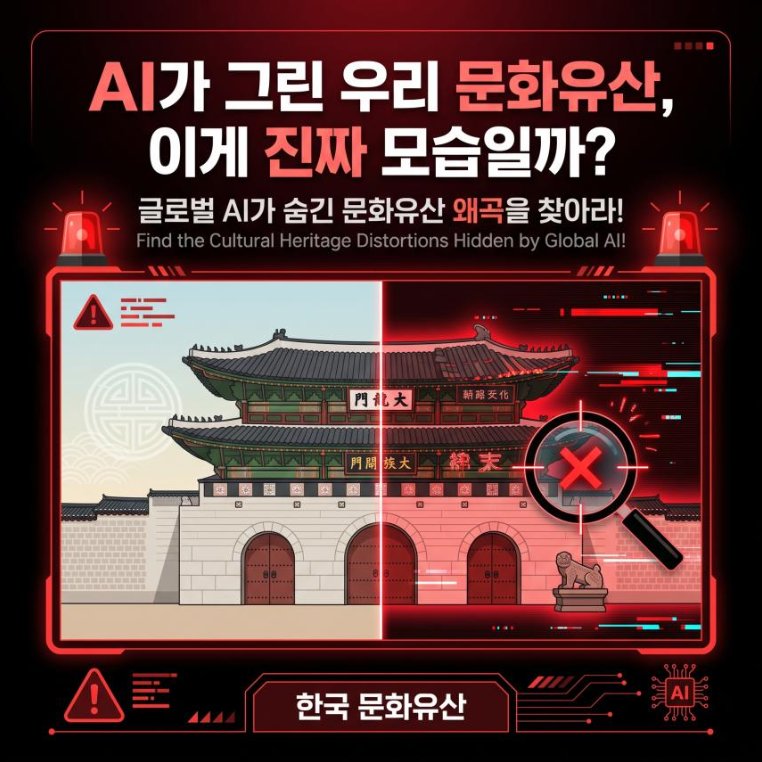
As generative artificial intelligence (AI) becomes increasingly influential in the digital space, a group of young people has taken on the task of identifying and correcting inaccurate information about Korean cultural heritage generated by AI systems.
The National Research Institute of Cultural Heritage under the Korea Heritage Service and VANK, a Korean nonprofit public diplomacy organization, said on Aug. 18, 2026, that the second round of its “Global AI Cultural Heritage Ambassadors” program had successfully concluded after a month of activities from June 29 to July 26.
The program was launched to enable young people around the world to identify errors and distortions involving Korean cultural heritage in generative AI systems and promote accurate information through digital content. As search engines and generative AI increasingly shape how people understand history and culture, the organizers said verifying the accuracy of AI-generated information has become increasingly important.
Generative AI systems can produce inaccurate information or images that differ from reality depending on their training data and model characteristics. The program was designed to prevent such errors from spreading online and to give younger generations a direct role in verifying and correcting cultural heritage information.
A total of 76 teenagers and young adults participated in the second round. Over the four-week program, they used various global AI tools to search for Korean cultural heritage, identify and document errors and distortions, and create digital content aimed at correcting misinformation and promoting the value of Korea’s cultural heritage.
One notable error involved the fountain in front of Seokjojeon Hall at Deoksugung Palace. While searching for cultural heritage sites through global AI systems, participants found that the fountain was incorrectly generated as a pond resembling Buyongji, the famous pond in the rear garden of Changdeokgung Palace.
The case demonstrated how AI can confuse architectural and landscape features from different royal palaces and reconstruct them in ways that do not correspond to reality. It also highlighted the potential for inaccurate cultural heritage information to become embedded and reproduced in AI-generated content.
The ambassadors went beyond identifying such errors and developed a range of digital materials to promote accurate information. They produced short-form videos imagining scenes of whale hunting while exploring the Bangudae Petroglyphs, created card news highlighting distortions in information about Korean cultural heritage, and produced a podcast introducing the Tomb of King Muryeong in four languages — Korean, English, Chinese and Spanish.
Through these projects, participants sought to demonstrate practical ways of correcting misinformation and reaching international audiences with reliable cultural heritage information.
The National Research Institute of Cultural Heritage and VANK selected 19 participants as outstanding ambassadors based on their activities and submitted work. The selected participants will be given an opportunity in September to visit cultural heritage sites in person and will take part in a session to share the results and experiences of the program.
The second round followed the program’s inaugural edition, which ran from Dec. 30, 2025, to Jan. 30, 2026, and produced 42 outstanding ambassadors.
VANK, founded in 1999, is a private public diplomacy organization that has trained Korean teenagers and young adults, overseas Koreans and foreigners as digital diplomats and ambassadors for Korea. The organization has worked to promote Korea’s history and culture around the world.
The National Research Institute of Cultural Heritage said it would continue to provide support and opportunities for future generations to play an active role in safeguarding the value of Korea’s cultural heritage and promoting it internationally.
The organizers said the second round demonstrated the potential of a participatory model for addressing cultural heritage misinformation in the AI era, with young people directly identifying inaccuracies, creating multilingual content and helping ensure that accurate information about Korean heritage reaches a wider global audience.