
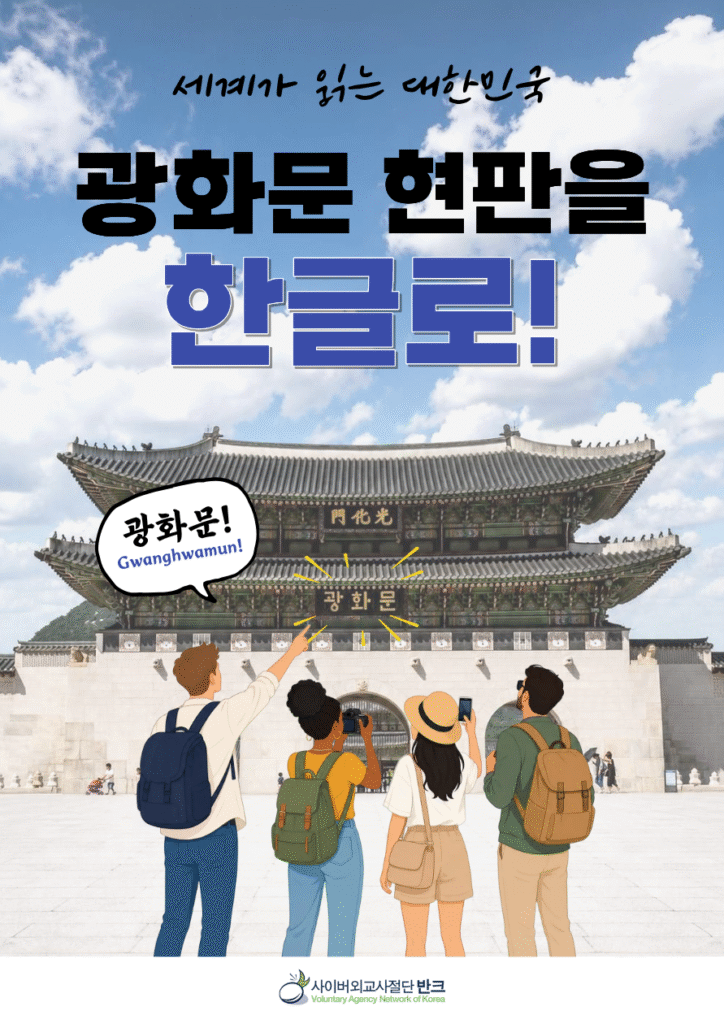
The Voluntary Agency Network of Korea (VANK), led by Park Gi-tae, has launched an online campaign calling for a Hangeul sign to be installed on Gwanghwamun, one of Korea’s most prominent national and cultural symbols, the cyber diplomacy organization said Aug. 13, 2026.
The campaign seeks to make Gwanghwamun a space that represents not only Korea’s historical heritage but also the growing global status of the Korean language and Hangeul, the Korean writing system. Launched ahead of Liberation Day on Aug. 15, the campaign also highlights the legacy of Ju Si-gyeong, a pioneering Korean linguist who devoted his life to researching and promoting Hangul.
Gwanghwamun, the main gate of Gyeongbokgung Palace, currently bears a black plaque inscribed in gold Chinese characters. The plaque was based on the calligraphy of Im Tae-young, the commander of the palace guard during the reconstruction of Gyeongbokgung in 1865, and was recreated in 2023 following historical research.
VANK said it respects the historical significance of the current plaque but believes Gwanghwamun should also reflect the growing global interest in Korean culture and language.
The organization stressed that its proposal is not intended to reject Chinese characters or erase history. Rather, it seeks to find a way to preserve the historical value of Gwanghwamun while also highlighting Korea’s cultural identity and the international standing of Hangeul.
Gwanghwamun is a major national symbol and one of the country’s most visited cultural heritage sites. Gwanghwamun Square is also home to a statue of King Sejong the Great, whose creation of Hangeul is commemorated as a landmark achievement in Korean history. VANK argues that the gate itself should similarly embody the global rise of Korean language and culture.
The campaign comes amid growing international interest in Korea, fueled by the global popularity of K-pop, K-dramas and Korean cuisine as well as a rising number of people learning Korean and Hangeul. VANK said the roughly 200 million Hallyu fans worldwide are increasingly moving beyond consuming Korean popular culture to studying the Korean language and learning about the country’s history and culture.
To promote the campaign, VANK has produced three posters highlighting different perspectives: the spirit behind King Sejong’s creation of Hangeul, the life and work of Ju Si-gyeong, and the perspective of foreign visitors encountering a Hangeul sign at Gwanghwamun. One poster depicts a foreign tourist looking at the proposed sign and saying, “Gwanghwamun! Gwanghwamun!”
VANK plans to promote the campaign through its public policy platform “Woollim,” social media and other online channels, while collecting public support and opinions for the proposal. Existing campaign materials calling for a Hangeul sign at Gwanghwamun will also be distributed in Korea and abroad.
“Some 200 million Hallyu fans around the world are creating a new trend by learning Korean and Hangeul and seeking to understand Korea’s history and culture beyond its popular culture,” VANK Director Park Gi-tae said. “The spaces where people from around the world encounter Korea should also evolve to reflect this change.”
Choi Ju-eun, a VANK youth researcher, said the campaign was intended to connect the legacy of Ju Si-gyeong with contemporary Korea.
“On the occasion of Liberation Day, we wanted to reflect once again on the life of Ju Si-gyeong, who devoted himself to protecting and promoting Hangeul, and carry that spirit forward at Gwanghwamun today,” Choi said. “We hope this campaign will provide an opportunity to reconsider the value and significance of Hangeul.”