
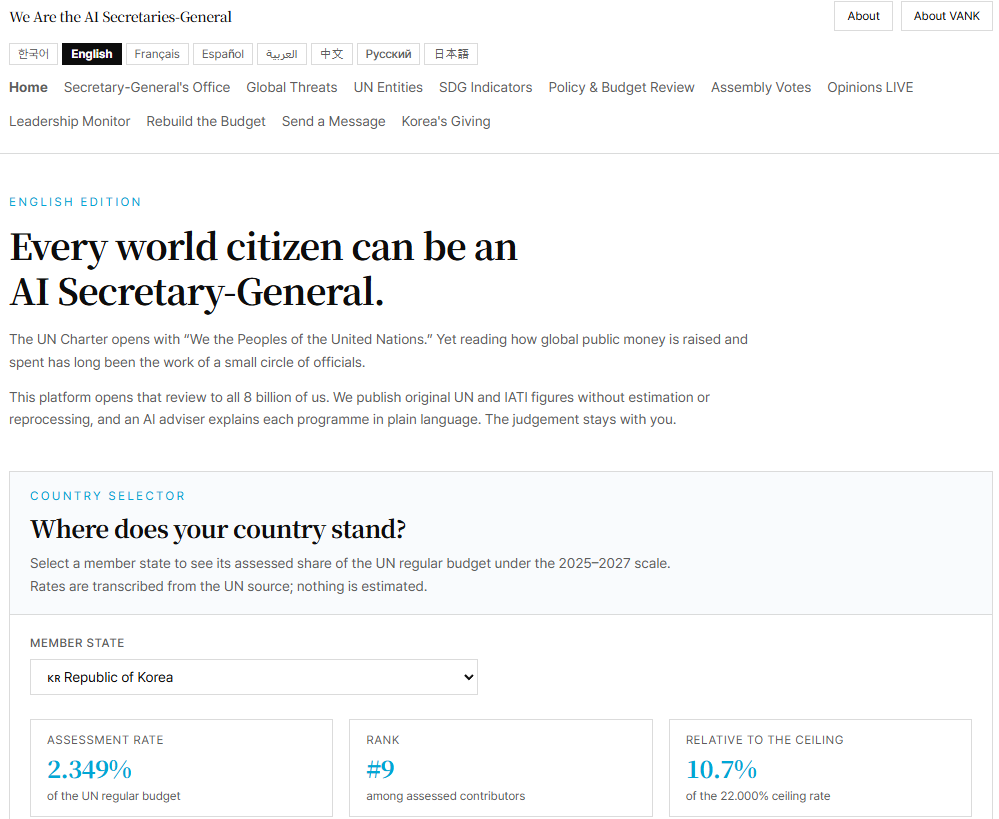
VANK has launched an AI-powered platform that allows citizens around the world to examine and evaluate the budgets, policies and activities of the United Nations and its affiliated international organizations.
The platform, called “I Am the AI Secretary-General of an International Organization,” combines generative artificial intelligence with open data from international organizations to bring the monitoring of global public finances and policy decisions beyond diplomats and experts and into the hands of ordinary citizens.
VANK said on Aug. 18, 2026, that the platform is designed to give the world’s 8 billion people a direct role in understanding and evaluating how international organizations spend public funds and implement policies.
The project expands globally on VANK’s earlier “I Am the AI National Assembly Member” platform, which was created to allow South Korean citizens to examine and monitor the government’s national expenditure budget. VANK said the new platform is based on the idea that just as roughly 300 lawmakers face limitations in scrutinizing an entire national budget, UN officials and representatives from 193 member states cannot independently review every detail of the vast number of international programs and expenditures.
Bringing International Organization Budgets Within Citizens’ Reach
The platform currently contains about 800 detailed projects from 15 UN-related organizations, with combined budgets of approximately $95.07 billion for 2024-2026, or about 139.7 trillion won.
It draws on publicly available source material from the International Aid Transparency Initiative (IATI), official UN financial statistics, original resolutions from the UN Digital Library and Sustainable Development Goals (SDG) indicators, as well as data released by organizations including the UN Office for the Coordination of Humanitarian Affairs (OCHA), the UN Refugee Agency (UNHCR), the Global Disaster Alert and Coordination System (GDACS) and the World Bank.
To make the vast amount of information easier for the public to understand, VANK has incorporated an “AI International Organization Adviser.” The tool provides real-time briefings in six areas: individual projects, organizations, leaders, resolutions, the SDGs and South Korea’s contributions.
For example, users can select the UN World Food Programme’s “Sudan Unconditional General Food Assistance” project. The AI adviser analyzes the original IATI data and summarizes key information, including the program’s emergency food and cash assistance, vulnerable populations affected by the civil war, performance indicators for relief supplies and challenges involved in safely delivering funds and aid to conflict zones.
The platform also provides information on major programs in Africa, including nutrition assistance in the Democratic Republic of the Congo worth about 2.45 trillion won, South Sudan crisis response programs worth about 2 trillion won, relief and nutrition programs in Somalia worth about 1.53 trillion won, and UNHCR operations in Ethiopia and Sudan worth about 1.25 trillion won and 1.22 trillion won, respectively.
From Taxpayers to Global Policy Participants
The platform allows South Korean users to trace how their contributions to the UN are distributed. By using South Korea’s net contributions to UN organizations and population data, users can estimate how much of their taxes ultimately goes to individual organizations and track spending flows by organization, sector and project.
Citizens can also vote on whether the budgets of 800 individual projects should be increased or reduced, cast votes for or against resolutions adopted by the UN General Assembly and Security Council, and view public assessments through a “financial traffic light” system.
A “rebuild the budget” function allows users to adjust the budgets of individual organizations within a range of plus or minus 50 percent, effectively putting them in the position of policymakers and allowing them to consider how scarce public resources should be allocated.
The platform also provides real-time briefings on the UN secretary-general’s five key priorities and the activities and major issues of 24 international organizations. Users can view global crises and funding gaps through data linked to the 17 SDG indicators and public APIs from organizations including OCHA, UNHCR, GDACS and NASA.
In addition, users can write policy statements and submit them directly to national missions to the UN and the office of the UN secretary-general.
The service is available in Korean, English, French, Spanish, Arabic, Chinese, Russian and Japanese, making it accessible to citizens in different parts of the world.
Expanding Korean Public Diplomacy Into Global Civic Action
VANK plans to use the platform not only to promote accurate information about Dokdo, the East Sea and Korean history, but also to expand its global solidarity efforts, particularly with Africa.
One of its major initiatives will be a global campaign calling for the UN to officially adopt the Equal Earth world map, which represents the relative sizes of continents more accurately than the widely used Mercator projection.
VANK has criticized the Mercator projection for making Africa appear significantly smaller than its actual size and plans to use the platform’s citizen participation features to build international support for the Equal Earth map.
According to VANK, the government of Togo plans to submit a resolution at the UN General Assembly in September calling for the adoption of the Equal Earth map, with the backing of all 55 members of the African Union. If the resolution is formally introduced, VANK plans to launch a global public support campaign through the platform’s General Assembly and resolution voting functions.
Park Gi-tae, head of VANK, said the organization had trained young South Koreans as “digital diplomats” and “AI diplomats” since its founding in 1999 to overcome the limitations of relying on a small number of diplomats.
“Now, we want to empower young people in South Korea and citizens around the world to become ‘AI secretaries-general of international organizations,’” Park said.
“Rather than leaving the evaluation of public programs to a small number of lawmakers and diplomats, citizens everywhere should be able to participate directly in the process,” he said. “We hope this will be an opportunity for the Korean Wave to expand beyond culture into transparent public administration and democratic systems, helping South Korea emerge as a global leader in fiscal democracy.”
The “I Am the AI Secretary-General of an International Organization” platform was independently developed and is operated by VANK. It is available free of charge without requiring users to create an account.