
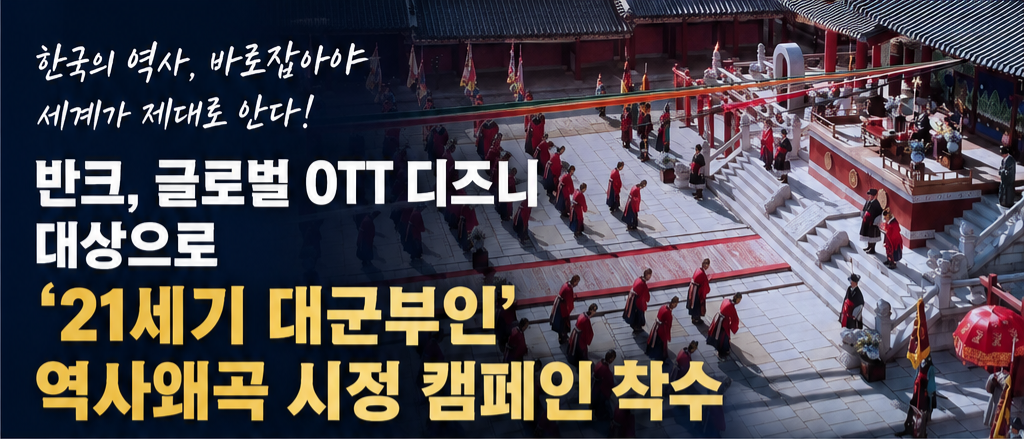
VANK announced on May 17, 2026, that it has launched a campaign urging corrections to allegedly distorted historical expressions in the MBC drama Perfect Crown, which is being distributed globally through Disney+.
VANK said it sent an official letter to Disney+ requesting revisions to the audio and subtitles of a controversial coronation scene that sparked accusations of historical distortion among viewers and historians alike. The organization also announced plans to expand the initiative into a global civic campaign encouraging Hallyu fans worldwide to report and correct historical inaccuracies in Korean dramas and video content distributed through international streaming platforms.
The controversy centers on Episode 11, which aired on May 15, 2026. Set in a fictional 21st-century constitutional monarchy version of South Korea, the scene depicts the coronation of Prince Ian, played by Byeon Woo-seok. During the ceremony, the king wears a guryumyeollyugwan — a nine-string royal crown historically associated with vassal states under the Chinese imperial order — while court officials shout “Cheonse,” rather than “Manse,” toward the newly crowned monarch.
According to VANK, “Manse” is considered the appropriate ceremonial expression for the ruler of a sovereign nation, whereas “Cheonse” has historically been associated with rulers of tributary states under imperial China. The organization argued that the use of such expressions could create the misleading impression that Korea itself acknowledges the logic behind China’s so-called “Northeast Project,” a controversial historical initiative accused of incorporating Korean history into a broader Chinese historical framework.
VANK also raised concerns over the historical accuracy of the royal regalia used in the scene. The organization said an independent sovereign emperor would traditionally be represented by a sibimyeollyugwan — a crown featuring 12 hanging strands — while the drama instead portrayed the monarch wearing a nine-strand crown associated with feudal rulers subordinate to the Chinese emperor.
The controversy intensified because, despite widespread criticism immediately following the broadcast and an official apology from the production team, the disputed scene reportedly remained unchanged on Disney+’s global streaming service as of 3 p.m. on May 17. VANK noted that the drama is currently available with subtitles in 10 languages, including Japanese, raising concerns that what it describes as distorted historical symbolism could spread to international audiences across borders.
According to the organization, the original audio still includes the term “Cheonse,” while subtitles in Korean, Japanese and other languages also continue to display the expression without revision. VANK stressed that the issue goes beyond a simple translation problem and instead concerns the potential misrepresentation of Korea’s historical status and national symbolism to global viewers.
The production team behind the drama previously issued a formal apology, saying it “takes seriously viewers’ concerns that the scene may undermine Korea’s sovereign historical identity.” Producers added that they had failed to carefully examine how royal ceremonial customs evolved throughout Korean history and pledged to revise the audio and subtitles in future rebroadcasts, VOD releases and OTT versions of the episode.
As of May 18, edited versions released on some domestic OTT services had reportedly muted the shouted “Cheonse” chants during the coronation sequence. The drama’s script publication is also expected to undergo revisions, with early purchasers set to receive corrected PDF files and physical correction stickers from the publisher.
The drama, starring IU and Byeon Woo-seok, drew major attention throughout its run, recording a nationwide peak viewership rating of 13.8 percent, according to Nielsen Korea. However, the series also faced repeated controversies, including criticism over historical inaccuracies and acting performances.
Earlier debates surrounding the show focused on fictional royal succession arrangements and regency systems that some viewers argued conflicted with the structures of the Joseon Dynasty and the Korean Empire. While those discussions were initially dismissed by some fans as excessive criticism of a fantasy romance series, the coronation controversy near the finale reignited broader concerns over historical representation in Korean media.
VANK President Park Ki-tae emphasized the growing global influence of Korean streaming content, saying Korean dramas distributed through global OTT services now wield even greater influence than foreign textbooks, encyclopedias or websites.
“Overseas viewers naturally absorb Korea’s history, culture, traditions and national symbols through dramas,” Park said. “Even a small historical error in a production can be accepted by global audiences as an accurate representation of Korea.”
He added that all Koreans should now recognize themselves as “OTT ambassadors for Korea,” stressing that monitoring and correcting inaccurate portrayals of Korean history and culture on platforms such as Netflix and Disney+ has become an increasingly important public task in the global streaming era. Park also called on broadcasters and streaming platforms to take greater responsibility for historical and cultural verification in internationally distributed content.
VANK said it plans to continue monitoring Korea-related content on global platforms and work with domestic and overseas viewers to seek corrections when distorted historical expressions or inaccuracies are identified.
The organization previously led successful correction campaigns involving French subtitles for the Bride of the Water God on Netflix and German subtitles for the Korean film Time to Hunt, in which the East Sea had reportedly been incorrectly labeled as the “Sea of Japan.”