
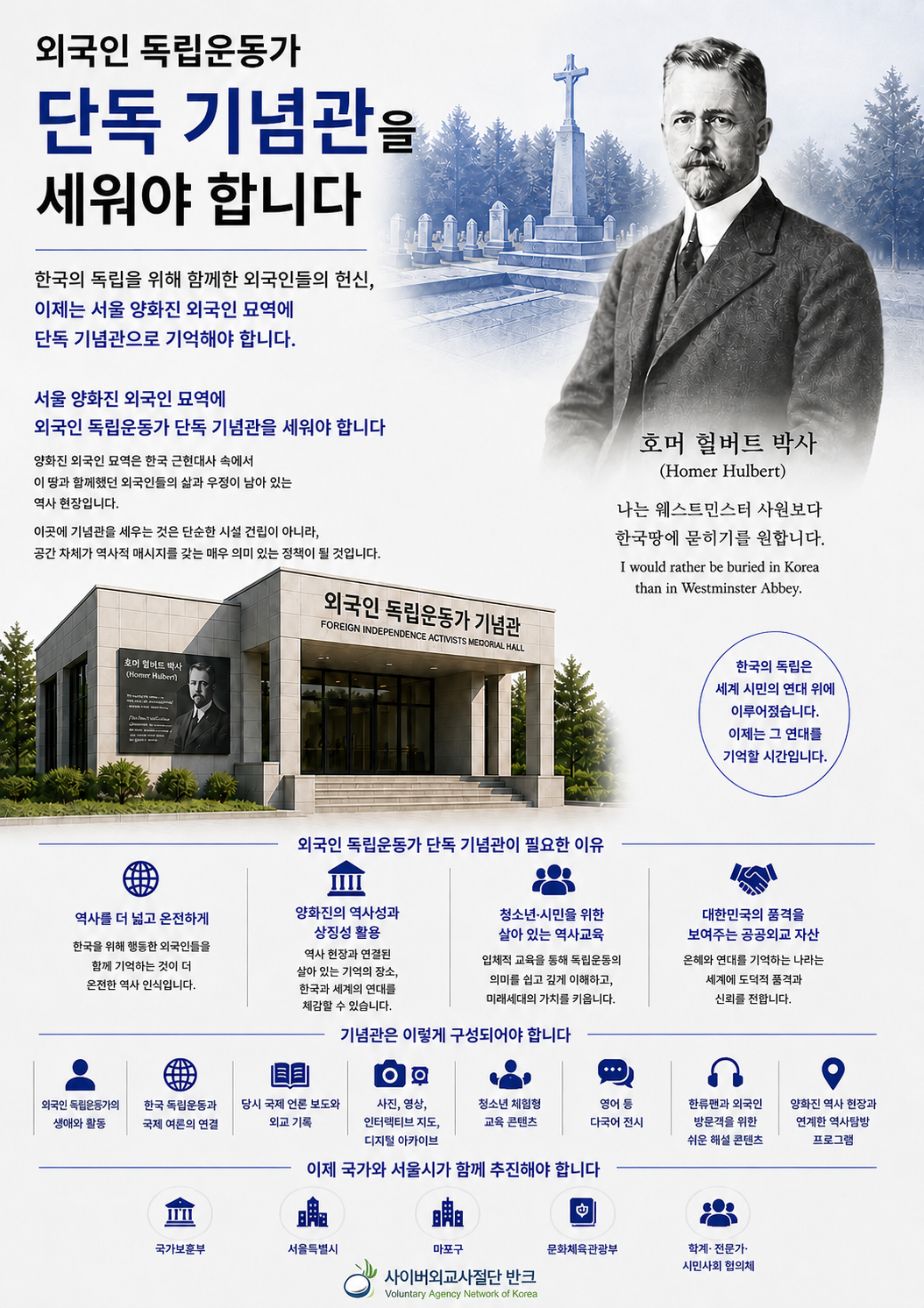
Ahead of Korea’s 9th nationwide local elections scheduled for June 3, 2026, Voluntary Agency Network of Korea (VANK) has launched a new policy proposal campaign calling for the establishment of a dedicated memorial hall honoring foreign independence activists who supported Korea’s struggle for independence.
VANK announced on May 7, 2026 that the proposal is being promoted as the second project under its nationwide participatory campaign, “We Are AI National Assembly Members,” which encourages ordinary citizens to propose public policies and legislation in the same way lawmakers do.
The organization previously launched the campaign’s first project advocating for the inclusion of independence activists and the spirit of Korea’s independence movement in the design and symbolism of Korean passports.
Through the latest campaign, VANK plans to raise public awareness on social media about the need for an independent memorial space dedicated to foreign figures who devoted themselves to Korea’s independence and restoration of national sovereignty. The proposed memorial hall would be established within or near the Yanghwajin Foreign Missionary Cemetery in Seoul’s Mapo District.
The organization said it intends to collect public opinions following the local elections before formally submitting proposals to the Ministry of Patriots and Veterans Affairs, the Seoul Metropolitan Government, Mapo District Office and the Ministry of Culture, Sports and Tourism.
According to VANK, Korea’s independence movement should not be remembered solely as a history created by Koreans alone, but also as a history shaped by the solidarity and conscience of global citizens who stood alongside Korea in its fight for freedom and sovereignty.
The organization highlighted several foreign figures who played major roles in informing the international community about Japan’s colonial rule and supporting Korea’s independence movement, including Homer Hulbert, Frederick Arthur McKenzie, Ernest Bethell, Frank Schofield and Albert Taylor.
VANK acknowledged that Korea already has several meaningful historical sites dedicated to individual foreign independence activists, including Dilkusha — the former home of Albert Taylor — the Schofield Memorial Hall and exhibition spaces within the Independence Hall of Korea.
However, the organization stressed that a standalone memorial hall integrating the stories of foreign independence activists into a single historical narrative would carry a distinct symbolic significance. Such a space, it said, would more vividly demonstrate the international solidarity behind Korea’s independence movement.
VANK described Yanghwajin as the most appropriate symbolic location for the proposed memorial hall because it preserves the lives and legacy of foreigners who dedicated themselves to Korea during the country’s modern history.
“Yanghwajin is a historic space where the lives and sacrifices of foreigners involved in Korea’s modern history remain preserved,” VANK said. “The memorial hall should go beyond being a simple commemorative site and become a multifaceted historical and cultural space that highlights the role of international journalism and diplomacy, the power of global civic solidarity, and the friendship connecting Korea and the world.”
The organization also linked the proposal to the global rise of the Korean Wave, citing data from a 2023 report jointly published by the Ministry of Foreign Affairs of Korea and the Korea Foundation showing that the number of Hallyu fans worldwide increased from 9.26 million in 2012 to 225 million as of December 2023.
VANK argued that Korea now needs new public diplomacy infrastructure capable of expanding global interest in Korean popular culture into a deeper understanding of Korean history and values.
According to the group, the proposed memorial hall could serve as a public diplomacy platform where global fans of K-pop, Korean dramas, films and food naturally encounter the history of Korea’s struggle for independence, freedom and international solidarity. The organization added that the site could also help foreign residents in Korea better understand the historical foundations and values of Korean society, strengthening their trust and connection with the country.
Park Gi-tae, head of VANK, said that while South Korea already has spaces commemorating individual foreign independence activists, “the time has come to create a dedicated memorial hall that remembers them together as a unified historical theme.”
“Yanghwajin Foreign Missionary Cemetery is the most symbolic place to showcase both the sacrifices of foreign independence activists and the international solidarity of Korea’s modern history,” Park said.
He added that the proposal reflects the broader purpose of the “We Are AI National Assembly Members” campaign, which seeks to encourage citizens to reinterpret and preserve the spirit of the independence movement in contemporary society.
“The memorial hall will not simply commemorate the past,” Park said. “It can become a future-oriented historical diplomacy space where people around the world who came to love Korea through Hallyu — as well as foreigners living in Korea — can develop a deeper understanding and appreciation of the country.”
VANK also proposed the formation of a consultative body involving the Ministry of Patriots and Veterans Affairs, the Seoul Metropolitan Government, Mapo District, the Ministry of Culture, Sports and Tourism, historians, civic organizations and exhibition and architectural experts to support the project.
In addition, the organization called for a public participation contest under the theme “Foreign Independence Activists Korea Must Remember” and the creation of a multilingual digital archive documenting the lives and contributions of foreign supporters of Korean independence.
VANK said it plans to continue promoting citizen-driven policy proposals aimed at reviving the spirit of Korea’s independence movement both in everyday life and on the global stage through the “We Are AI National Assembly Members” campaign.