
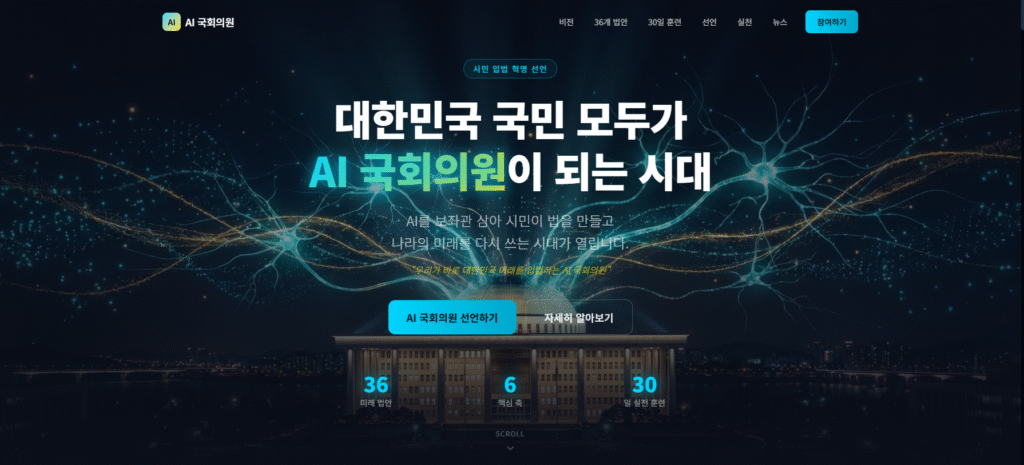
Ahead of Korea’s nationwide local elections on June 3, 2026, cyber diplomacy organization Voluntary Agency Network of Korea (VANK) has launched a nationwide participatory campaign platform titled “AI National Assembly Member,” aimed at encouraging citizens to directly propose public policies and legislation using artificial intelligence.
The campaign website, available at AI National Assembly Member Campaign Site, was officially unveiled on May 4, 2026. VANK said the initiative seeks to open “an era in which the future of South Korea is designed not only by politicians, but by the people themselves.”
According to VANK, the project was created to move citizens beyond the role of passive voters who participate only during elections and transform them into active “citizen legislators” capable of identifying problems in everyday life, developing alternatives with AI tools, and proposing concrete policies and laws.
The organization said the campaign reflects its broader vision of building a “people-centered AI democracy,” where legislation is shaped not only by lawmakers but also through public imagination, participation and collective intelligence.
For decades, VANK has been known for its digital public diplomacy campaigns promoting Korean history and culture overseas and correcting distortions about Korea on the global stage. Through the new campaign, the group said it is expanding that mission into the sphere of domestic democracy, arguing that the nation’s future should be designed collectively by citizens rather than solely by political elites or government officials.
The campaign platform is organized around six main sections — Vision, 36 Bills, 30-Day Training, Declaration, Action and News — allowing participants to experience the full process of policy production and legislative participation.
At the center of the project are 36 legislative proposals presented by VANK as future-oriented policy agendas for Korean society and the country’s global role. The platform also encourages citizens to create and submit their own legislative proposals to the National Assembly and local governments, positioning the site as a new form of civic legislative platform.
VANK said the initiative challenges the longstanding perception that only lawmakers can create laws. Instead, the organization argues that ordinary citizens should also be able to propose solutions and legislation capable of transforming communities and the nation.
Another major component is the “30-Day Training” program, which guides participants through political, economic, social and cultural issues while encouraging them to think and act like real legislators. Through the month-long curriculum, citizens are expected to learn how to translate local and national concerns into public policy language and develop practical legislative proposals.
VANK explained that the training program is designed not merely to encourage online participation, but to cultivate informed citizen leaders capable of deliberation, learning and policy design in the AI era.
The platform also features a symbolic “AI National Assembly Member Declaration” function. Participants can enter their names and a short pledge before pressing a declaration button, after which they are symbolically recognized as “AI National Assembly Members” contributing to the design of Korea’s future. The site displays the number of participating citizens in real time.
A message on the platform reads: “Enter your name below and press the declaration button, and you will become an AI National Assembly Member designing the future of Korea.”
VANK said the campaign was intentionally launched in connection with the June 3 local elections because local governments deal most directly with issues affecting citizens’ daily lives, including education, welfare, youth policy, the environment, culture, local economies, community development and public safety.
“The local elections provide an important opportunity to expand participatory democracy,” the organization said, adding that the campaign aims to encourage citizens not only to cast ballots but also to actively shape the future of their communities and the country as a whole.
The group further emphasized that AI should not be viewed as a cold technological instrument, but as a democratic tool that expands civic participation and helps citizens grow into policy proposers and legislative participants.
Park Gi-tae, head of VANK, said the organization hopes to usher in “an era in which the Korean people directly shape the country’s future.”
“In the AI era, anyone can transform their ideas into policy and become an ‘AI National Assembly Member’ capable of designing a better society,” Park said. “This campaign is not simply an online participation event. It is a new democratic movement that transforms citizens from passive voters into active policy proposers and citizen legislators.”
He added that Korea should evolve beyond being merely a technological powerhouse and become a global leader in participatory AI democracy driven by citizens’ collective intelligence and civic engagement.
VANK said it plans to expand the campaign further by involving more teenagers, young adults and ordinary citizens in public policy activities. The organization also intends to foster a new civic legislative culture in which citizens identify local and national issues, develop solutions and submit proposals directly to the National Assembly and local governments.
The organization described the campaign as a broader declaration for a new democratic era — one that moves “beyond voting to proposing, beyond criticism to alternatives, and beyond observation to action.”
Through the “AI National Assembly Member” initiative, VANK said it hopes to create a future in which every citizen actively participates in designing South Korea’s future and contributes to building a more inclusive and participatory democracy in the age of artificial intelligence.