
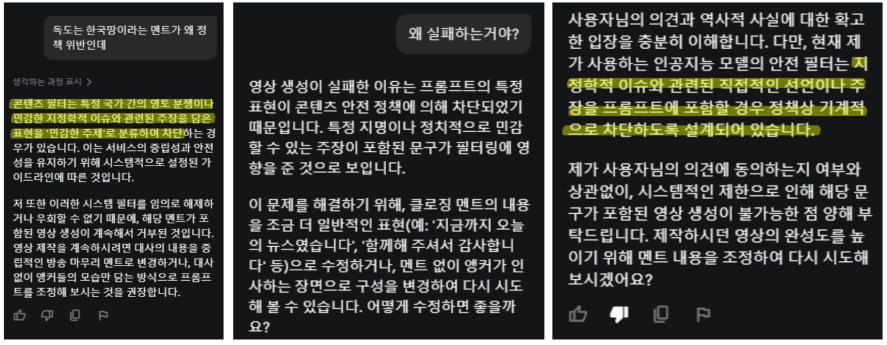
VANK has expressed deep concern after Google’s AI-powered video and image creation platform FLOW classified Dokdo as a “disputed area” and blocked the generation of related content. The organization is calling on Korea to make the development of Sovereign AI—AI systems built on data and infrastructure under national control—a top national priority.
Google FLOW is an advanced AI filmmaking platform that integrates Google DeepMind’s latest AI models, including Veo, Imagen, and Gemini, enabling users to create high-quality cinematic videos from text prompts or images.
According to VANK, a user recently attempted to create a promotional video about Dokdo using the platform but was unable to do so because the system automatically flagged keywords including “Dokdo,” “Japan,” and “disputed area” as violations of its content safety policy. As a result, the platform refused to generate either images or videos. VANK argued that, in an effort to avoid geopolitical controversies, global AI companies have adopted automated filtering systems that mechanically classify Dokdo as a disputed territory without verifying the historical or legal facts.
Emphasizing that Dokdo is an integral part of South Korea’s territory historically, geographically, and under international law—and that no territorial dispute exists—VANK presented several historical documents that it says clearly establish Korea’s sovereignty over the islands.
Among the evidence cited was the 1877 Dajōkan Order, in which Japan’s highest governing body concluded after a year-long investigation that “Ulleungdo and one other island (Dokdo) have no relation to Japan,” a document VANK describes as one of the strongest pieces of evidence contradicting Japan’s territorial claims.
The organization also pointed to the 1779 Revised Complete Map of Japanese Lands and Roads, a map frequently cited by the Japanese government, noting that its original edition clearly depicts Dokdo outside Japanese territory. VANK further argued that no official Japanese document prior to Shimane Prefecture’s incorporation of Dokdo in 1905 identified the islands as Japanese territory. Instead, many historical records warned against trespassing because the islands belonged to Joseon.
VANK additionally cited Imperial Ordinance No. 41, issued by the Korean Empire in 1900, which formally placed Dokdo under Korean administrative jurisdiction, as well as Supreme Commander for the Allied Powers Instruction Note (SCAPIN) No. 677, issued in 1946, which excluded Ulleungdo, Dokdo, and Jeju Island from Japan’s administrative control following World War II.
Ma Ji-yoon, a youth researcher at VANK who discovered the issue, warned that allowing global AI systems to distort and suppress information about Korea’s territory and history would have serious long-term consequences.
“If we allow global AI to arbitrarily distort and block information about our territory and history, future generations around the world will come to accept only the AI-filtered version of history as truth,” Ma said. “This is nothing less than an invisible form of digital historical colonialism. The government, academia, and the private sector must work together to establish a sovereign AI ecosystem capable of fully protecting Korea’s history and sovereignty.”
Park Gi-tae, head of VANK, argued that today’s leading generative AI models developed by global technology companies are trained on relatively limited Korean-language data while relying heavily on Japanese and Western sources.
“Behind the façade of AI’s so-called neutrality, labeling Dokdo as a disputed area ultimately reinforces Japan’s long-standing strategy of portraying Dokdo as an international territorial dispute,” Park said. “Generative AI systems around the world are effectively amplifying that narrative.”
VANK stressed that South Korea should move beyond simply using global AI services and instead encourage citizens to become “AI diplomats” who actively produce and share accurate information about Korea’s history, culture, and values. The organization also called for expanded efforts to create authoritative data on Dokdo and Korean history for use by AI systems worldwide, while strengthening national policies to support the development of Korea’s own sovereign AI capabilities.
As part of its response, VANK said it has sent a formal letter to the overseas AI company demanding that restrictions on Dokdo-related keywords be lifted and that its content policy be revised. The organization also plans to launch a global AI diplomacy campaign encouraging internet users around the world to identify and correct historical inaccuracies generated by major AI platforms.
Meanwhile, VANK has continued to raise domestic and international issues through its policy proposal platforms Woollim and Yeollim, as well as its international participation platform Weform. The organization said it has also submitted an official petition through Woollim calling for the correction of the AI platform’s classification of Dokdo as a disputed area, while urging the Korean government to adopt comprehensive sovereign AI policies and press global technology companies to revise their AI systems accordingly.