
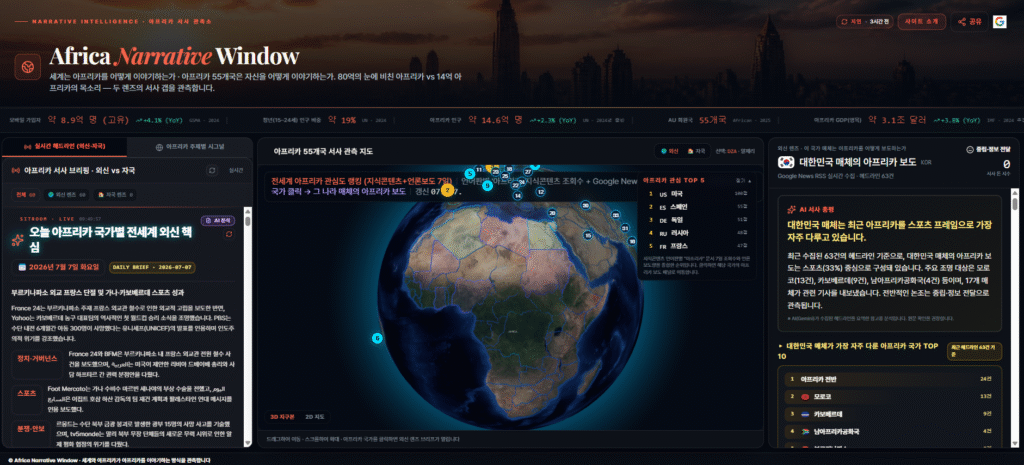
VANK has launched the Africa Narrative Window (https://africaeye.one/), a digital observatory that uses real-time data to analyze and visualize the gap between how Africa is portrayed by global media and knowledge platforms and how African media present their own countries. The platform, available at Africa Narrative Window, expands VANK’s long-running campaign to correct misinformation and improve global perceptions of Africa by combining AI, data analytics, and map-based monitoring technologies.
According to VANK, the initiative also reflects the organization’s broader evolution from correcting historical inaccuracies about Korea—including Dokdo, the East Sea, and Korean history—to promoting universal values of mutual respect by challenging global misconceptions about Africa. Drawing on years of experience monitoring international information and leading digital public diplomacy campaigns, VANK aims to address persistent narratives that portray Africa primarily through the lenses of poverty, disease, and conflict, while overlooking the continent’s diversity across 55 countries and more than 3,000 ethnic groups.
The Africa Narrative Window continuously monitors all 55 member states of the African Union (AU) through two parallel perspectives: the Global Media Lens, which tracks how major international news organizations and knowledge platforms cover Africa, and the Local Media Lens, which follows how leading media outlets within African countries report on their own societies. Using AI, the platform collects, translates, and summarizes reports published in English, French, Arabic, Portuguese, and other languages in real time. It also analyzes coverage across nine categories—including politics, the economy, culture, and technology—and measures differences between international and local reporting through a Narrative Gap Score, displayed in interactive maps and charts.
The platform highlights contrasts in media coverage by showing that while international outlets often focus on armed conflicts and public health crises, African media frequently report on topics such as Nigeria’s startup ecosystem, Kenya’s mobile finance industry, South Africa’s cultural sector, and Rwanda’s governance innovation. VANK said the data provides clear evidence of the gap between external narratives and the stories African countries tell about themselves.
VANK Director Park Gi-tae said the organization’s work over the past two decades correcting misinformation about Dokdo, the East Sea, and Korean history demonstrated how inaccurate information and prejudice can limit the future of a nation or an entire continent. “Just as we worked to correct misinformation about Korea, it is now time to correct the narrative about Africa that has been shaped by the perceptions of the world’s eight billion people,” he said.
Park added that Africa should be recognized not as a continent defined by poverty and despair, but as one with a rich history, vibrant cultures, and dynamic economic and technological development. He said the new observatory would use data to reveal the scale of one-sided global narratives and would support efforts to correct inaccuracies in textbooks, AI systems, and news coverage while helping all 55 African countries present their own stories more accurately to the world.
Alongside the launch of the platform, VANK said it will further strengthen its five major campaigns to improve global perceptions of Africa. These include promoting the Equal Earth world map as an alternative to the Mercator projection and continuing to request corrections to inaccurate descriptions of Africa in textbooks, encyclopedias, and generative AI platforms.
VANK expressed hope that the Africa Narrative Window will help identify the gap between Western narratives about Africa and the perspectives African countries seek to share with the world. The organization added that it will continue its digital diplomacy efforts until the image of Africa held by the global public more accurately reflects the reality of its 1.4 billion people.