
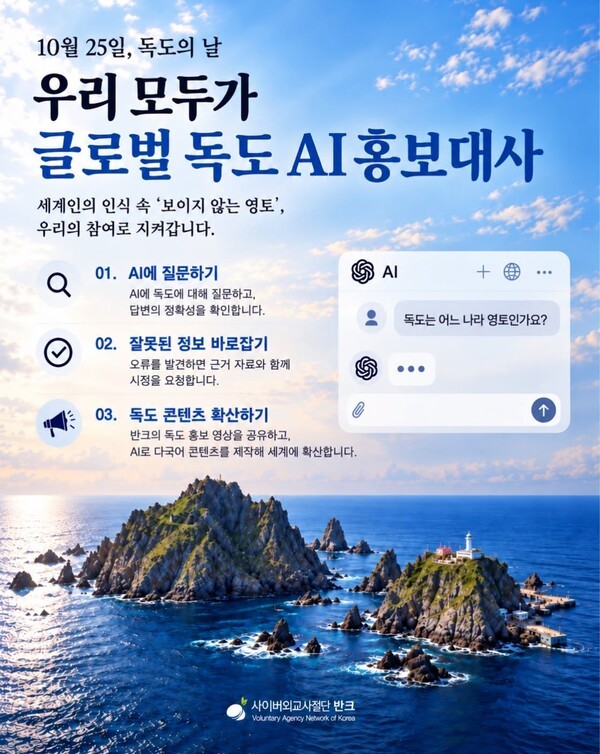
VANK is launching a global campaign to counter misinformation about Dokdo in generative artificial intelligence (AI) responses, calling on citizens in Korea and abroad to verify AI-generated information and request corrections to inaccuracies.
VANK announced on October 24, 2026, that it would launch the campaign under the slogan “Dokdo Day: We Are All Global Dokdo AI Ambassadors” in observance of Dokdo Day on October 25. The initiative aims to ensure that international audiences receive accurate information about Dokdo, which is part of Korean territory, as AI increasingly becomes a primary source of information.
VANK has identified establishing Dokdo’s sovereignty in the minds of people around the world as a central goal of the campaign. The organization has expressed concern that major overseas online platforms continue to label Dokdo as “Takeshima” or portray it as a territorial dispute between Korea and Japan, often without sufficient historical context.
VANK describes this as a problem of “invisible territory”: information that may escape notice more easily than errors on maps or in textbooks but can still shape how people around the world perceive Dokdo. The organization warns that inaccurate information accumulated on overseas platforms could be reproduced and spread through AI-generated answers.
The campaign invites participants to ask the generative AI services they regularly use about Dokdo’s location, history and the basis for Korean sovereignty, then check the responses for inaccuracies. Issues to look for include claims that Dokdo belongs to Japan, answers that reflect only Japan’s territorial claims or omit or distort South Korea’s administration of the islands, and responses that use “Liancourt Rocks” as the sole name instead of “Dokdo.”
When an error is identified, participants are asked to record the AI service used, the language of the query, the question and answer, and the date of verification. They can then compare the information with relevant reference materials and submit a correction request through the service’s official feedback channel.
Overseas Koreans are also encouraged to review AI responses in the languages spoken in their countries of residence, request corrections and share accurate information about Dokdo with their local communities. VANK will promote videos about Dokdo from its official YouTube channel through social media, educational institutions and community networks.
Participants will also be encouraged to use generative AI tools for translation and content creation to produce and distribute multilingual materials explaining Dokdo’s history and supporting Korea’s position.
The campaign builds on VANK’s previous efforts to track and correct misinformation about Korea through its Global Korea Fake News Tracker and other initiatives. By involving AI users directly in identifying errors and requesting corrections, the organization aims to expand these efforts into a form of citizen diplomacy suited to the AI era.
VANK also seeks to place the Dokdo issue in a broader historical context, arguing that treating it solely as a territorial dispute between Korea and Japan risks obscuring its connection to Japanese imperial expansion and colonial rule. The organization plans to emphasize the history of colonialism, the restoration of sovereignty and the universal value of peace to foster greater understanding and solidarity internationally, particularly among countries in Asia, Africa and Latin America that have experienced colonial rule.
“Exercising territorial sovereignty on the ground and establishing Dokdo as Korean territory in the minds of people around the world are two separate issues,” VANK Director Park Gi-tae said. He stressed the need to pay greater attention to protecting what the organization calls Dokdo’s “invisible territory” in global public consciousness.