
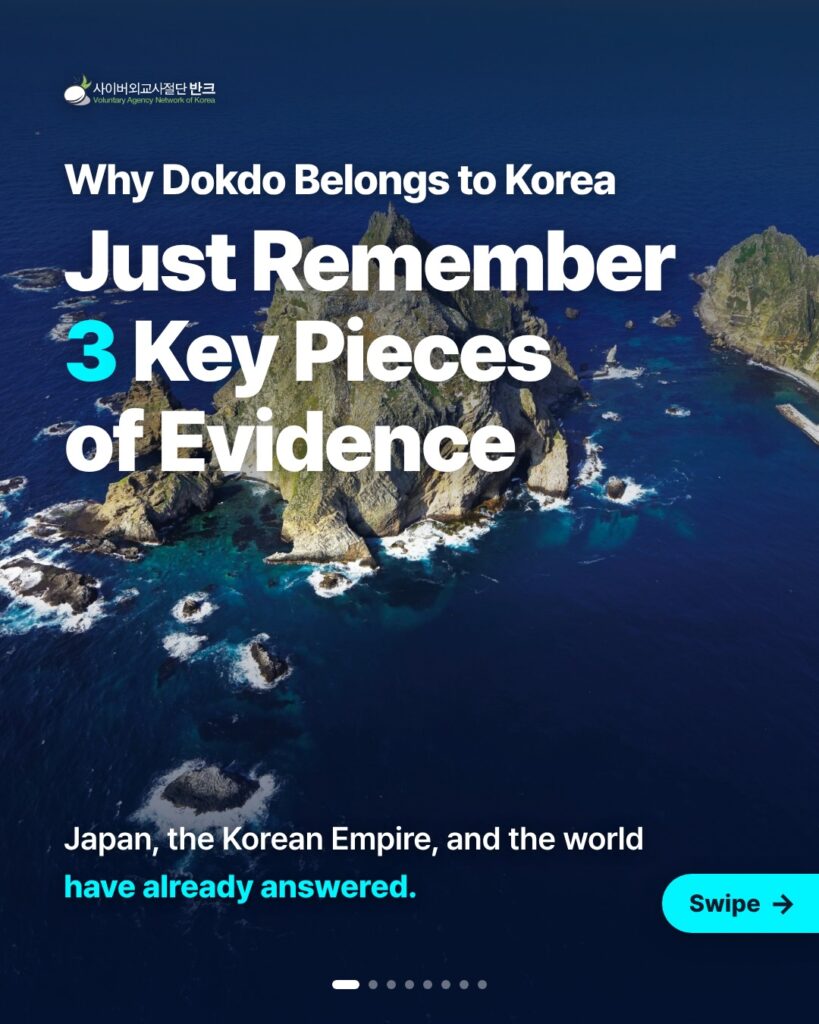
To mark Dokdo Day on Oct. 25, VANK has produced short-form videos and infographics in Korean and English explaining three key historical documents related to Korea’s sovereignty over Dokdo. The content aims to make complex historical records easier to understand and help young people in Korea and abroad, as well as global audiences, learn about the historical basis for Korea’s claim to the island.
VANK announced on Oct. 23, 2026, that it would share the content through social media platforms, including its official YouTube and Instagram channels. The video adapts key points from the organization’s existing English-language series, “The Dokdo Files,” under the theme “Just Remember These 3 Pieces of Evidence That Dokdo Is Our Land.”
Rather than simply listing the titles of historical documents, the content explains who created each record, when it was issued and what it says, making the historical evidence easier for viewers to understand and share.
The first document is an 1877 directive issued by Japan’s Dajokan, the country’s highest administrative body at the time. The directive stated that Ulleungdo and Dokdo had no connection to Japan. VANK presents it as a Japanese historical record relevant to examining Japan’s claim to Dokdo.
The second is Imperial Decree No. 41, issued by the Korean Empire in 1900 with the approval of Emperor Gojong. The decree renamed Ulleungdo as Uldo County and placed Ulleungdo, Jukdo and Seokdo under its jurisdiction. VANK identifies Seokdo as Dokdo and emphasizes that the decree reflects the Korean Empire’s inclusion of the island within its administrative jurisdiction before Japan’s 1905 annexation claim.
The third document is Supreme Commander for the Allied Powers Index Number (SCAPIN) 677, issued in 1946 following World War II. It excluded Ulleungdo, Dokdo and Jeju Island from the scope of Japan’s governing and administrative authority. VANK presents the directive as evidence relevant to the postwar settlement process, while noting that it did not itself determine final territorial sovereignty.
The video pairs original texts from the historical documents with photographs of Dokdo, motion graphics and on-screen text to present the key points concisely. At the end, the phrase “Japan acknowledged it, the Korean Empire proclaimed it, and the world recognized it” sums up the three documents and encourages viewers to save and share the content.
Ma Ji-yun, a youth researcher at VANK who helped produce the video, said the content was designed to make it easier to explain the historical basis for Korea’s claim when people overseas ask why Dokdo belongs to Korea. Presenting the original records also allows viewers to examine the evidence themselves and share it with others.
VANK Director Park Gi-tae stressed the importance of explaining Dokdo’s history through objective historical records and evidence rather than emotional appeals.
VANK hopes the videos and infographics will help Korean teenagers and young adults, overseas Koreans, students at Korean schools abroad and foreigners interested in Korea better understand the historical background of the Dokdo issue and share accurate information with audiences worldwide.
The content is available through VANK’s official YouTube and Instagram channels.