
VANK said on Aug. 13, 2026, that it had identified factual errors and Eurocentric bias in history and geography textbooks published by three major Spanish textbook companies and called on the publishers to make corrections.
The analysis covered eight history and geography textbooks published by Santillana, ANAYA and Vicens Vives.
One of the factual errors VANK identified appeared in a photo caption in Santillana’s high school world history textbook, Historia del Mundo Contemporáneo 1 BTO, which described the image as showing “a sales stand of a technology company in Abuja, the capital of Niger, in 2019.”
Abuja, however, is the capital of Nigeria, while the capital of Niger is Niamey.
The analysis also found examples of Eurocentric historical narratives.
In ANAYA’s high school world history textbook, Historia del Mundo Contemporáneo 1 Bachillerato, British missionary David Livingstone is described as “the discoverer” (el descubridor) of Victoria Falls on the Zambezi River in 1855.
The falls, however, had long been known to local communities before Livingstone arrived. The UNESCO World Heritage Centre also lists the site under both its local name, Mosi-oa-Tunya, and the name Victoria Falls.
VANK said that describing a European’s arrival as the “discovery” of a place can exclude the knowledge and history of local people who had already known, named and lived in the area. It called for a clear distinction between the arrival of Europeans and the discovery of a place.
The same textbook also used the term “Black Africa” (África negra). VANK recommended using geographical terms such as “sub-Saharan Africa” (África subsahariana) instead of categorizing the continent along racial lines, depending on the context.
Similar problems were found in descriptions of Africa’s decolonization.
Santillana’s secondary school history textbook, 4ESO Historia, attributed the delayed pace of decolonization to “the persistence of underdeveloped social structures and the absence of strong nationalist movements.” ANAYA’s high school world history textbook likewise attributed the start of decolonization only in the late 1950s to the “poor social and economic development” of most territories.
VANK said such explanations overlook the diverse forms of anti-colonial resistance and nationalist movements that emerged across Africa during the colonial period.
Eurocentric perspectives were also evident in descriptions of African independence.
Several textbooks used expressions suggesting that France and Portugal “failed to prevent” independence, that French President Charles de Gaulle “recognized” Algeria’s right to self-determination, or that Spain “granted” independence.
Such wording can portray African independence not as a political process organized, demanded and won by local populations, but as an outcome permitted by colonial powers or achieved only after they could no longer prevent it.
The same pattern appeared in the selection of images.
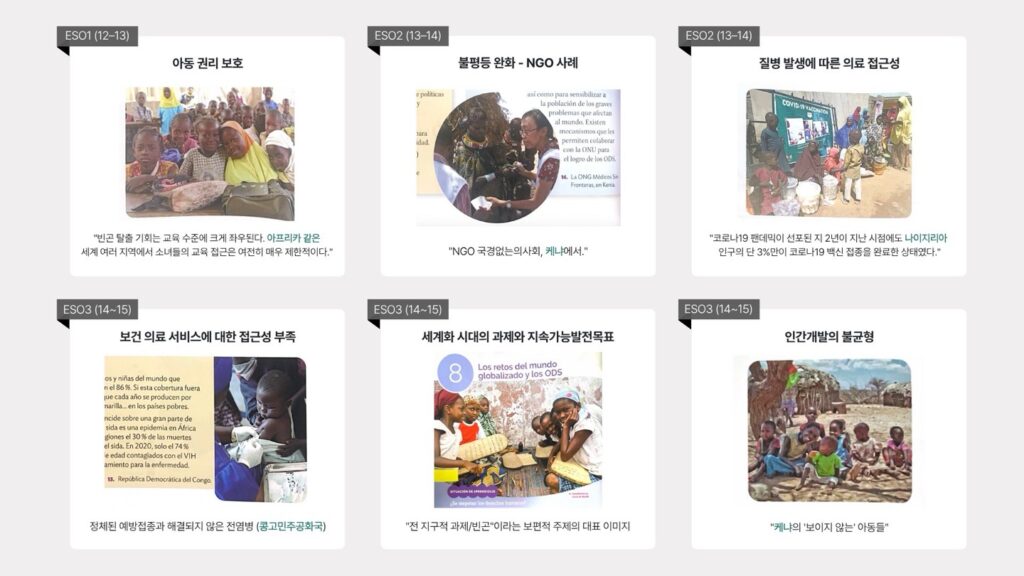
VANK identified more than 10 cases across five textbooks in which photographs of African countries, including Gambia, Nigeria and Kenya, were repeatedly used to illustrate global issues such as malnutrition, unequal access to vaccines, water shortages and wartime sexual violence.
VANK sent reports detailing its findings, along with letters requesting corrections, to Santillana, ANAYA and Vicens Vives.
Vicens Vives responded officially, saying it had shared the information with its editorial team and would consider incorporating the changes in future editions, according to VANK.
VANK has also sent its findings and specific correction proposals to Santillana and ANAYA and is awaiting their responses.
Since last year, VANK has been carrying out its “Promote Africa Correctly” project, examining how Africa is portrayed across educational information environments, including textbooks, dictionaries and artificial intelligence (AI).
The organization has now expanded its analysis beyond Korean- and English-language materials to Spanish-language textbooks.
VANK Director Park Gi-tae said world history textbooks are an important educational medium for understanding the histories and experiences of different societies, and that Africa should likewise be presented not as a subject defined by outside perspectives but as a region with its own history and social context.
He said he hoped such changes would go beyond improving perceptions of a particular continent and help provide students with a more balanced and multidimensional understanding of the world.
Lee Sei-yeon, a VANK youth researcher who conducted the analysis, said she hoped the findings would encourage broader discussion of not only factual accuracy but also the perspectives and context created by individual words and expressions used in the writing and revision of textbooks.
Following its analysis of the Spanish textbooks, VANK also urged the public to make active use of its “I Am the AI Lawmaker” platform (koreavision.one/en), a civic participation platform that allows citizens to examine and evaluate government budgets for official development assistance (ODA) projects in Africa and propose alternatives.
VANK noted that the Ministry of Foreign Affairs’ government budget for international development cooperation in Africa amounts to 246 billion won and called on the government to allocate part of the budget to efforts to improve biased perceptions of Africa in textbooks in Spain and other countries around the world.