
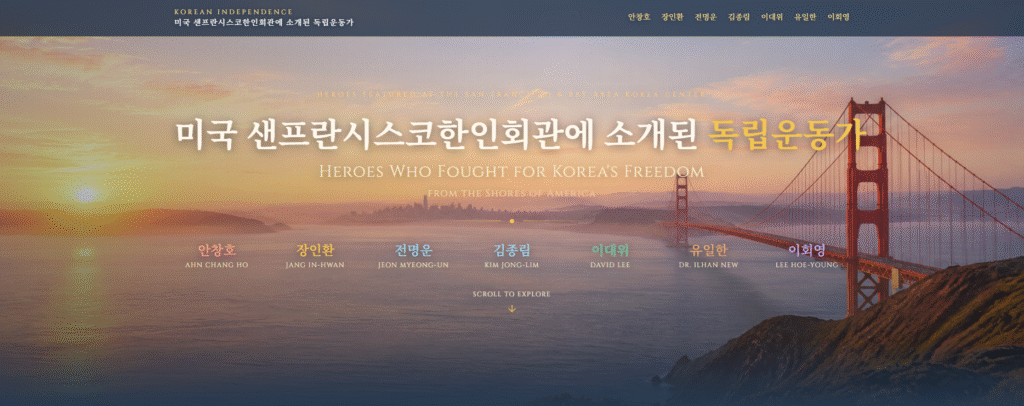
San Francisco, a major center of Korea’s independence movement in the United States, is being highlighted through a new global website documenting the efforts of Korean immigrants who organized, raised funds and worked for their homeland’s independence more than a century ago.
Cyber Diplomacy Organization VANK, the San Francisco Bay Area Korean Association and the Jin Duck & Kyung Sik Kim Foundation jointly launched the website, “Heroes Who Fought for Korea’s Freedom on American Soil,” on Oct. 2, 2026. The site, available at koreaheroes.com, brings the history featured at the San Francisco Korean Association Hall to a global audience.
The project was designed to highlight San Francisco as an important center of Korea’s independence movement and to show how the contributions and dedication of Korean immigrants provided an important foundation for the struggle for independence.
The website focuses on seven figures: Dosan Ahn Chang-ho, independence activists Jang In-hwan and Jeon Myeong-un, Lee Dae-wi, Kim Jong-rim, New Il-han and Lee Hoe-young.
Their stories include the 1908 killing of Durham W. Stevens by Jang and Jeon in San Francisco, Ahn’s efforts to organize the Korean community, Lee’s work to protect and organize Korean immigrants, Kim’s financial support for the independence movement, and Yoo’s participation in the NAPKO Project. Lee Hoe-young, who did not directly carry out his activities in the United States, is also featured for devoting his entire fortune to the independence movement and helping lay the groundwork for armed resistance.
San Francisco was an important starting point for Ahn Chang-ho’s activities in the United States. He organized the Korean Public Association there in 1905, helping build unity and self-reliance within the Korean community. In 1913, he founded the Young Korean Academy, known as Heungsadan, in San Francisco, establishing a framework for preparing for independence through education, character development and the strengthening of national capabilities.
The website also features an interactive map showing major independence movement centers and routes in the United States, as well as documentary videos. The digital content allows users to explore where Korean communities were formed, where independence activities took place and how activists and organizations were connected.
Park Gi-tae, head of VANK, said the project was intended to show that the independence movement was not the work of a small number of prominent figures, but also the result of the fundraising, organization and dedication of countless Korean immigrants.
“We want the world to know that the organization, fundraising and dedication of Korean immigrants at the time provided an important foundation for Korea’s independence movement,” Park said.
Kim Han-il, President of the San Francisco Korean Association, said the project expands the history displayed at the Korean association hall so that people around the world can access it. Kim Soon-ran, chairwoman of the Jin Duck & Kyung Sik Kim Foundation, said she hopes Korean American youth will discover traces of the independence movement in the communities where they live and develop a stronger sense of their historical roots.
The three organizations plan to distribute the website and video materials through Korean diaspora communities in more than 180 countries, Korean-language schools, local schools and libraries as part of a broader campaign to share the history of Korea’s independence movement overseas.