
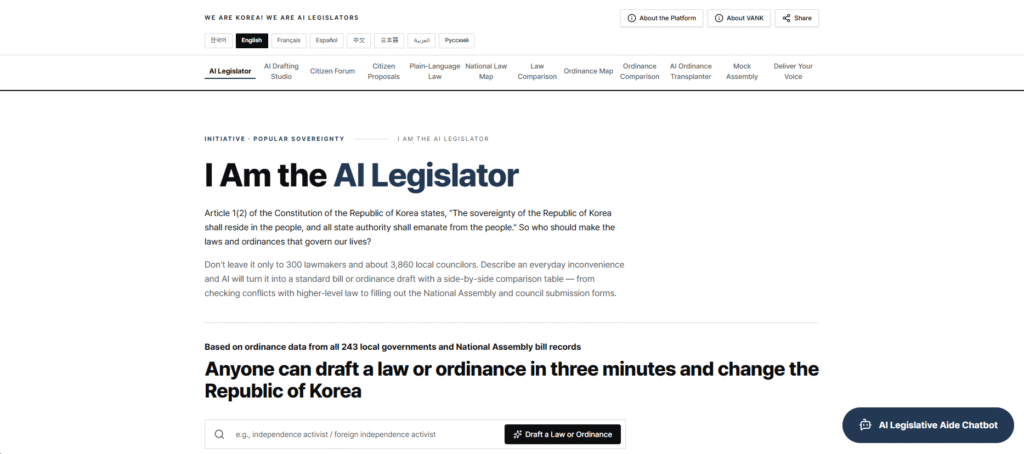
VANK has launched an artificial intelligence-powered platform designed to allow citizens to turn everyday ideas and policy proposals into draft laws and local ordinances.
The organization announced on Aug. 27, 2026, the launch of “I am the AI Legislator,” a participatory legislative platform aimed at lowering the barriers that have traditionally limited direct public participation in the legislative process.
VANK said the platform was developed to expand lawmaking and local self-governance beyond the relatively small group of elected officials, local government leaders and public administrators who have traditionally held responsibility for proposing and revising legislation.
At the center of the platform is an “AI Legislative Assistant,” which uses AI and public data to help users transform ideas expressed in everyday language into formal legislative proposals.
Users can enter as little as three sentences describing a problem they have encountered or an idea for improving a policy. The AI then compares and analyzes data from the autonomous regulations of all 243 local governments in Korea, along with bills and legislative proposals submitted to the National Assembly, and generates a draft law or ordinance in a standardized format within minutes.
The system can produce key elements required for a legislative proposal, including the purpose of the bill, its main provisions and a comparison between the proposed and existing provisions.
From Civil Complaints to Legislative Proposals
VANK said the platform was created in response to the difficulties ordinary citizens face when trying to translate policy ideas into actual legislation.
Complex legal terminology and strict drafting formats have often meant that ideas originating in everyday life remain limited to civil complaints or petitions rather than developing into concrete proposals for legal or institutional reform.
The new platform is intended to bridge that gap by allowing citizens to describe an issue in ordinary language and receive AI-assisted guidance on how the idea could be structured as a law or local ordinance.
One example released by VANK was a proposed bill titled the “Act on the Establishment of a Memorial Hall for Foreign Independence Activists and the Promotion of Diplomatic and Cultural Exchanges.”
The proposal would honor foreign nationals, including Homer Hulbert, Frank Schofield and Ernest Bethell, who contributed to Korea’s independence movement, while creating a framework for exchanges with their descendants and countries of origin.
In a preliminary review conducted by the AI Legislative Assistant, the proposal received a score of 92 out of 100.
It was evaluated across five areas: consistency with the legal system, which received 97%; specificity of the provisions, 100%; duplication and originality, 95%; financial feasibility, 80%; and public acceptability, 70%.
The platform’s bill analysis report also examined potential objections, including concerns about overlapping functions with existing independence memorial institutions. It further suggested practical next steps, such as clarifying the responsibilities of relevant government ministries and requesting a cost estimate from the National Assembly Budget Office.
VANK said the example demonstrates how AI could serve not only as a drafting tool but also as an assistant capable of identifying potential issues and suggesting improvements before a proposal moves forward.
A Tool for Civic Participation and Democracy Education
The platform includes 12 services designed to support both public participation and grassroots democracy education.
Among them are the AI Legislative Studio, an Easy Law Finder for exploring laws relevant to everyday life, a National Law Map, and a Law Comparison Radar.
Services focused on local governments include a map of ordinances across Korea’s 243 local governments, an ordinance comparison tool and an AI Ordinance Transplanter, which allows users to examine ordinances adopted elsewhere and adapt them to local conditions.
The platform also includes a public forum for sharing citizen proposals and a Mock Assembly, where young people and other users can experience the legislative process from the introduction of a bill through parliamentary deliberation and a final vote.
Users can also submit opinion letters to local government leaders and access legal information through an AI chatbot.
VANK said the platform could serve as an educational tool for teenagers and young people, allowing them to learn about democratic participation and local self-governance by directly experiencing how laws and ordinances are proposed, reviewed and debated.
Eight Languages and a Broader Vision for AI Democracy
The platform supports eight languages: Korean, the United Nations’ six official languages — English, French, Spanish, Arabic, Chinese and Russian — as well as Japanese.
VANK said the multilingual service is intended not only to support Korean citizens and overseas Koreans but also to introduce Korea’s digital democracy model to a wider international audience.
Park Ki-tae, head of VANK, said the organization aims to use AI to lower the barriers that have long separated citizens from the legislative process.
“Popular sovereignty should not be limited to casting a vote during an election,” Park said. “It should also be realized through the process of citizens directly addressing problems in their communities and improving the systems that affect their daily lives.”
He added that the platform was designed to make the traditionally complex field of legislation more accessible and to allow citizens to participate directly in improving laws and local ordinances.
Kwon So-young, a researcher at VANK, said many citizens’ policy ideas had previously remained at the level of simple complaints because of barriers created by legal terminology and standardized drafting requirements.
“We hope the platform will serve as a space for legislative education for young people and as a participatory tool that allows citizens to develop their ideas into concrete legislative proposals,” she said.
The launch is part of VANK’s broader vision for the AI era, which includes public monitoring of national finances and parliamentary activity, citizen participation in global governance and direct participation in grassroots legislation.
VANK said it plans to analyze the citizen proposals and participation data accumulated through the platform to identify legislative gaps and regional differences in laws and ordinances. The findings will be shared with the National Assembly, local governments and local councils.
The platform is independently operated by VANK and is available free of charge, without registration, to Korean citizens and overseas Koreans.