
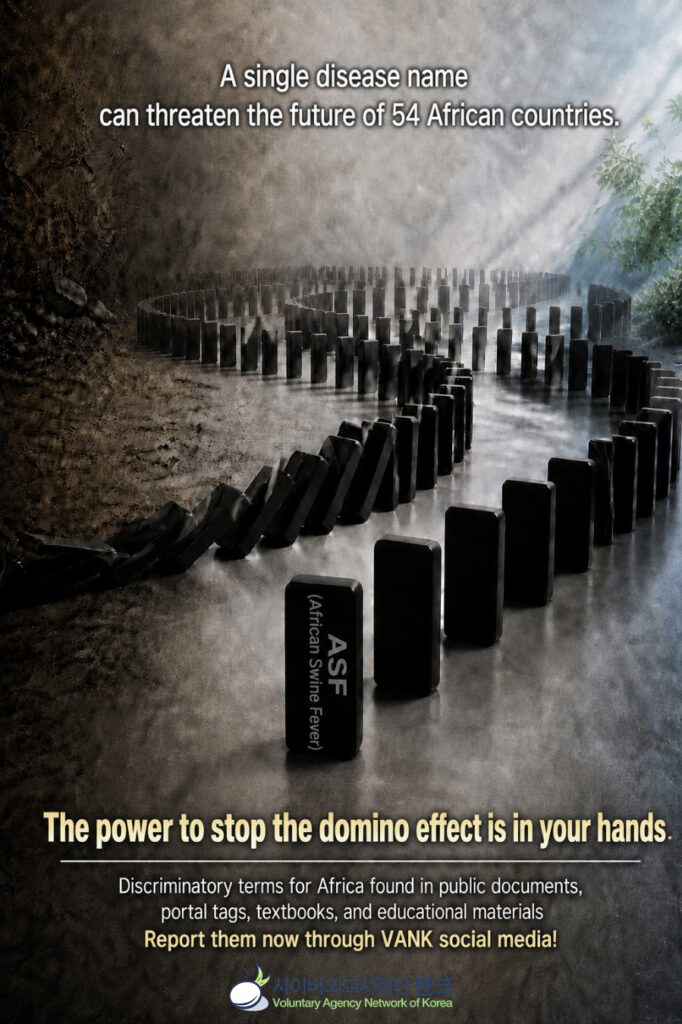
VANK, led by Park Gi-tae, announced on Aug. 25, 2026, that it is launching a campaign to address what it describes as the linguistic stigma associated with the name “African Swine Fever” by encouraging the use of its international abbreviation, ASF.
VANK argues that the commonly used name reinforces the perception of Africa as a continent associated with the origin of disease, despite the continent being home to 1.4 billion people and 54 independent countries.
The organization said the issue should be addressed in line with broader efforts to move away from disease names associated with specific regions or groups. It cited the World Health Organization’s efforts to discourage geographically based disease names, including the shift from “Wuhan pneumonia” to COVID-19 and the renaming of “monkeypox” to mpox.
A VANK official said the indiscriminate use of regional names could damage Africa’s national and regional brand and reinforce the so-called “Africa discount,” in which negative perceptions can affect trade, investment and broader economic opportunities.
As part of the campaign, VANK has produced bilingual posters in Korean and English depicting the potential of Africa’s 54 countries being knocked down in a chain reaction by a single domino block representing a stigmatizing disease name.
The organization has also launched a citizen-participation campaign inviting internet users around the world to report instances in which the term “African Swine Fever” is used on government websites, in news reports or in public information materials.
Participants can submit reports to VANK’s social media channels using campaign hashtags such as #Change_ASF and #StopStigma.
Based on the reports it collects, VANK plans to send letters recommending the use of ASF to major Korean government institutions, including the presidential office, the Prime Minister’s Office and the Ministry of Agriculture, Food and Rural Affairs, as well as media organizations.
The organization also plans to pursue broader international institutional change by using its own platforms to call on the World Organisation for Animal Health (WOAH) and the World Health Organization (WHO) to review and update the terminology.
“Korea, too, has experienced the consequences of having its national image undervalued because of prejudice and stereotypes,” Park said. “We should not allow stigmas directed at an entire continent to persist. It is time to end the outdated practice of confining Africa within the name of a disease.”