
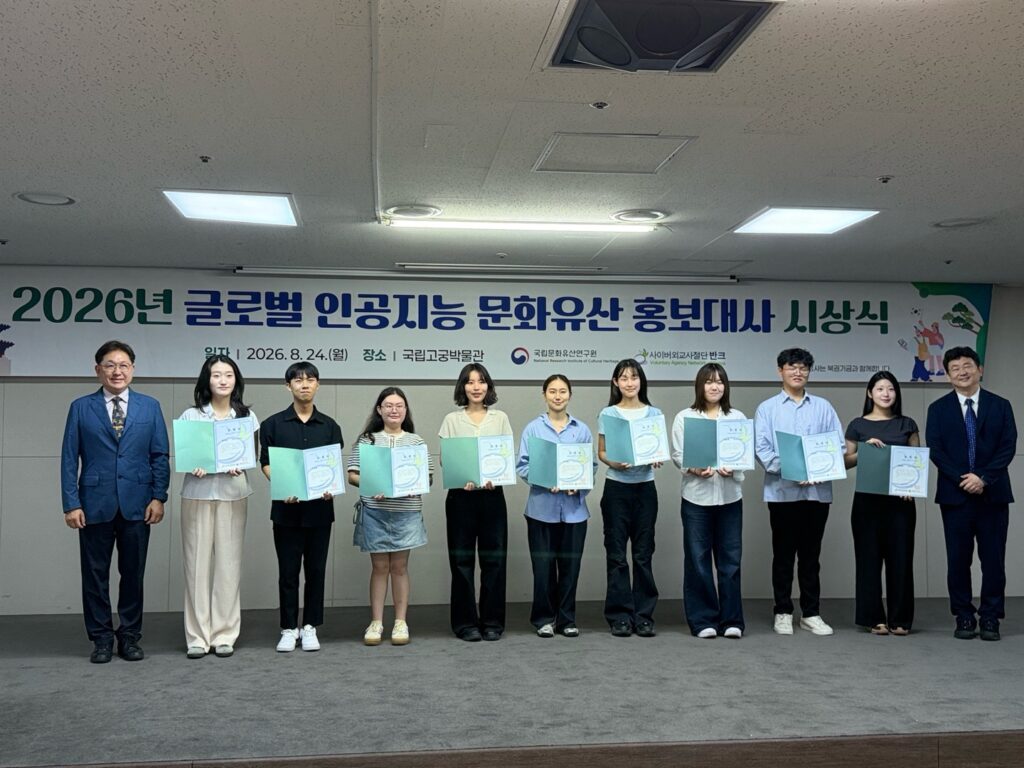
VANK, a Korean cyber diplomacy organization led by Park Gi-tae, and the National Research Institute of Cultural Heritage, headed by Lim Jong-deok under the Korea Heritage Service, held an appointment ceremony on Aug. 24, 2026, for outstanding participants in their Global AI Cultural Heritage Ambassadors program at the main auditorium of the National Palace Museum of Korea.
The ceremony was held to share the achievements of young participants who directly examined information about Korean cultural heritage generated by artificial intelligence, identified and sought to correct errors, and promoted the value of Korea’s cultural heritage to a global audience.
As generative AI increasingly becomes a major gateway through which people around the world encounter Korea’s history and culture, the program aims to empower teenagers and young adults to take an active role in verifying and improving cultural heritage information in the AI era.
The National Research Institute of Cultural Heritage and VANK signed a memorandum of understanding in September last year on the protection and use of cultural heritage and the wider dissemination of research findings. Based on the agreement, the two organizations have jointly operated the Global AI Cultural Heritage Ambassadors program to train young people as a new generation of cultural heritage advocates in the age of artificial intelligence.
Following the program for the first cohort, which ran from Dec. 30 last year to Jan. 30 this year, the program for the second cohort was held from June 29 to July 26. A total of 42 participants from the first cohort and 19 from the second were selected as outstanding ambassadors.
The rapid spread of generative AI is changing the way people around the world access information about Korean cultural heritage. In the past, efforts to identify and correct misinformation often focused on how Korea’s history and culture were described in foreign textbooks, maps, encyclopedias and websites.
Today, however, generative AI draws on vast amounts of digital information to produce not only written explanations of cultural heritage but also images and videos for users around the world.
Against this backdrop, the ambassadors directly searched for information about Korean cultural heritage using generative AI and generated images to examine how accurately AI understood and represented historical facts, physical features and cultural significance. When errors were identified, participants reviewed relevant sources and called for corrections and improvements.
Among the notable projects, participants used AI to create a short-form video imagining scenes of whale hunting depicted in the Petroglyphs of Bangudae Terrace. They also produced card-style news content highlighting the problem of distorted information about Korean cultural heritage.
Other projects included a podcast introducing the Royal Tomb of King Muryeong in four languages—Korean, English, Chinese and Spanish—demonstrating a range of ways AI can be used to share the value of Korean cultural heritage with the world.
Through these activities, participants moved beyond simply consuming AI-generated information and instead took an active role in checking and verifying information, creating accurate content and sharing it with a global audience.
Ten outstanding ambassadors attended the appointment ceremony, where participants shared the results of their activities and received certificates of appointment. Three top ambassadors were also presented with the Director-General’s Award of the National Research Institute of Cultural Heritage.
The three top ambassadors gave presentations on their experiences, sharing what they learned while using AI to research and promote Korean cultural heritage.
Lee Eun-chong, one of the three top ambassadors, said the program changed the way of viewing cultural heritage.
“Although I had always considered cultural heritage important, I tended to think of it as something somewhat distant from everyday life—something encountered mainly through history books or museums,” Lee said. “As I began asking AI about cultural heritage and examining its answers and images one by one, I was struck by the realization that cultural heritage does not simply remain in the past. It can also be understood in new ways depending on how we record and share it today.”
Following the ceremony, participants visited the restoration and maintenance site of the Yeonghundang area at Gyeongbokgung Palace.
With explanations from project officials, they observed how cultural heritage is preserved through research, investigation, excavation and restoration. The visit also gave them a firsthand look at how the information they encounter online is grounded in research and documentation from actual heritage sites.
The field visit underscored the importance of reliable research, investigation and documentation in enabling AI to accurately understand and explain cultural heritage, while also highlighting the essential role people play in verifying and communicating that information correctly.
Lim Jong-deok, director-general of the National Research Institute of Cultural Heritage, said the development of AI is changing not only how cultural heritage is studied but also how research findings are shared with the public and the world.
“This ambassador program is particularly meaningful because it has connected the cultural heritage research accumulated by our institute with the creative use of AI by teenagers and young adults, demonstrating new possibilities for understanding and promoting our cultural heritage,” Lim said.
Park Gi-tae, the head of VANK, said the task of protecting cultural heritage has traditionally focused on restoring damaged sites and correcting inaccurately recorded historical information.
“In the age of AI, however, a new challenge has been added: what information will AI learn about Korean cultural heritage, and how will it explain that heritage to people around the world?” Park said.
“Simply correcting AI one answer at a time whenever it produces an error is not enough,” he added. “We need to create a virtuous cycle in which accurate cultural heritage research and records are more extensively accumulated in the digital space, while teenagers and young people use those resources to verify AI-generated information, create new content and share it with the world.”
Cho Eun-kyung, a director at the National Research Institute of Cultural Heritage, said cultural heritage has been passed down to the present through decades of accumulated research, investigation and conservation efforts.
“It is important that these achievements do not remain confined to the research field but continue through the participation of new generations, who can put them to use and help spread them throughout society,” Cho said.
“As AI becomes a new gateway to cultural heritage, we will work to connect the research and conservation achievements accumulated over the years with new technologies so that more people can understand and make use of cultural heritage,” she added.
Choi Ju-eun, a VANK youth researcher in charge of the program, said promoting accurate information about cultural heritage should not be limited to experts.
“Anyone can take part in this work if they have access to accurate information and reliable sources,” Choi said. “We hope this experience will encourage participants to continue paying attention to how Korean cultural heritage is represented in AI and digital spaces, and to identify, correct and share information about problems they encounter even after the program ends.”
Meanwhile, VANK has also been developing citizen-participation platforms that allow the public to examine national policies and budgets directly and take part in shaping Korea’s future, alongside its efforts to correct misinformation about Korean history and culture in the age of AI.
VANK recently launched its public sovereignty platform, “I Am the AI Lawmaker” (koreavision.one), which allows citizens to directly examine and evaluate national budgets and policies and propose alternatives.
The platform is designed to make vast amounts of national budget data easier for ordinary citizens to understand. With the support of an AI assistant, users can examine national spending priorities and policy directions and make their own assessments and proposals.
VANK said cultural heritage is not only a value that should be protected and shared with the world, but also a public domain supported through government policies and budgets for preservation, research, restoration, use and international promotion.
Through the platform, citizens can examine what projects government ministries and public institutions are pursuing, how much funding is allocated to them, and how national resources are being used for cultural heritage research, conservation, restoration, use and overseas promotion.
Users can also compare related projects and budgets, assess whether existing policies are sufficient, identify areas that need improvement and propose new initiatives and alternatives.
VANK stressed that efforts should go beyond simply identifying and correcting inaccurate information about cultural heritage generated by AI. Citizens, it said, should also become active participants in examining the national policies and budgets used to protect and promote Korea’s cultural heritage and in proposing better alternatives.
Going forward, VANK plans to develop “I Am the AI Lawmaker” into a key citizen-participation platform through which people can identify issues ranging from Korea’s history, culture and territory to national policies and budgets, examine relevant policies and spending, and work with AI to propose solutions.