
Sixth-grade elementary school students will find fewer negative depictions of Africa related to poverty and hunger and more content highlighting the continent’s population, growth potential and cooperation with Korea in the social studies textbooks they will use from the second semester.
The changes follow a campaign by VANK, a Korean cyber diplomacy organization led by Park Gi-tae, calling for distorted descriptions of Africa in school textbooks to be corrected. The Education Ministry and textbook publishers responded positively to the campaign.
VANK said Aug. 20, 2026, that its analysis of seven sixth-grade social studies textbooks to be used this fall found significant changes in descriptions and images related to Africa that the organization had asked publishers to improve last year.
The textbooks analyzed included two editions published by Chunjae Textbook, along with editions from i-Scream Media, Jihaksa, YBM, Dong-A Publishing and Visang Education. All seven editions passed the Education Ministry’s review on Sept. 30 last year.
The Ministry of Education of Korea said it would continue supporting the development of textbooks that help students develop a sense of global citizenship.
A ministry official said the greater diversity in descriptions of Africa identified in VANK’s analysis appears to be the result of textbook authors and publishers reviewing a range of perspectives during the independent textbook-writing process.
“The Ministry of Education will continue to communicate with various sectors so that a wide range of views can be considered in the textbook development process, and will support the development of textbooks that help our children develop balanced perspectives and a sense of global citizenship,” the official added.
Negative Images of Hunger and Refugees Eased
Many of the examples VANK had identified in its previous analysis of textbooks under the 2015 revised curriculum as distorting Africa’s image—and had called for their removal or complete replacement—have been eliminated from the newly approved editions.
Last year, VANK launched a campaign to promote a more accurate understanding of Africa, pointing out that existing textbooks often portrayed the continent primarily through poverty, hunger and civil war, reinforcing the image of Africans as passive recipients of aid and charity.
VANK also raised concerns that the textbooks did not adequately reflect Africa’s cultural and economic diversity or the growing exchanges between Korea and Africa.
According to VANK’s analysis, negative materials depicting Africa, including a “World Hunger Map” and images related to hunger and refugees, have been reduced in the newly approved textbooks.
Descriptions that had focused heavily on traditional clothing and funeral customs have been broadened to include the continent’s population growth potential and technological development. The portrayal of Korea-Africa relations has also expanded from a focus on one-way assistance to cooperation in areas such as resources, technology and trade.
Wangari Maathai, Nelson Mandela and Other African Figures Highlighted
VANK identified the more diverse and active portrayal of people of African descent as one of the most notable changes.
In several textbooks covering the work of international organizations and nongovernmental organizations (NGOs), people of African descent appear not as people waiting for assistance but as active participants directly involved in solving problems.
For example, Chunjae Textbook features people of African descent working in refugee protection efforts by the U.N. High Commissioner for Refugees (UNHCR) and international medical missions by Doctors Without Borders.
YBM similarly depicts African people working in Doctors Without Borders’ relief and medical operations, moving away from the conventional framework that divided people into “those providing aid” and “those receiving aid” along racial lines.
More examples also highlight people from Africa for their contributions to global peace, environmental protection and development.
Wangari Maathai, the Kenyan environmental and women’s rights activist who became the first African woman to receive the Nobel Peace Prize, is featured in textbooks published by Jihaksa, YBM and Visang Education.
Former South African President Nelson Mandela, a global symbol of the human rights movement, is presented by YBM as a prominent figure who contributed to world peace.
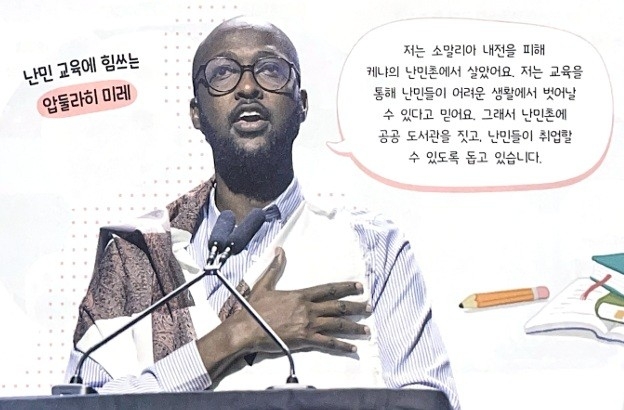
Dong-A Publishing introduces Abdullahi Mire, a Somali refugee and journalist who has worked to provide education for refugee children.
Indigenous Place Names Appear as Korea-Africa Relations Emphasize Cooperation
There have also been changes in the way African place names are presented.
Chunjae Textbook gives precedence to the local name “Mosi-oa-Tunya” for the waterfall on the Zambezi River between Zambia and Zimbabwe, rather than the Western name Victoria Falls. i-Scream Media uses Victoria Falls as the main name but also introduces its local name.
VANK has also campaigned for the use of indigenous African place names to highlight the continent’s historical and cultural identities that have been obscured by colonial-era naming systems.
The textbooks also contain descriptions of Korea-Africa relations that emphasize mutual cooperation and exchange rather than viewing Africa simply as a source of natural resources.
Jihaksa describes expanding mineral and technology cooperation between Korea and African countries, presenting African nations as partners rather than merely sources of resources.
i-Scream Media presents South Africa as a trading partner in the global division of labor involved in smartphone production, showing how African countries participate in global production and trade.
More textbooks also address Africa’s population structure as the world’s youngest continent.
Several editions compare the high birth rates and young populations of countries such as Nigeria, Niger and Ethiopia with those of Korea and Japan.
Topics related to Africa have also expanded beyond traditional clothing and lifestyles to include tourism, food culture, contemporary fashion and renewable energy.
VANK said the changes—including greater use of indigenous place names, stronger portrayals of Africans as active participants and a more cooperative depiction of Korea-Africa relations—represent meaningful progress.
“These changes show that textbook descriptions are moving away from the conventional view of Africa centered on poverty and hunger and toward a more diverse portrayal of the continent and its relationships with the world,” VANK said.
“Changing Textbooks Means Changing How Future Generations See Africa”
VANK said its analysis also identified areas that still need improvement.
Although materials related to poverty and hunger have generally declined, some textbooks continue to concentrate images and examples of Africa in sections dealing with poverty and hunger.
In one case, a world hunger map is followed by an activity asking students to identify African regions with high rates of malnutrition.
VANK also found examples in which people from other continents were portrayed as active figures expressing opinions or taking action on global issues, while African people were depicted receiving medical treatment or fetching water.
Park Gi-tae, head of VANK, said the changes were significant because they went beyond correcting individual expressions and could influence how future generations view Africa and the wider world.
“These changes are meaningful because they are connected to changing the way future generations see Africa and the world,” Park said. “When textbooks move beyond a single set of images and present diverse realities and perspectives in a balanced way, students can also develop a broader and more balanced understanding of the world.”
Lee Sei-yeon, a VANK youth researcher who conducted the analysis, said the most significant change was not simply the reduction in negative content but the shift in how textbooks portray Africa and people of African descent.
“The most meaningful change is that, beyond reducing negative content, the perspective through which textbooks view Africa and people of African descent is beginning to change,” Lee said.
“The fact that people once portrayed only as recipients of aid are now shown actively working in the field, and that Africa is beginning to be described as a partner in cooperation rather than simply a source of resources, represents an important achievement,” Lee added.
VANK has been working with Yonhap News Agency since last year on a project aimed at correcting stereotypes and distorted perceptions of Africa in the international community.