
The Voluntary Agency Network of Korea (VANK), led by Park Gi-tae, has launched a digital platform designed to track and counter fake news and distorted information about Korea in the age of generative artificial intelligence (AI), the cyber diplomacy organization said Aug. 12, 2026.
VANK has characterized the growing presence of distorted information about Korea in the data used to train global generative AI systems such as ChatGPT and Gemini as a form of “cognitive warfare.” The organization said that as generative AI becomes an increasingly important source of information for people around the world, protecting Korea’s national image and the interests of its roughly 200 million Hallyu fans requires a system capable of identifying and blocking the technological channels through which misinformation spreads.
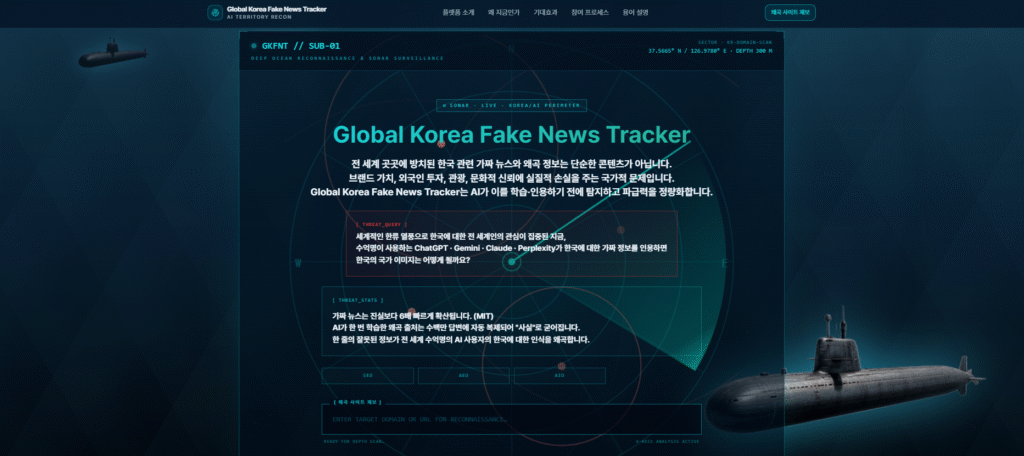
The newly launched Global Korea Fake News Tracker is designed around the concept of a deep-sea submarine’s covert reconnaissance system. It monitors potentially hostile websites and other sources in real time without alerting them, while its interface is modeled after a command-and-control center, allowing users to quickly identify signs of information distortion.
The platform offers three main tools for detecting and countering fake news.
First, it visualizes in real time how much global AI systems rely on distorted information about Korea found on overseas portals and websites identified as potentially harmful or hostile. Users can also trace the sources of information being used.
Second, the platform assesses the levels of search engine optimization (SEO), answer engine optimization (AEO) and artificial intelligence optimization (AIO) used by potentially harmful websites. Sites are assigned risk levels from one to five, along with priority rankings to help determine which sources require an immediate response.
Third, users around the world can report URLs containing suspected fake news. The platform then generates an analysis report in real time, which VANK plans to use when formally asking global AI developers to exclude or correct distorted data.
VANK said the initiative is not intended to address Korea’s information environment alone. The organization plans to make its diagnostic technology and response model available free of charge to countries across the Global South that face similar problems involving AI bias and distorted representations.
The organization pointed to cases in which African countries, for example, continue to be portrayed primarily through outdated images of poverty, hunger and conflict. VANK said such patterns demonstrate how biased data can shape the way entire countries and regions are perceived by AI systems and, ultimately, by global audiences.
“Territorial disputes in the AI era are becoming information wars over the data that global AI systems learn from,” VANK Director Park Gi-tae said. “If a country’s data is distorted, its identity and even its perceived value can be erased from the global information environment in an instant.”
VANK plans to build a dataset of fake news and websites containing distorted information and share it with major technology companies, including Google and OpenAI. It also plans to launch international campaigns calling for corrections and the removal or exclusion of misleading data from AI systems.
The organization said the platform is intended to serve as a form of digital public diplomacy, helping ensure that AI systems provide more accurate and balanced information about Korea.
The Global Korea Fake News Tracker is available to the public through its official website (https://koreafake.one), where users can also submit reports of suspected misinformation.