
The English-language websites of major global institutions, including UNESCO, NASA and National Geographic, contain inaccurate or incomplete accounts of Korean ancient history, according to a new survey by the Voluntary Agency Network of Korea (VANK).
VANK, a Korean civic diplomacy organization led by Director Park Gi-tae, said on Aug. 9, 2026, that it examined 10 major English-language websites operated by international organizations, government agencies, museums, media outlets and encyclopedia services. The survey identified 11 cases of historical inaccuracies or missing context, including five related to the Great Wall of China, four concerning Balhae and two concerning Goguryeo, with some cases falling into more than one category.
VANK warned that such inaccuracies could have a far greater impact in the age of generative artificial intelligence, as information published by authoritative institutions can be picked up by search engines and used as reference material by AI systems.
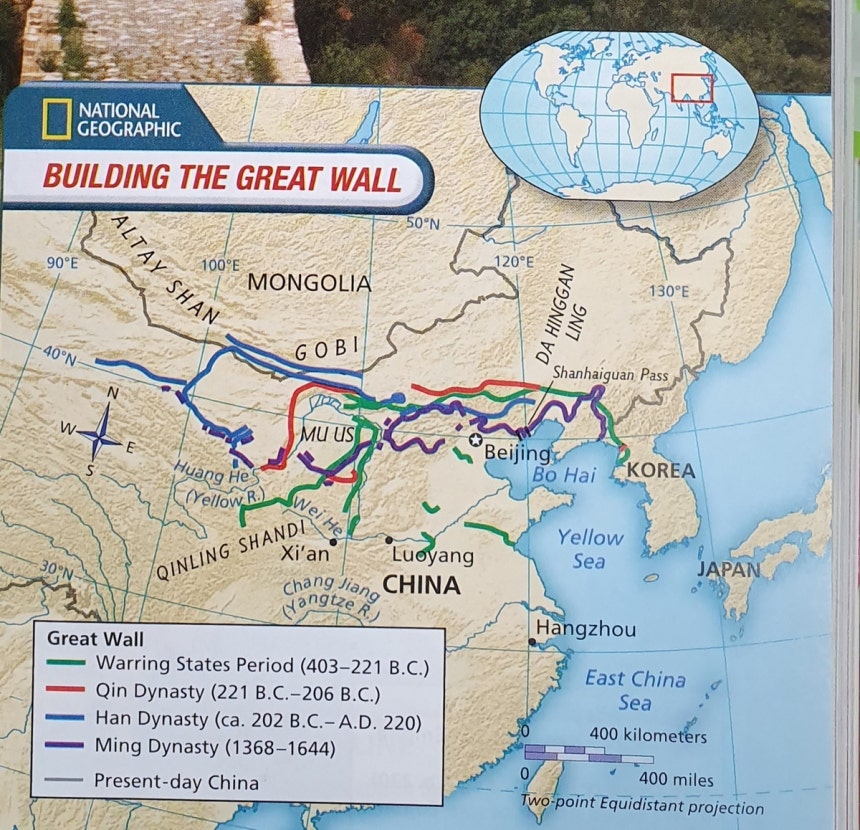
NASA, National Geographic describe Great Wall as extending to Korea
One of the most prominent cases concerns descriptions of the eastern end of the Great Wall of China.
NASA’s Earth Observatory describes the Great Wall as extending “from Korea to the Gobi Desert,” while National Geographic similarly states that the structure stretches “from the Korean border to the Gobi Desert.”
VANK said such descriptions could contribute to the misconception that the Great Wall extended into the Korean Peninsula or to areas historically associated with Goguryeo.
The organization argued that these descriptions are consistent with China’s efforts to promote a claim that a Goguryeo fortress site known as Bakjaksan was part of the Great Wall and had been reconstructed as Hushan Mountain Fortress, or Hushan Great Wall, and presented as the wall’s eastern terminus.
China expanded its claimed length of the Great Wall in 2012, incorporating the area around the former Goguryeo fortress. VANK said internationally influential institutions may be repeating elements of this narrative without sufficiently examining its historical context.
VANK also noted that UNESCO described Shanhaiguan as the eastern end of the Great Wall when the site was inscribed as a World Heritage site in 1987, while subsequent Chinese claims have significantly expanded the wall’s eastern extent.
The issue is not new. In a 2021 survey of 40 widely used world history textbooks published overseas, VANK found that 29 depicted the eastern end of the Great Wall as reaching the Sinuiju-Amnok River area, while seven extended it as far as North or South Pyongan Province. One map in Glencoe’s World History, for example, showed the Great Wall extending into South Pyongan Province.
Concerns over the portrayal of Goguryeo and Balhae
VANK said it also found several cases in which the historical territory and significance of Goguryeo and Balhae were reduced or presented without sufficient context.
According to VANK, UNESCO’s World Heritage Centre describes Goguryeo’s territory simply as “northern China,” potentially blurring the distinction between the modern geographical boundaries of China and the historical territory of the ancient kingdom. VANK also pointed to inconsistencies in the stated founding date of Goguryeo, with some materials giving 277 B.C. and others 37 B.C.
The Metropolitan Museum of Art, meanwhile, describes the main areas of activity of Goguryeo and Balhae as being on the Korean Peninsula, which VANK said understates the historical reach of the two kingdoms into parts of Manchuria and the Russian Far East.
Encyclopedia.com was also criticized for omitting Balhae entirely when describing the period following the fall of Goguryeo and the unification of the Three Kingdoms by Silla. VANK said this omission could leave readers with the mistaken impression that Silla ruled the entire Korean Peninsula after 676.
Britannica, meanwhile, categorizes Balhae as being associated with “China and Korea” but does not separately identify South Korea among the relevant areas, according to VANK.
The organization said that such omissions and geographic descriptions can make it difficult for international audiences to understand the broader historical development and geographic scope of ancient Korean history.
AI could amplify historical inaccuracies
VANK said the consequences of these errors are more serious today because of the rapid spread of generative AI.
Information from authoritative websites is increasingly used by search engines and AI systems to retrieve, summarize and generate answers. As a result, a short sentence containing an inaccurate geographic description or a missing piece of historical context can be repeatedly reproduced to millions of users.
Microsoft has reported that more than 1.2 billion people now use AI tools, underscoring the potential scale of the problem, VANK said.
“An authoritative institution’s sentence does not simply remain on its website,” VANK Director Park Gi-tae said. “It can reach hundreds of millions of people through search engines and generative AI. Correcting information about Korean history is more important than ever in today’s global information environment.”
Lee Sei-yeon, a VANK youth researcher who conducted the survey, said that in the AI era, the issue is not simply how much information exists, but which information is selected and which historical context is repeatedly reproduced.
“Not only major historical distortions, but even a short geographical expression or a single omission can shape how people around the world understand Korean history,” Lee said.
VANK calls for corrections and stronger digital diplomacy
VANK said it plans to send letters to the institutions identified in the survey, providing objective historical sources and requesting corrections.
The organization also plans to continue monitoring how major generative AI services describe Korean history and expand its digital public diplomacy efforts, including its English-language “Paradox of the Great Wall” campaign, to improve the accuracy and balance of information about Korea available online.
Park said correcting such information is a key part of digital public diplomacy.
“Providing accurate Korean history is the starting point for giving people around the world reliable digital knowledge,” he said.
VANK has previously campaigned to correct similar historical inaccuracies. In 2021, it examined 40 overseas world history textbooks and found that 29 contained maps that extended the Great Wall to areas as far north as Pyongan Province.
The organization said it will continue efforts to ensure that distorted accounts of Korean history are not reproduced by generative AI.
Calls for preventive measures in K-content production
VANK is also participating in efforts to establish preventive measures against historical and cultural inaccuracies in the production of Korean content.
On Aug. 9, 2026, Rep. Kim Seung-soo of the People Power Party, a member of the National Assembly’s Culture, Sports and Tourism Committee, announced that he had introduced a bill to revise the Framework Act on the Promotion of Cultural Industries. The proposed revision would expand the Korea Creative Content Agency’s support for collecting, preserving and utilizing domestic and international content materials to include historical consultation on historical distortions and cultural verification, as well as interpretation, translation and proofreading support.
The bill incorporates proposals from VANK’s youth researchers, according to Kim’s office.
The move follows controversies earlier this year over historical and cultural verification errors in video content, including subtitle translations and depictions of traditional clothing. In May, Kim’s office and VANK held a policy discussion at the National Assembly on preventing the spread of China’s Northeast Project-related historical narratives through global over-the-top streaming platforms.
“At a time of global OTT platforms and generative AI, content itself has become a channel through which Korea’s history and culture are presented to the world,” Park said.
He added that establishing a systematic review process from the early stages of content production could prevent unnecessary controversies and significantly strengthen the international credibility of Korean content.
Kim likewise stressed the need for a preventive support system covering historical consultation, cultural verification, translation and proofreading from the beginning of the production process.
“Even a small historical error can affect a country’s image and credibility,” Kim said.