
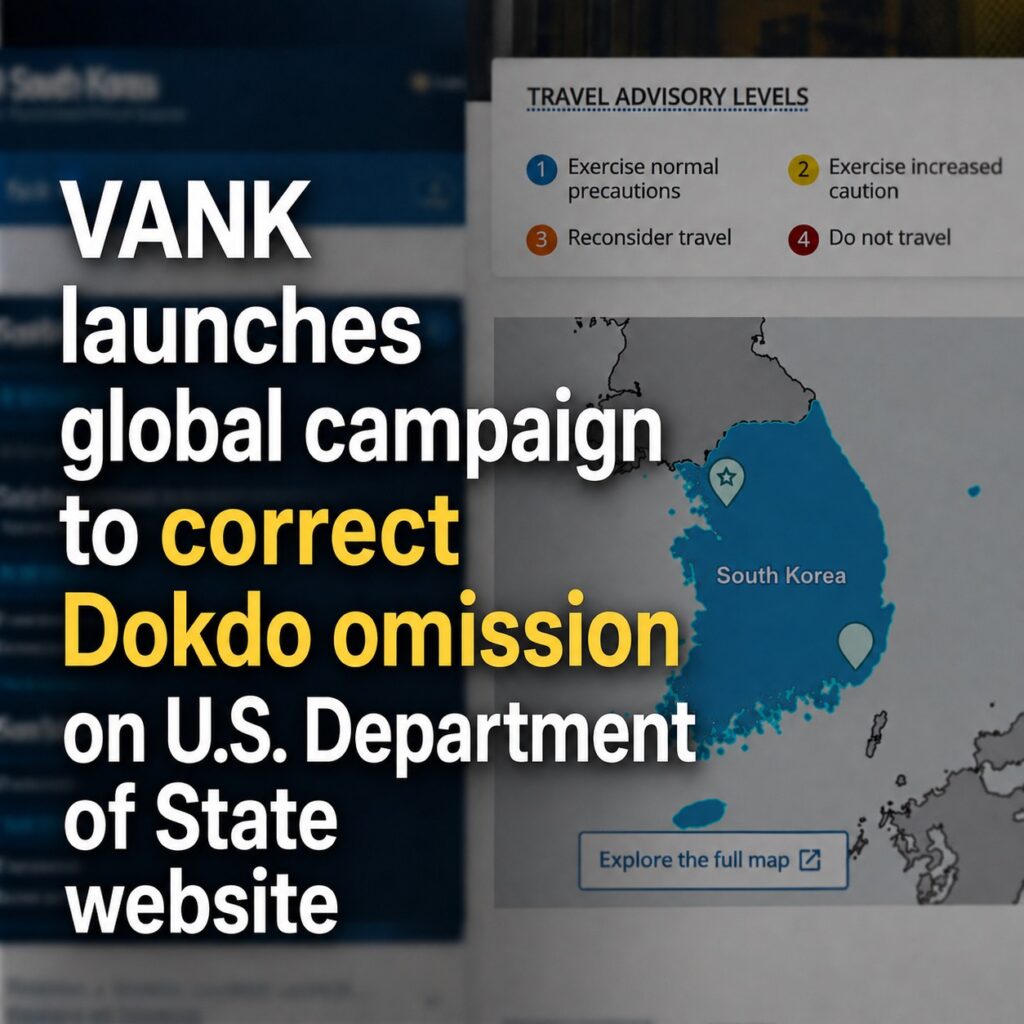
The omission of Dokdo from an official U.S. government map of South Korea has drawn renewed attention following Japan’s latest reiteration of its territorial claim over the island, prompting a global correction campaign by VANK.
VANK announced on Aug. 5, 2026, that it has launched an international campaign urging the U.S. Department of State to correctly identify Dokdo as part of South Korean territory on maps featured on its official travel information website.
The campaign comes after Japan reaffirmed its claim to Dokdo in its 2026 Defense White Paper, marking the 22nd consecutive year since 2005 that Tokyo has included the disputed claim in the annual report.
“While Japan continues to strengthen its international campaign over Dokdo, inaccuracies on the U.S. Department of State’s website—which carries significant diplomatic influence worldwide—risk spreading distorted perceptions,” VANK said.
According to the organization, the map displayed on the South Korea page of the Department of State’s travel advisory website highlights Korean territory when users move their cursor over the country. Jeju Island and Ulleungdo are included within the highlighted area, but Dokdo is excluded.
VANK said the omission remains even when users zoom in on Ulleungdo, with only the larger island recognized as South Korean territory.
The organization added that the same issue appears on the Department of State’s Japan travel advisory page, where Jeju Island and Ulleungdo are highlighted as neighboring Korean territory while Dokdo is omitted.
VANK warned that because the Department of State’s travel advisory website is widely used by international travelers, government officials, and media organizations, excluding Dokdo from Korea’s highlighted territory could lead users to mistakenly regard the island as unclaimed land or disputed territory.
The organization also expressed concern that Japan could use such representations to reinforce its territorial claims over Dokdo.
Having previously succeeded in correcting the omission of Dokdo from maps used by the World Health Organization (WHO), VANK said it will send an official protest letter to the U.S. Department of State while simultaneously launching an online global campaign calling for the correction.
Park Gi-tae, president of VANK, stressed the importance of addressing inaccuracies published by internationally trusted institutions.
“What has been taken away can be recovered, but what is surrendered voluntarily is far more difficult to regain,” Park said. “The omission of Dokdo by an authoritative institution must be corrected.”
Beyond seeking changes to the Department of State’s maps, VANK also plans to formally propose that the Korean government establish a proactive national policy to identify and correct inaccurate information about Dokdo appearing in overseas government agencies, international organizations, online platforms, and educational materials before such errors become more widespread.
The organization said it believes a systematic, government-led monitoring and response mechanism is needed to counter recurring inaccuracies and strengthen the international presentation of Korea’s territorial information.