
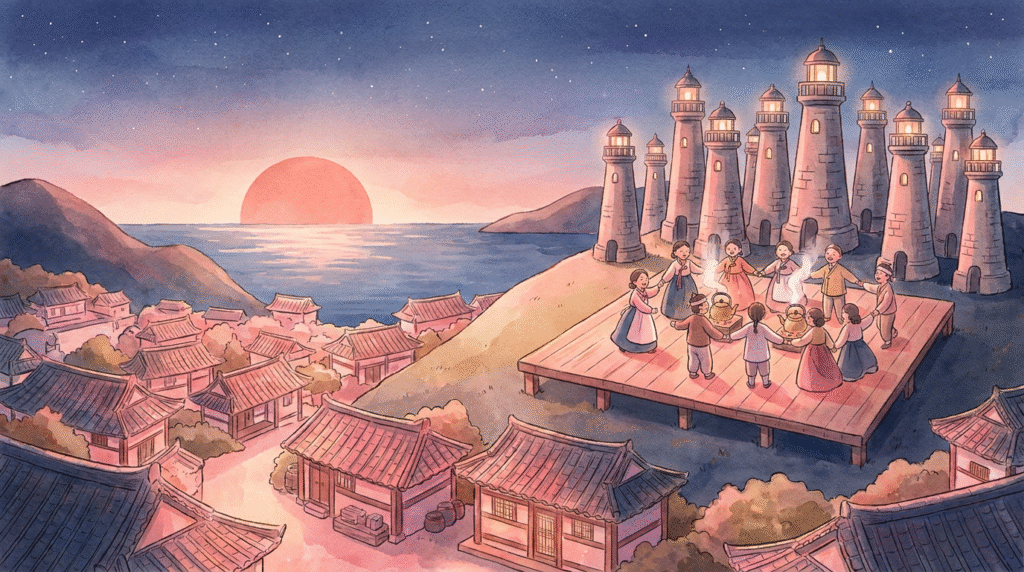
VANK has released a new web-based illustrated story designed to encourage young people to become active participants in addressing social challenges, presenting a new model of civic education for the artificial intelligence (AI) era.
VANK announced on July 4, 2026, that it has made The Lighthouse Keeper and the Twelve Lights, a free online civic education story available through its official website (www.kchanger.one). Bearing the subtitle A Story of Listening and Solidarity Across Korea’s 12 Major Challenges, the project aims to help teenagers and young adults move beyond passive political engagement limited to election periods and instead develop into citizens who identify and address social issues in their everyday lives.
The organization said the story reflects a vision of future generations using AI not merely as a technology tool but as a policy assistant, enabling them to take an active role in solving public issues as what it calls “AI lawmakers.”
The story unfolds on a fictional island named Joseon, where 50 residents symbolize Korea’s population of 50 million. Across the island stand 12 abandoned lighthouses whose lights have gone out, each representing one of the country’s major social challenges.
Among the issues explored are Korea’s declining birth rate and aging population, elderly poverty in a super-aged society, employment changes driven by AI, the climate crisis and global warming, inter-Korean division and security tensions, and political polarization and social conflict.
The narrative follows a young Korean boy who embarks on a journey to restore the extinguished lighthouses alongside a companion named Goryeo—the historical name from which the English word “Korea” is derived. As they travel across the island, the pair listen to local residents, seek to understand the roots of each problem, and work together to find practical solutions.
Rather than emphasizing criticism or ideological confrontation, the story highlights listening, dialogue, and solidarity, conveying the message that solving social problems requires the participation of ordinary citizens rather than politicians or experts alone.
VANK said the project also reflects the participatory civic values it has promoted through its policy proposal platforms Woollim and Yeollim, where citizens collaborate in developing public policy ideas.
“The web story expands those experiences into a narrative that any young person can understand and put into practice,” said VANK researcher Kwon So-young. “We wanted to show that civic participation is not an extraordinary activity but something that can become part of everyday life.”
Another VANK researcher, Koo Seung-hyun, said the AI era requires a new understanding of political participation.
“We need to move beyond the idea that politics belongs only to lawmakers or experts,” Koo said. “This story presents a new civic education model that shows young people can identify social problems, propose solutions, and grow into ‘AI lawmakers’ capable of creating meaningful change.”
The project combines traditional Korean ink-wash illustrations with contemporary civic education themes, linking Korean artistic aesthetics with issues shaping the future. It is available free of charge in both web and PDF formats, allowing users to access the content easily on smartphones and computers.
VANK said it intentionally adopted a storytelling format that blends illustrated fiction with civic education, departing from conventional lecture- and textbook-centered approaches in order to make complex social issues more engaging and accessible for younger audiences.
VANK President Park Gi-tae said genuine democracy depends on citizens who participate continuously rather than only during elections.
“In an era of true popular sovereignty, the real protagonists are not those who think about politics only once every four or five years during elections, but citizens who actively solve problems in their own communities and daily lives,” Park said. “I hope every young person grows into both a K-Changemaker and an ‘AI lawmaker’ who becomes a lighthouse illuminating society.”
The organization plans to distribute the web story widely as teaching material for elementary, middle, and high school civic education, global citizenship education, social studies classes, creative extracurricular activities, and lectures introducing Korea.
It also plans to provide the content to Korean language schools abroad, overseas Korean youth, and Korean language learners as educational material on Korean identity and civic values.
Looking ahead, VANK said it intends to expand the project into a cultural official development assistance (ODA) model for developing countries by combining Korea’s civic education experience with cultural content. The organization added that, building on the global spread of Korean popular culture and its previous efforts to promote Korea’s history and culture, it hopes to advance what it calls a new wave of “K-policy” by sharing Korea’s experiences in civic participation and social problem-solving with the international community.