
VANK has launched a global campaign calling for revisions to what it describes as historically distorted narratives in the Korean Gallery at New York’s Metropolitan Museum of Art, arguing that the exhibition places Korea’s history and culture in the shadow of China and Japan.
VANK announced on July 27, 2026, that it identified the issues after conducting an on-site survey and analysis of the museum’s Asian Art galleries and Korean Gallery. The organization said the investigation was carried out while its delegation was in the United States to attend the 44th National Association for Korean Schools (NAKS) Conference and General Assembly in New Jersey, where it also examined how Korea is represented at major cultural institutions.
According to VANK, the gallery’s introductory panel appears, at first glance, to present Korean culture in a positive light. However, the organization argues that the text incorporates four sophisticated interpretive frameworks that collectively diminish Korea’s independent history and cultural creativity.
The first concern centers on the gallery’s description of Korea as being located “on the Korean Peninsula, a strategic crossroads in Northeast Asia.” VANK contends that this characterization reduces Korea to a peninsula while overlooking the histories of ancient continental kingdoms such as Gojoseon, Goguryeo, and Balhae, which once extended across parts of Manchuria and the Russian Far East. The organization argues that such a description could lend support to interpretations associated with Japan’s former colonial historiography and China’s Northeast Project.
VANK also criticized the gallery’s portrayal of Korean culture as “a crossroads at the eastern end of the Silk Road” that received, transformed, and transmitted outside influences. According to the organization, this narrative undervalues Korea’s own cultural achievements—including Goryeo celadon, Joseon white porcelain, and Hangeul—and instead presents Korea primarily as a cultural intermediary between China and Japan, reflecting what it describes as an Orientalist perspective that has long existed in parts of Western scholarship.
The organization further objected to the gallery’s statement that Korea “emerged as a unified state in the seventh century,” arguing that the simplified description effectively erases the distinct historical traditions of Gojoseon and the Three Kingdoms period, which preceded Silla’s unification of much of the peninsula by several centuries.
VANK also took issue with an interpretation linking the manufacturing technique of 17th- and 18th-century Joseon moon jars—formed by joining separately crafted upper and lower halves—to Korea’s experience of foreign occupation and the division of the Korean Peninsula in the 20th century. The organization described the comparison as an anachronistic interpretation that reduces Korean culture to a passive product of foreign intervention rather than recognizing the intrinsic artistic value of the works themselves.
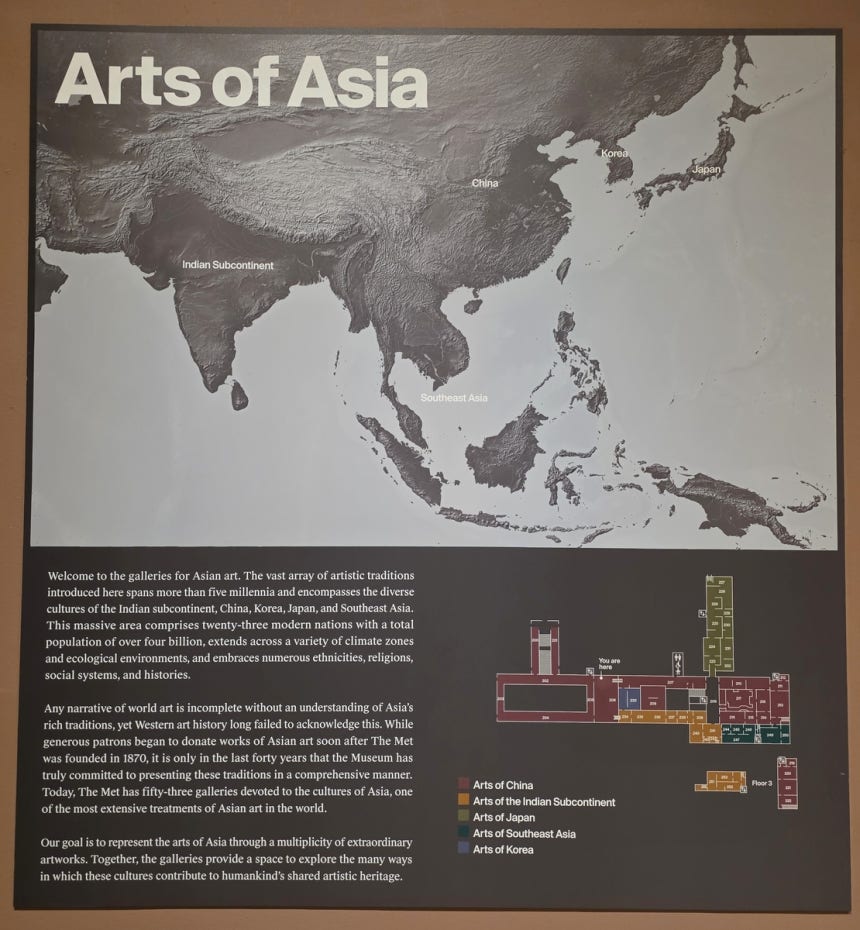
In addition to the exhibition texts, VANK said it found that maps depicting the seas surrounding the Korean Peninsula omitted both Dokdo, Korea’s easternmost territory, and the East Sea.
The organization also raised concerns about the physical scale and placement of the Korean Gallery within the museum. It noted that the gallery occupies a single exhibition room, compared with 23 rooms for the Chinese galleries and 10 for the Japanese galleries. Positioned between the two larger national collections, the Korean Gallery could, according to VANK, leave visitors with the impression that Korean culture occupies a subordinate position between its neighboring civilizations.
“Correcting museum descriptions is no longer simply a matter of fixing place names or factual errors,” said Park Gi-tae, Director of VANK. “Today, we must also address more sophisticated and subtle interpretive frameworks that distort historical understanding. Allowing such narratives to remain unchallenged can seriously undermine Korea’s national brand.”
As part of its campaign, VANK said it plans to send a formal letter to the Metropolitan Museum of Art requesting revisions to the exhibition’s historical descriptions.
The organization also intends to use its national policy communication platform, Woollim, to promote a public petition urging government agencies—including the Embassy of the Republic of Korea in the United States, the Ministry of Culture, Sports and Tourism, and the Northeast Asian History Foundation—to respond more actively to the issue.
In addition, VANK said it will launch a global online petition in cooperation with K-culture fans and internet users around the world, calling on major overseas museums to expand exhibition space devoted to Korea and further enhance the quality and historical depth of Korean gallery content.