
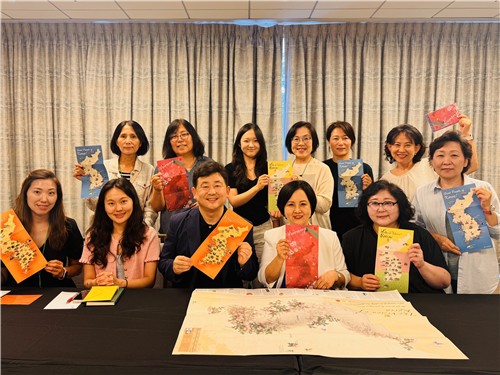
VANK (Voluntary Agency Network of Korea) and the National Association for Korean Schools (NAKS) have unveiled a new vision to transform Korean schools across the United States into “AI embassies” for Korea, with teachers and students serving as “AI diplomats” who promote the country’s history, culture, and identity in the age of artificial intelligence.
The initiative was announced during a joint seminar held ahead of the 44th NAKS Conference and General Assembly, taking place in New Jersey from July 23 to 25, 2026. The seminar focused on redefining the role of Korean schools in the AI era, strengthening identity education for future generations, expanding access to educational resources on Korean history and culture, and addressing misinformation about Korea generated by AI.
This year’s conference, themed “Growing Together: Korean Schools in the AI Era,” is expected to bring together about 500 Korean school teachers, education professionals, and scholars from across the United States and South Korea to discuss how Korean-language and Korean cultural education should evolve in response to rapidly changing technologies.
VANK and NAKS agreed that AI should be viewed not simply as a classroom tool but as a new platform for public diplomacy capable of conveying Korea’s history, culture, and national identity accurately to both global audiences and AI systems.
As part of that vision, the organizations proposed transforming approximately 350 Korean schools across the United States into “AI embassies” representing Korea while nurturing more than 20,000 teachers and students as “AI diplomats.”
The organizations also agreed to establish a comprehensive educational resource hub that will integrate reliable teaching materials on Korean history and culture produced by government ministries and public institutions, allowing teachers to access them through a single platform.
In addition, they plan to jointly develop AI literacy programs that teach students how to critically evaluate AI-generated information, identify inaccuracies related to Korea—including issues involving Dokdo, the East Sea, and Korean history—and contribute to improving the quality of information available to future AI systems.
VANK noted that Korea already supports Korean language and cultural education overseas through Korean Education Centers in eight major U.S. cities—including Washington, New York, Chicago, Houston, Los Angeles, San Francisco, Atlanta and Seattle—as well as 273 King Sejong Institutes worldwide, staffed by 1,163 instructors.
The organization argued, however, that another important national asset has received comparatively little attention: Korean schools established and operated voluntarily by overseas Korean communities.
For decades, these schools have preserved Korean language, history and cultural identity among younger generations while introducing Korea to their local communities, serving as grassroots centers of citizen diplomacy.
NAKS President Kwon Yea-soon said the AI era demands a new educational approach in which students become active communicators of Korea rather than simply learners.
“In the AI era, students should move beyond learning about Korea to using AI to introduce Korea’s history and culture to the world,” Kwon said.
She added that helping teachers access authoritative educational materials more easily while enabling students to critically assess AI-generated information has become an increasingly important priority.
“Through our partnership with VANK, we will provide teachers with practical educational resources while expanding opportunities for students to explore their history and culture and share them with the global community,” she said.
VANK Director Park Gi-tae said Korean schools should now be recognized not only as educational institutions but also as strategic assets that contribute to Korea’s national brand.
“For decades, Korean schools have taught Korean language, history and culture to younger generations while serving as important bases of citizen diplomacy,” Park said. “Their role and value deserve to be viewed from the perspective of national branding.”
He added that the government should recognize Korean schools as key partners in shaping Korea’s international image and support them as institutions capable of serving as “AI embassies” around the world.
Park also stressed that teachers have long acted as unofficial ambassadors for Korea and that, in the AI era, students should likewise be empowered to use AI as a tool for public diplomacy by sharing accurate information about Korea with global audiences.
VANK and NAKS said the initiative marks the beginning of a broader partnership aimed at integrating Korean language education, identity education, AI literacy and public diplomacy into a new educational framework for the AI era.
The organizations expressed hope that Korean schools across the United States will evolve into global hubs that not only preserve the heritage of overseas Korean communities but also help strengthen Korea’s national brand by ensuring its history and culture are accurately understood around the world.