
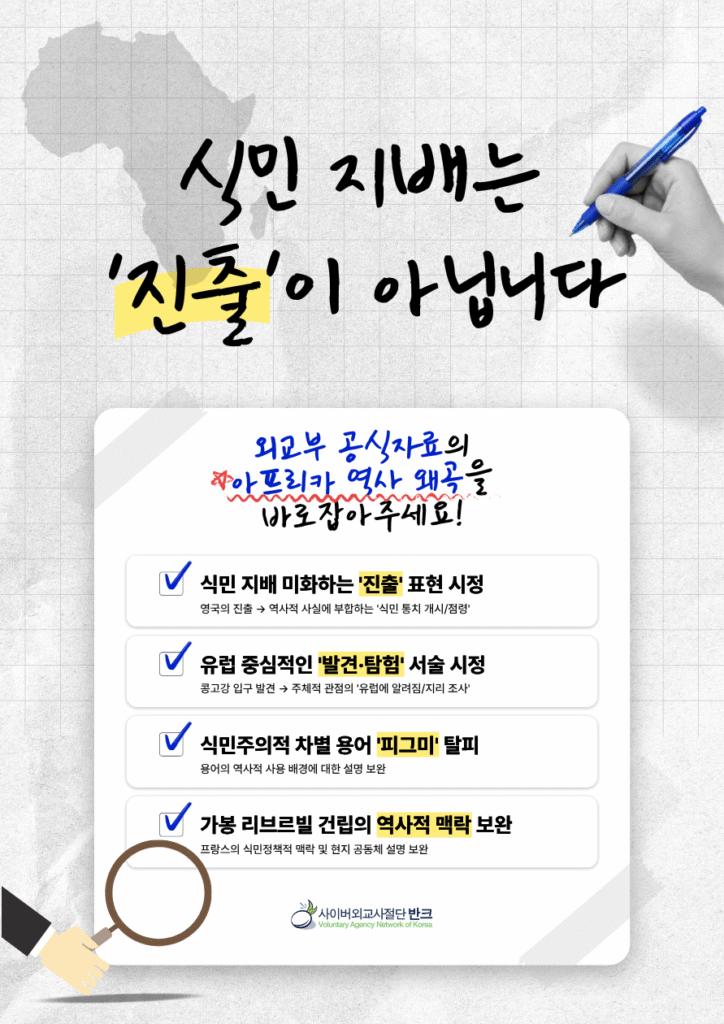
VANK announced on July 15, 2026, that it has launched a campaign urging the Ministry of Foreign Affairs of Korea to revise what it describes as colonial and Eurocentric language remaining in the ministry’s official country profiles.
After reviewing the ministry’s profiles of 54 African countries, VANK found numerous expressions that it says either soften the violence of colonial rule or reflect a European-centered historical perspective.
In particular, the organization identified repeated use of phrases such as “Britain’s advance,” “the large-scale arrival of Europeans,” and “before Europe’s advance into South Sudan” when describing European colonial expansion.
VANK argued that the Korean word translated as “advance” is typically used in neutral contexts such as business expansion or entry into overseas markets, making it inappropriate for describing colonial conquest carried out through military force and coercion. According to the organization, such wording risks minimizing the violence of invasion and colonial rule.
Instead, VANK has urged the ministry to adopt more historically accurate expressions, including “established colonial rule,” “launched an invasion,” “occupied,” and “carried out colonization.”
The organization also called for revisions to several other descriptions. These include the use of the terms “discovery” and “exploration” in the profile of the Democratic Republic of the Congo, which VANK says overlook communities that already existed in the region; the use of the term “Pygmy,” which it describes as a discriminatory label originating during the colonial era; and the explanation of the founding of Libreville, Gabon, which it says does not adequately address the context of French colonial policy or acknowledge the area’s preexisting local communities.
VANK has submitted an official request for corrections to the Ministry of Foreign Affairs while also launching a public campaign through its national policy proposal platform, Woollim, where citizens can view campaign materials and participate by signing an online petition.
Earlier, VANK reviewed encyclopedia entries on all 54 African countries published on Naver Knowledge Encyclopedia and succeeded in correcting nine descriptions that it identified as reflecting colonial or Eurocentric perspectives.
At the time, however, Naver informed the organization that some entries could not be revised immediately because they relied on the Ministry of Foreign Affairs’ official country profiles as their source. VANK said this prompted its latest review in an effort to address what it considers the root cause of the problematic descriptions.
“VANK previously succeeded in correcting a colonial-era expression in a Harvard Business School textbook that stated Japan had ‘integrated’ Korea,” said VANK Director Park Gi-tae. “Just as we have worked to correct misleading descriptions of Korea’s history under Japanese colonial rule, the colonial histories of African countries should also be presented accurately based on historical facts rather than from an imperialist perspective.”
Choi Ju-eun, a VANK youth researcher, said, “While working to correct descriptions of Africa in online encyclopedias, we found that some of the problematic wording originated from official government materials. That led us to conclude that more fundamental improvements were needed, which is why we conducted this review. Describing colonial rule with neutral terms such as ‘advance,’ or explaining history from a Eurocentric perspective, should be reconsidered.”
More information about the campaign is available on VANK’s national policy communication platform, Woollim (www.woollimkorea.net/beginning-of-woollim/view.jsp?sno=4245).