
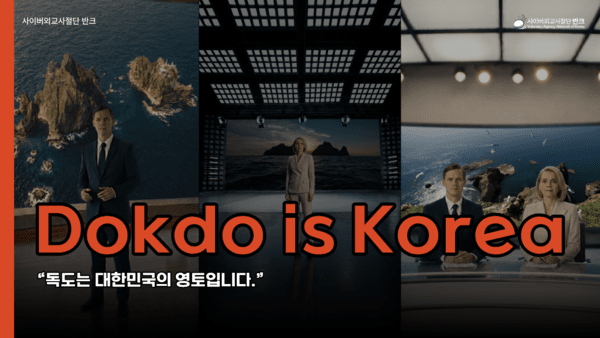
VANK, led by Park Gi-tae, has released a three-part English short-form video series highlighting the historical and legal basis for South Korea’s sovereignty over Dokdo in response to Japan’s global campaign over the disputed islets.
The series, titled “Dokdo: The Island of Truth,” has been published on social media platforms including YouTube, Instagram, and TikTok.
The videos were produced to help global audiences understand why Dokdo belongs to South Korea through historical records and international legal evidence, as overseas references to the islets continue to use Japanese names such as Takeshima or the neutral designation Liancourt Rocks.
Content Created to Counter Japan’s Global Dokdo Campaign
According to VANK, the project was launched in response to the Japanese Ministry of Foreign Affairs’ ongoing efforts to promote its territorial claims over Dokdo through multilingual videos and other promotional materials aimed at international audiences.
The videos are designed to present the key evidence supporting South Korea’s sovereignty in a clear and accessible way through English narration and subtitles, focusing on historical documents, the postwar international order, and South Korea’s effective control of the islets.
The first video, “Dokdo: Korean Territory Recognized by the Japanese Government Itself,” highlights the 1877 Dajokan Directive, issued by Japan’s highest governing body at the time. The directive officially concluded that “Ulleungdo and Dokdo have nothing to do with Japan,” which VANK describes as historical evidence that the Japanese government itself acknowledged Dokdo was not Japanese territory.
The video also examines the first edition of the Revised Complete Map of Japanese Lands and Roads (1779)—a map frequently cited by Japan to support its territorial claims—and notes that Dokdo was depicted outside Japanese territory even in that original edition.
Allied Documents and U.S. Actions Presented as Legal Evidence
The second video, “Dokdo Confirmed by the United States and the Allied Powers,” focuses on SCAPIN No. 677, issued by the Supreme Commander for the Allied Powers following World War II.
VANK explains that the directive excluded Dokdo, along with Ulleungdo and Jeju Island, from Japan’s administrative jurisdiction when defining the territory under Japanese control.
The video also recounts an incident in which the U.S. Air Force designated Dokdo as a bombing range but withdrew the designation immediately after protests from the South Korean government. VANK presents the episode as another important example of U.S. recognition of Dokdo as South Korean territory.
“Effective Control Is the Strongest Proof of Sovereignty”
The third video, “Dokdo: The Island of Peace Recognized by the International Community,” challenges Japan’s claim that Dokdo is a disputed territory.
It highlights Imperial Ordinance No. 41, issued by the Korean Empire in 1900, which formally placed Dokdo under Korean administrative jurisdiction. The video also emphasizes that Korean citizens live on Dokdo, police officers are permanently stationed there, and the islets have an official South Korean postal code, demonstrating South Korea’s effective control—the strongest evidence of sovereignty under international law.
Ma Ji-yoon, the VANK youth researcher who planned the series, said the videos use AI-assisted cinematic production techniques to reconstruct historical documents in a documentary format.
“Our goal was to present Dokdo’s complex history and legal foundation in a way that global audiences can easily understand and engage with,” Ma said.
“Rather than relying on emotional appeals, we focused on visualizing objective historical records and international legal evidence. We hope the series will help correct misconceptions about Dokdo overseas that have been shaped by Japan’s claims and promote a more accurate understanding of history,” she added.
Park Gi-tae, head of VANK, said the Japanese government continues to spread its claim that Dokdo is Japanese territory through multilingual videos on YouTube and other platforms, and that such content is now being disseminated even more rapidly through AI.
“To respond to the Japanese Foreign Ministry’s distorted publicity campaigns, as well as its continued territorial claims in history textbooks and defense white papers, every South Korean citizen must become an ‘AI diplomat,'” Park said.
“We hope this short-form series will serve as a valuable resource for people introducing Dokdo to audiences around the world. We also plan to expand its reach beyond YouTube to platforms such as Instagram Reels and TikTok,” he added.