
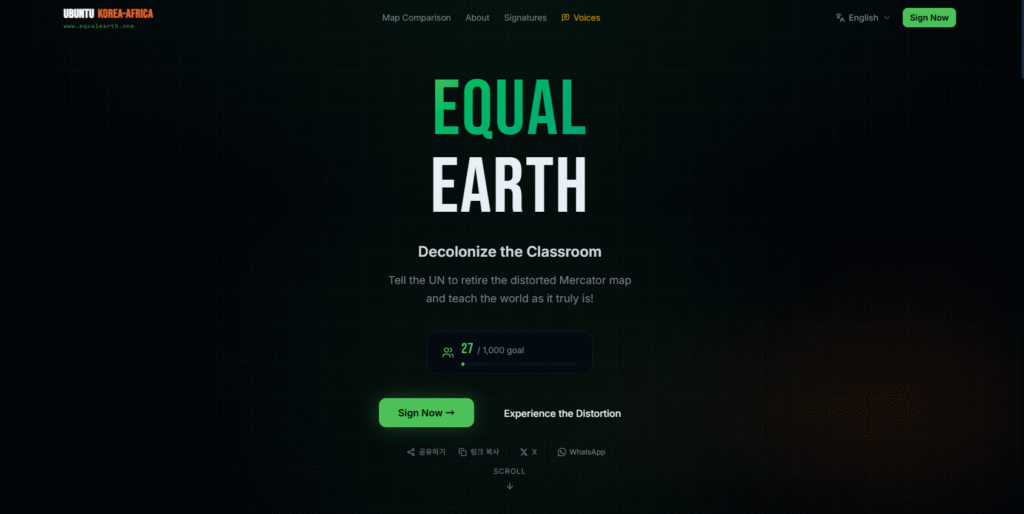
VANK announced on June 24, 2026, that it has launched a global campaign to raise awareness of the fact that Greenland and Africa are not the same size.
VANK said it aims to help secure the passage of a resolution at the upcoming United Nations General Assembly in September that would call for the retirement of the Mercator projection map and the adoption of the Equal Earth projection. The resolution is reportedly being prepared by Togo with the support of the 55 member states of the African Union (AU).
As part of the campaign, VANK has officially launched the global petition website “Equal Earth” (https://equalearth.one).
The newly unveiled platform is available in five languages—Korean, English, French, Spanish, and Arabic.
The Mercator projection, which remains widely used in geography textbooks and major online platforms around the world, was originally developed in 1569 during the European Age of Exploration as a navigational map. While revolutionary for providing sailors with straight-line routes, the projection significantly distorts land areas by shrinking regions near the equator and enlarging those located at higher latitudes.
One of the most frequently cited examples of this distortion is the visual representation of Greenland and Africa. Although Africa covers approximately 30.37 million square kilometers—about 14 times the size of Greenland, which measures roughly 2.16 million square kilometers—the two often appear similar in size on Mercator maps. In reality, Africa is so vast that it could accommodate the entire land areas of the United States, China, India, and Europe combined, with room to spare.
By contrast, the Equal Earth projection, introduced in 2018, more accurately reflects the relative sizes of continents and countries, including Africa.
VANK argued that the Mercator projection was historically misused as a visual tool that reinforced the territorial expansion of Western colonial powers and continues to shape perceptions of Africa as a peripheral region of world history and merely a recipient of aid, even in the post-colonial era.
The organization added that, having long worked to correct errors related to the East Sea and Dokdo, it remembers the experience of seeing Korea omitted or misrepresented on world maps and now seeks to speak out on behalf of Africa, which it says has been unfairly diminished and marginalized in global cartography.
Unlike conventional petition websites that simply collect signatures through text-based appeals, the newly launched platform offers an interactive digital simulation tool. Visitors can drag and compare distorted continents displayed on a Mercator map with their actual relative sizes.
The website also features a real-time global signature counter and visualizes the geographic distribution of participants on an Equal Earth world map, allowing users to track international support as it grows.
VANK plans to expand the campaign throughout July and August using social media platforms such as Instagram, TikTok, and YouTube. The organization intends to produce short-form videos featuring students overturning distorted maps and lifting maps that accurately represent the true size of continents, while encouraging participation from educators worldwide.
In September, when the UN General Assembly convenes, VANK plans to deliver a global petition and statement of demands to diplomatic missions representing UN member states in New York, as well as to UNESCO headquarters. The organization hopes to build international support for the resolution expected to be introduced by the Togolese government.
Park Gi-tae, director of VANK, said, “When world maps distort the size of continents, they also distort the knowledge systems and historical perspectives of future generations. The resolution that the Togolese government plans to advance at the UN General Assembly represents the restoration of scientific truth and a declaration of decolonizing the classroom by removing colonial-era legacies.”
VANK has been carrying out initiatives aimed at improving perceptions of the African continent based on the spirit of Ubuntu, often expressed as “I am because you are.”
The organization has also urged authorities and media outlets to stop routinely using the term “African swine fever,” arguing that it reinforces negative stereotypes about Africa despite recommendations from the World Health Organization (WHO) against naming diseases after specific regions or continents. Instead, VANK has called for the use of the more neutral term “swine fever.”
In addition, VANK has been conducting campaigns to correct what it describes as distorted portrayals of Africa in elementary, middle, and high school textbooks in Korea.