
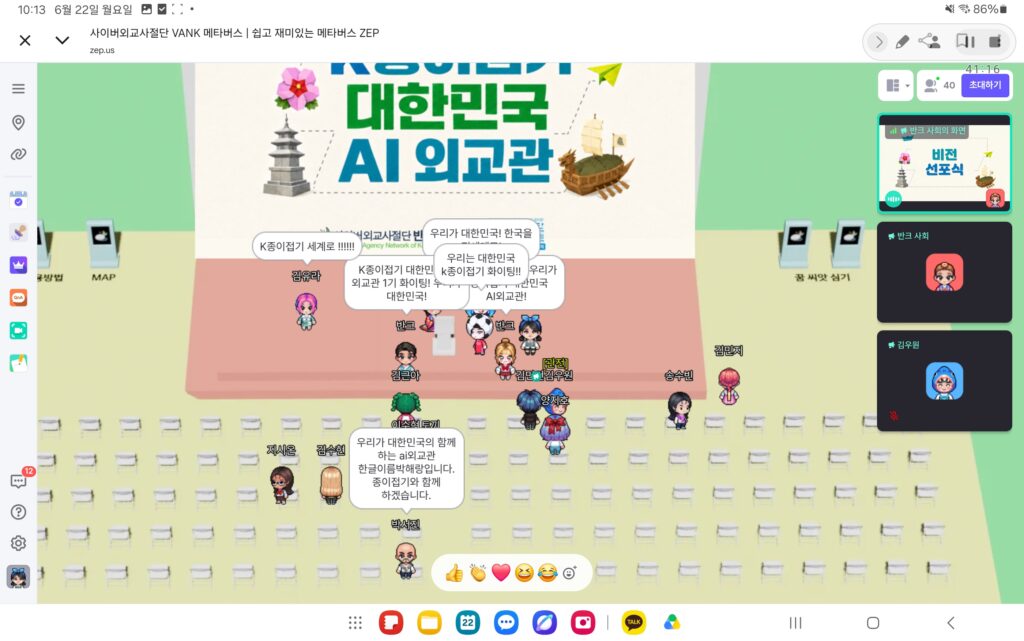
The first cohort of “K-Jongie Jupgi (Korea Jong ie jupgi: Paper Folding) AI Diplomats” has officially started their activities, aiming to promote K-Jongie Jupgi as well as Korea’s history and culture around the world through the use of generative artificial intelligence (AI).
According to the Voluntary Agency Network of Korea (VANK) and the Paper Culture Foundation and World Jongie Jupgi Organization, 144 participants were selected after a nationwide recruitment process that attracted 152 applicants. The participants officially began their activities during an inauguration ceremony held on a metaverse platform on June 22, 2026.
Over the next month, the AI diplomats will engage in a wide range of digital cultural diplomacy activities designed to advance the global recognition of K-Jongie Jupgi and promote Korean culture internationally.
Unlike VANK’s previous ambassador and citizen diplomacy programs, which primarily targeted teenagers and young adults, the new initiative brings together participants from multiple generations. Among the 144 selected members, 76 are elementary school students, 25 are middle school, high school, and university students, and 40 are middle-aged and older adults.
VANK said the diverse age distribution reflects the broad appeal of Jongie Jupgi among people of all generations. Some older participants have previously introduced Korean culture through K-Jongie Jupgi in overseas educational and international exchange programs, while several elementary school participants already hold paper-folding instructor certifications or regularly share their creations on social media.
The organization expects the project to serve as a new model of cultural diplomacy that combines intergenerational experience with digital skills.
The inauguration ceremony featured a congratulatory address by Noh Young-hye, Chair of the Paper Culture Foundation and World Jongie Jupgi Organization, followed by a lecture on the history and cultural value of K-Jongie Jupgi. VANK researchers also provided training sessions on Korea’s digital promotion strategies in the AI era, content creation related to Korean history and culture, and the use of civic participation platforms.
Participants will carry out a four-stage mission program through July 16. In the first stage, they will share reflections on the opening lecture and survey international perceptions of K-Jongie Jupgi and Korean culture with friends overseas.
During the second stage, participants will use generative AI to create content featuring K-Jongie Jupgi and stories related to Korean history and culture. They will also identify and report errors or distortions concerning Korea found on AI platforms. To support these activities, VANK will provide thematic resources on Korean culture and AI fact-checking guidelines.
The third stage focuses on developing AI-based strategies and policy proposals to promote the global spread of K-Jongie Jupgi and accurate information about Korean history and culture. In the final stage, participants will design and carry out their own campaigns or challenges based on the knowledge and experience gained throughout the program.
Outstanding participants who successfully complete all four stages will receive certificates of appointment and be recognized as AI diplomats leading digital cultural diplomacy in the AI era.
Park Gi-tae, head of VANK, said K-Jongie Jupgi represents a powerful cultural diplomacy asset because people around the world can actively participate by folding, sharing, and creating with their own hands. He added that the wider use of the term “Jong ie jupgi” through generative AI would help strengthen the recognition of Korea’s paper-folding tradition within global AI training data and digital information ecosystems.
Noh Young-hye, Chair of the Paper Culture Foundation and World Jongie Jupgi Organization, said K-Jongie Jupgi has evolved beyond emotional development and creativity education into a multidisciplinary cultural content platform with applications in science, art, and industry. She expressed hope that the AI diplomat project would further establish “Jong ie jupgi” as a familiar cultural term worldwide by combining years of accumulated experience with the new possibilities offered by AI technology.
Lee Se-yeon, a youth researcher at VANK, noted that one of the project’s most distinctive features is the participation of both elementary school students and older adults. She said the initiative is expected to create opportunities for meaningful conversations about Korean culture within families while participants learn and use AI together.
VANK and the Paper Culture Foundation and World Jongie Jupgi Organization have worked together to promote the globalization of K-Jongie Jupgi since signing a cooperation agreement in April 2022. The two organizations have produced promotional materials in Korean and English and carried out international outreach activities. In April this year, they jointly hosted a strategic seminar on overseas dictionary registration and global promotion of K-Jongie Jupgi, where participants also explored AI-based publicity strategies.
The organizations said the launch of the first K-Jongie Jupgi AI Diplomats program marks an important step toward expanding the global presence of K-Jongie Jupgi and strengthening digital cultural diplomacy in the age of artificial intelligence.