
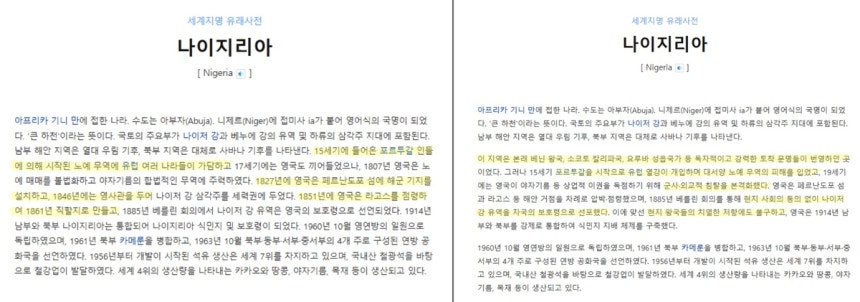
The Voluntary Agency Network of Korea (VANK), led by Director Park Gi-tae, announced on June 17, 2026, that it had successfully secured revisions to nine encyclopedia entries on African countries in Naver Encyclopedia that reflected colonial or Eurocentric perspectives.
VANK said it conducted a comprehensive review of Naver Encyclopedia entries covering all 54 African countries and requested corrections based on historical evidence and contemporary academic research.
One of the revised entries concerned Nigeria. Before the correction, the encyclopedia stated that “Britain established a naval base on Fernando Po in 1827 and opened a consulate in 1846, bringing the Niger Delta into its sphere of influence. Britain occupied Lagos in 1851 and made it a crown colony in 1861.”
Following VANK’s request, the entry was revised to include the statement that “the region was originally home to thriving and powerful indigenous civilizations, including the Kingdom of Benin, the Sokoto Caliphate, and the Yoruba city-states,” making clear that advanced local societies existed long before British colonial rule.
The revised text also notes that “during the 19th century, Britain intensified its military and diplomatic incursions in an effort to monopolize commercial interests, including the palm oil trade.”
The Mozambique entry was similarly updated to reflect not only the history of Portuguese colonial rule but also the region’s indigenous maritime trade networks and post-independence realities.
A previous description stating that “after Vasco da Gama discovered Mozambique Island in 1498, the Portuguese built a city called Mozambique on the island” was revised to read: “Mozambique Island, originally a maritime trading hub centered on Arab merchants and local communities, was transformed into a Portuguese administrative center following Vasco da Gama’s arrival in 1498.”
Entries for several other countries, including Cameroon, Ethiopia, Zimbabwe, Rwanda, and Senegal, were also revised.
VANK said it had submitted additional comments regarding entries on Gabon and Ghana. According to the organization, Naver explained that immediate revisions were difficult due to the policies of the original content providers. However, the company agreed to ensure that the recommendations would be considered during future database updates and content reviews.
Lee Sei-yeon, a youth researcher at VANK, said the achievement marked an important step forward.
“While VANK has previously focused on correcting biased terminology and descriptions related to Africa as a whole, this effort is particularly meaningful because it has led to more balanced and multidimensional portrayals of individual African countries,” Lee said.
Choi Ju-eun, another youth researcher at VANK, emphasized the significance of encyclopedia platforms in today’s digital information environment.
“Online encyclopedias are among the most accessible sources of information for students and the general public, and they also serve as key databases used by AI search engines for training and information retrieval,” Choi said. “We plan to continue monitoring these resources to ensure that users in the borderless digital space have access to more accurate information.”
Based on the findings of its review of all 54 African countries, VANK said it will continue examining additional sources, including country profiles published by the Ministry of Foreign Affairs of Korea, in order to identify and correct distorted or biased descriptions of African nations.
The organization noted that it had previously succeeded in revising discriminatory and biased expressions found in Naver Encyclopedia entries such as “African race” and “Negro race” in April of this year.
VANK has also published content highlighting the latest revisions through its Digital Africa Promotion Center website in an effort to raise awareness both in South Korea and internationally.
Park Gi-tae, head of VANK, said that Eurocentric perspectives and biased historical narratives established during the colonial era continue to be reproduced in today’s digital environment.
“It is important to move beyond viewing Africa solely through the lens of poverty and conflict,” Park said. “Instead, we should present the unique histories, cultures, and development experiences of all 54 African nations in a balanced and comprehensive manner.”
Since last year, VANK has been working with Korea’s national news agency, Yonhap News Agency, on the “Promoting Africa Correctly” project, which aims to challenge stereotypes and distorted perceptions of Africa within the international community.