
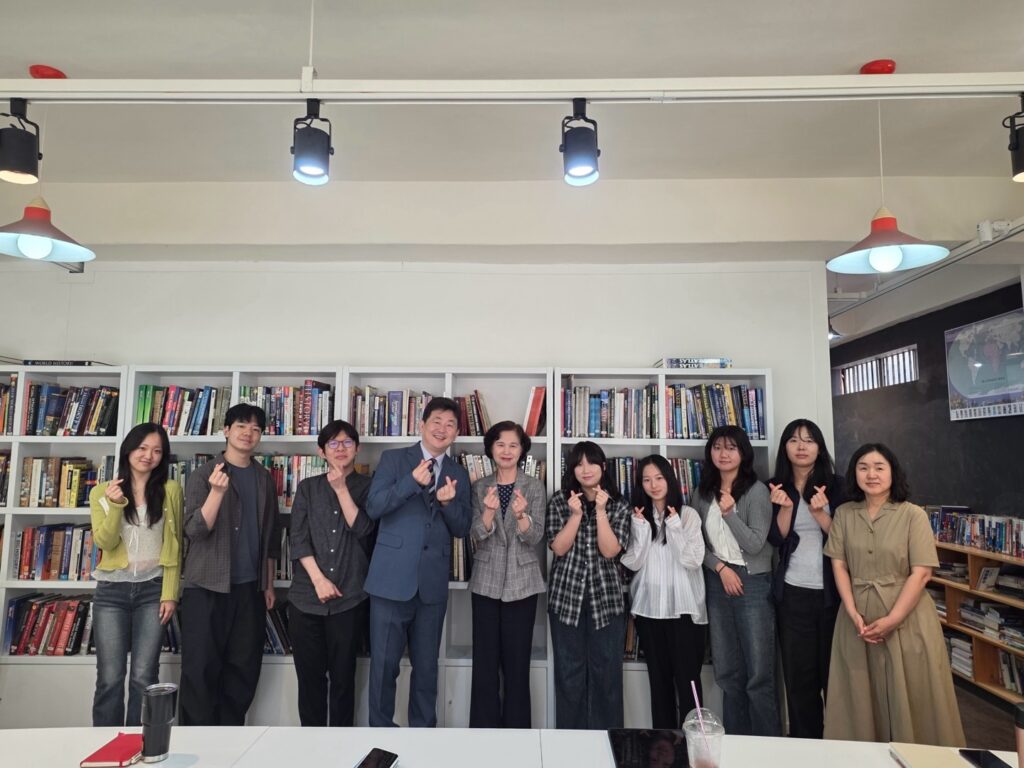
On June 11, 2026, the Voluntary Agency Network of Korea (VANK), led by Director Park Gi-tae, and Choi Mi-young, Chair of the Board of the National Association for Korean Schools (NAKS), held a seminar at VANK’s office in Bomun-dong, Seongbuk-gu, Seoul. The event provided an opportunity to share insights into the immigration history of Korean Americans, the formation of Korean diaspora identity, and ongoing efforts to promote an accurate understanding of Korean history in educational settings overseas.
The seminar traced the history of the Korean diaspora in the Americas, beginning with the first wave of Korean immigration to Hawaii in 1903. Discussions covered the Korean independence movement abroad, the establishment and growth of Korean language schools, and educational efforts aimed at strengthening the identity of younger generations of overseas Koreans.
Particular attention was given to So Far From the Bamboo Grove, commonly known in Korea as Yoko’s Story, a book that has long been the subject of debate in American educational circles. Participants examined how Korean American communities have responded to historical distortions and built public support for a more balanced understanding of history.
Choi Mi-young explained in detail how the book had been used in some American schools as an educational text and described the efforts undertaken by the Korean American community to address concerns surrounding its use.
Written by Japanese American author Yoko Kawashima Watkins, So Far From the Bamboo Grove recounts the escape of a Japanese family in the aftermath of World War II. Critics have argued that while the book portrays Koreans as violent aggressors, it provides insufficient historical context regarding Japan’s colonial rule over Korea and the broader circumstances of the period. As a result, debates have continued over the book’s historical balance and suitability as educational material.
The book was used in some U.S. schools as required reading and classroom material, influencing students’ understanding of history. This led Korean American communities and educators to raise concerns about its educational appropriateness and historical balance.
According to Choi, Korean American advocacy efforts did not frame the issue simply as a historical dispute between Korea and Japan.
“To persuade American society, it was more effective to focus on the objectivity and educational standards valued in U.S. education than to argue which side, Korea or Japan, was right,” she said.
She noted that although So Far From the Bamboo Grove was often presented in schools as an autobiographical account based on the author’s personal experiences and was therefore accepted by many students as factual, it was officially classified by publishers as fiction.
“In American education, the distinction between nonfiction and fiction is extremely important,” Choi said. “When a fictional narrative based on an author’s personal experiences is used in classrooms as though it were historical fact, it can create confusion among students.”
She also stressed that the controversy surrounding the book extended beyond historical interpretation and touched on broader issues of race and multicultural education.
“The United States is a multicultural society where people of diverse racial and cultural backgrounds live together. Educational institutions are therefore highly sensitive to content that reinforces prejudice or reproduces stereotypes about a particular ethnic group,” Choi said. “Our concern was not about arguing whether Korea or Japan was right. Rather, it was about questioning whether educational content that portrays a particular ethnic group in an overwhelmingly negative way is appropriate for classroom use.”
She added that history education should promote mutual understanding and respect rather than reinforce hatred or prejudice, describing the Korean American community’s efforts as an attempt to uphold educational objectivity, diversity, and the values of a multicultural society.
VANK expressed support for these concerns and noted that it has sent letters to education departments in U.S. states where the book has been adopted as instructional material, urging its removal. The organization has also promoted awareness of the need for history education grounded in factual accuracy through international petitions, content creation, and global campaigns.
Park Gi-tae, head of VANK, said the seminar demonstrated that addressing historical distortions requires more than rebuttals or emotional reactions.
“This seminar showed that meaningful change comes from understanding the values and principles that a society considers important and using those principles as the basis for persuasion,” he said. “The experience accumulated by overseas Korean communities through decades of historical education and public diplomacy offers valuable lessons for South Korea’s digital public diplomacy strategy in the AI era.”
He added that the most effective way to promote Korea globally in the age of artificial intelligence is not simply to repeat Korea’s own claims, but to communicate and persuade through universal values and language that resonate with people around the world.
VANK and NAKS said they plan to continue collaborative initiatives based on the educational experience and networks built by overseas Korean communities, with the goal of helping younger generations of Korean diaspora youth develop a sound understanding of history and a strong sense of global citizenship.
Kwon So-young, a VANK researcher participating in the 44th NAKS Conference and General Assembly, reflected on the history of overseas Korean communities.
“Looking back at the history of the Korean diaspora, it is clear that today’s strong sense of identity and community would not have been possible without the dedication of those who established Korean language schools under difficult circumstances and passed Korean history and culture on to future generations,” she said.
She added that the global rise of Korean popular culture did not happen overnight, but was made possible through the long-term dedication of overseas Korean educators who introduced and taught Korean culture in their local communities.
Koo Seung-hyun, another VANK researcher, said the Yoko’s Story case highlighted the importance of how concerns are raised.
“Many people view historical issues through the lens of emotion and confrontation,” she said. “What actually brought about change, however, was not language of blame but an understanding of the educational principles and standards that the other society values.”