
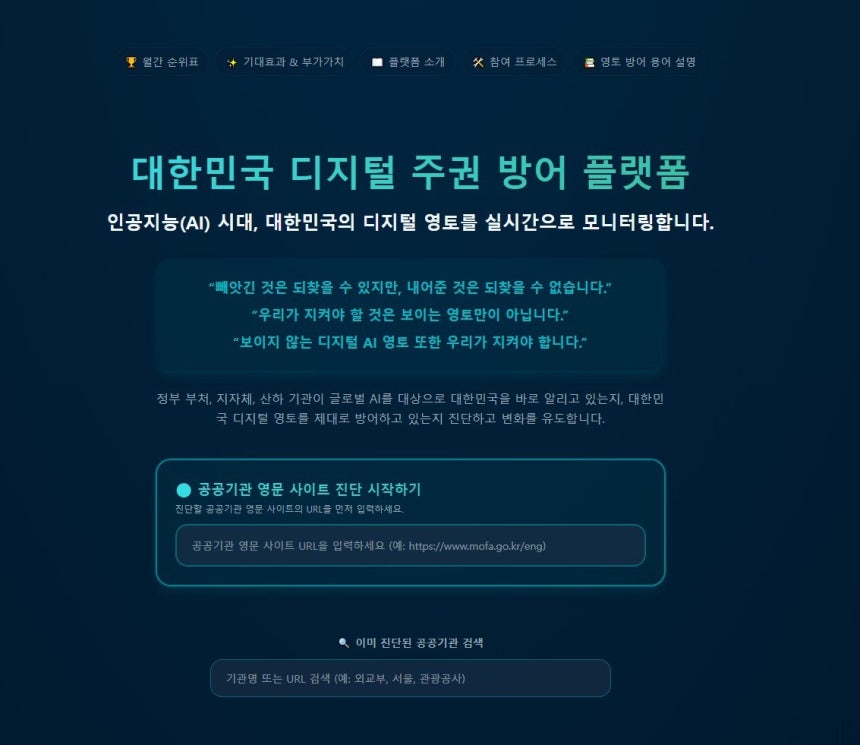
VANK, led by Director Park Gi-tae, announced on June 15, 2026, the launch of AI Korea (www.aikorea.life), the country’s first digital sovereignty defense platform designed to help ensure that global artificial intelligence systems learn accurate information about Korea’s history, culture, and territory.
According to VANK, the rise of generative AI has fundamentally changed how people around the world access information about Korea. More than 200 million global fans of Korean culture increasingly rely on AI services such as ChatGPT, Gemini, and Perplexity to learn about Korean history, traditional culture, tourist destinations, and regional heritage.
However, VANK argues that many English-language websites operated by government ministries, local governments, and public institutions remain poorly structured for AI systems, preventing official Korean information from being properly recognized and utilized. As a result, global AI models are often exposed to and trained on inaccurate or distorted information originating from external sources.
The organization pointed to examples of AI-generated responses that describe Dokdo as a disputed territory, refer to the East Sea as the Sea of Japan, claim that China’s Great Wall extended into the Korean Peninsula, inaccurately depict Gyeongbokgung Palace, or misrepresent the origins of Hanbok and Kimchi.
VANK warned that these problems are not merely isolated AI errors but reflect broader shortcomings in the digital information environment available to AI systems.
“If territory in the past was defined by visible borders, territory in the AI era is the data that global AI systems learn from,” Park said. “While lost physical territory can be recovered, digital territory that has been surrendered within the AI data ecosystem is far more difficult to reclaim. If authoritative Korean data is not properly utilized, it can affect Korea’s national image as well as perceptions of its history and cultural identity.”
The newly launched AI Korea platform is designed as a public participation system that allows citizens to evaluate and monitor the English-language websites of government agencies, local governments, and public institutions.
The platform assesses websites using three key criteria: Search Engine Optimization (SEO), which measures how easily search engines can access and index information; Answer Engine Optimization (AEO), which evaluates whether content is structured in a way that generative AI systems can readily cite and reference; and AI Optimization (AIO), which examines whether historical, cultural, and territorial information is presented accurately and with appropriate context.
VANK noted that many public-sector websites remain heavily dependent on image-based content, card-style graphics, and PDF attachments, creating what it describes as “digital dark zones” where AI systems are unable to effectively extract information. The organization also identified excessive reliance on automatic translation tools as another factor limiting the visibility of authoritative Korean data within global AI ecosystems.
“Many public institutions have hidden valuable Korean content behind images and attached files that AI systems cannot properly read,” Park said. “As a result, global AI models often cite distorted information from other sources instead of official Korean data.”
To encourage continuous improvement, the platform will publish a monthly “Digital Sovereignty Report Card” on the first day of every month. The report will disclose institutional rankings and track month-to-month changes, allowing the public and media to monitor progress and hold organizations accountable for improving their digital presence.
VANK also plans to closely monitor local government websites as international tourism increasingly expands beyond major cities into regional destinations. The organization said it is important that AI systems recognize local government websites as authoritative sources when users seek information about regional festivals, cultural heritage sites, and local attractions.
According to VANK, many local government websites continue to rely on bureaucratic language and static information formats that are difficult for AI systems to interpret and cite. The organization argued that local authorities must adopt more intuitive, story-driven content designed for conversational AI environments if they hope to increase international visibility and attract visitors.
As part of the initiative, VANK evaluated the English-language websites of 42 institutions, including central government ministries such as the Ministry of Culture, Sports and Tourism, the Ministry of Foreign Affairs, and the Ministry of Education; local governments including Gyeonggi Province and South and North Chungcheong provinces; and public organizations such as the Korea Tourism Organization.
The evaluation found that the Republic of Korea Government Portal ranked first overall. At the other end of the ranking, the Gangwon State Government’s English-language website placed last, while the Overseas Koreans Agency ranked 41st. VANK also noted that Jeju Province’s English-language website showed low AI compatibility due to its heavy reliance on automatic translation systems.
The organization particularly criticized tourism-oriented local governments such as Gangwon and Jeju for depending on machine-translated websites despite serving large numbers of international visitors.
“Global AI systems learn from structured text data,” VANK said. “When websites rely heavily on real-time machine translation, AI systems often struggle to recognize and utilize the information. This can ultimately result in local cultural and tourism content disappearing from the global AI learning ecosystem.”
VANK is calling on public institutions to implement what it describes as a “Three-Point Innovation Checklist,” including reducing dependence on image-based and card-news content, adopting AI-readable structured data formats such as JSON-LD, and improving content so that it directly answers user questions in a conversational manner.
Park urged Korean citizens, the country’s 7.5 million overseas Koreans, and global fans of Korean culture to participate in monitoring public websites through the platform.
“We hope that citizens, overseas Koreans, and Hallyu fans around the world will join this effort as 21st-century independence activists,” he said. “In the AI era, protecting invisible digital territory will become just as important as protecting visible national borders.”