
The Voluntary Agency Network of Korea (VANK), led by Director Park Gi-tae, has carried out large-scale revisions to biased descriptions and discriminatory expressions related to Africa in Naver Knowledge Encyclopedia.
The revisions covered a total of 36 entries and 84 cases, of which 64 have already been corrected. Improvements were made in most cases, excluding 20 that are still under review by content providers.
The outcome is significant as part of VANK’s “Promoting Accurate Understanding of Africa” project, launched in 2025. It marks a systematic effort to correct Western-centric and outdated descriptions that remained on widely accessible knowledge platforms.
Earlier, VANK conducted an initial review of top-ranked encyclopedia entries that appear when searching for “Africa” on Naver, identifying biased descriptions in 10 entries and requesting corrections. After terminology changes were applied in two entries, the organization expanded its review to cover broader terminology and narrative contexts related to Africa, leading to the comprehensive revision of 36 entries.
Notably, the latest revisions go beyond initial changes limited to terminology and extend to structural improvements, including replacing illustrations and images, overhauling main texts, and adding new content. The revisions shift away from narratives centered on negative imagery toward descriptions that reflect historical context and contemporary developments.
Corrections were made across descriptions, terminology, and images. Key targets included terms reflecting external or discriminatory perspectives, such as “Black Continent” (4 cases), “Third World” (5 cases), “Negro” (10 cases), “Pygmy” (4 cases), “Bushman” (18 cases), “Hottentot” (9 cases), “Dorobo” (2 cases), and “Gala” (1 case). In total, nine descriptive passages and two images were revised, along with broader adjustments to modes of expression.
Previously, descriptions of Africa in the encyclopedia tended to focus heavily on negative images such as poverty, disease, and conflict. VANK requested context-based improvements, including reflecting modern changes, adopting self-identifying terminology, and supplementing footnotes and references. As a result, many entries were restructured at the level of their overall narrative framework.
For example, the “Africa” entry in the Dictionary of World Place Name Origins was revised to move away from fixed, negative portrayals and instead reflect economic and social developments since the 2000s. Similarly, the “African Cultural Region” entry in the Basic Geography Terms Dictionary for High School Students was expanded beyond simple assessments focused on potential to provide a more multidimensional explanation incorporating historical background and diverse development paths.
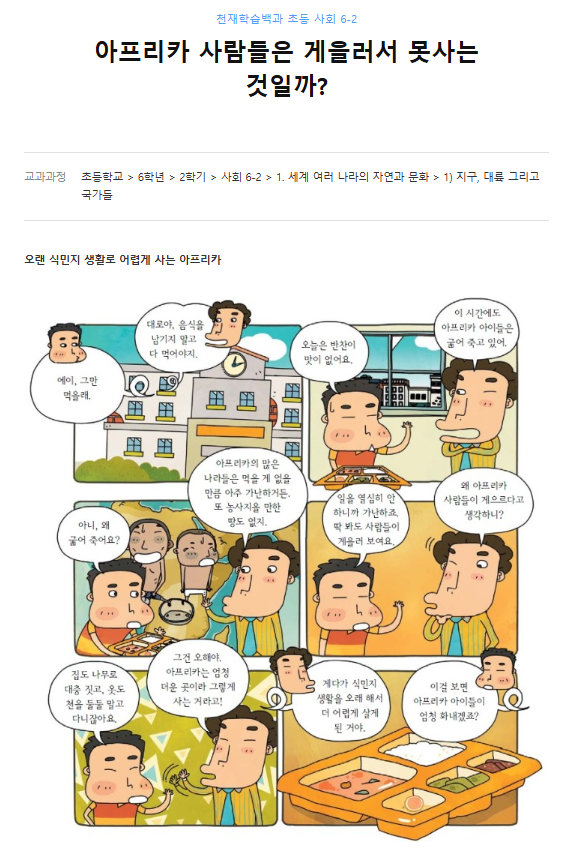
In elementary social studies content, more structural improvements were made. Three entries based on Chunjae Learning Encyclopedia: Elementary Social Studies 6-2 were fully revised, including titles, main text, and illustrations.
The entry “Africa’s Development Potential and Diverse Ethnic Groups” was changed to “Africa’s Diverse Features and Ethnic Groups,” and its representative image, previously centered on depictions of hunger and disease, was expanded to include diverse aspects such as rich culture, art, music, and urban vitality. Poverty was also reframed as “a challenge the global community must address together.”
Another entry, originally titled “Are Africans Poor Because They Are Lazy?”, was completely renamed “What Are the Real Reasons Behind the Challenges Africa Has Faced?” The accompanying comic focused on poverty and the subtitle “Africa Struggling After a Long Colonial Period” were removed. The main text was revised to include historical factors such as colonial rule and forced labor, while also presenting contemporary changes and growth.
The “Environment of Africa” entry was also revised by removing potential-focused expressions such as “a continent with great development potential” and incorporating descriptions that reflect growth across various sectors, a young population, and the expansion of cultural industries.
Map images were also improved. Previously, maps based on the Mercator projection could make Africa appear smaller than it actually is. These were replaced, and an explanation was added noting that land area can appear differently depending on map projection. Additional information was included stating that Africa is about 14 times larger than Greenland, enhancing the accuracy of the content. This follows VANK’s “Correct the Map Campaign” launched in September 2025.
These three elementary-level entries are also in line with broader textbook revisions. In May 2025, VANK analyzed biased portrayals of Africa in Korean textbooks and requested corrections from the Ministry of Education. As a result, related descriptions were improved in eight elementary social studies textbooks approved in September. The latest revisions show how such changes are now extending into digital knowledge content.
Meaningful changes were also made in terminology. “Black Continent” was replaced with “Sub-Saharan Africa,” “Negro” with “people of African descent,” and “Bushman” and “Hottentot” with “San people” and “Khoisan people,” respectively. For terms such as “Dorobo” and “Gala,” footnotes explaining self-identifying terms and historical context were added, while “Third World” and “Pygmy” were supplemented with explanations of their origins and appropriate usage.
In some cases, entry titles themselves were changed. The “Bushmen” entry in the Current Affairs Common Knowledge Dictionary was revised to “San people,” with added explanations of the limitations of externally imposed names. In the same dictionary, the “Negroid” entry was supplemented with explanations addressing its discriminatory nature and issues of overgeneralization. Additionally, in 1001 Historic Sites to See Before You Die, the “Slave Quarters” entry was revised to replace objectifying expressions such as “imported,” “cargo,” and “transported” with terms like “forcibly brought” and “forced transfer,” more clearly reflecting the coercive historical reality.
The revisions are significant in that they go beyond simple wording changes and instead reflect a shift toward descriptions grounded in historical facts and contemporary perspectives. Given the influence of major knowledge platforms on shaping public perception, the effort is seen as an important step in improving foundational data environments.
VANK noted that during the initial request process, some content providers said immediate revisions were difficult due to policy constraints. However, the organization supplemented its requests with additional data and evidence, ultimately achieving the current results.
Lee Sei-yeon, a youth researcher at VANK who led the project, said, “Africa has long been described through a dichotomy of a ‘negative present’ and ‘vague potential.’ Through these revisions, we have laid the groundwork for presenting Africa as an independent continent with diverse histories and realities.” She added, “As cross-verification of related descriptions takes place, this will serve as an opportunity to spread more balanced standards across knowledge and information content.”
Park Gi-tae, head of VANK, said, “Much of the current encyclopedia content is based on materials created more than 20 years ago and simply digitized. Expressions that were not seen as problematic at the time have persisted to this day, making continuous review and updates essential to reflect changing times.” He added, “This effort improves the quality of the foundational data that AI systems learn from and cite, and we will continue working to correct bias and errors in the global knowledge environment.”
Meanwhile, VANK plans to continue follow-up actions on entries still under review while carrying out ongoing efforts to examine and improve Africa-related descriptions across domestic and international knowledge and information platforms.