
VANK, led by Park Gi-tae, announced that its “Promoting Africa Correctly Project” has achieved a new milestone by receiving a response from an overseas textbook publisher promising to review and correct biased descriptions of Africa. The outcome follows earlier efforts to improve Africa-related descriptions in Korean textbooks.
VANK said on March 16, 2026, that it had received a reply from Pearson plc, the world’s largest textbook publisher, stating that “the content team is reviewing your suggestions and fixes will be made in any future releases of the titles.” VANK added that this positive response would serve as an important reference case in its efforts to encourage corrections from other overseas textbook publishers.
VANK said it plans to continue monitoring future editions of the textbooks to confirm whether the Africa-related descriptions are actually revised and to carry out follow-up reviews.
The response is significant as it marks the first overseas textbook correction outcome from the “Promoting Africa Correctly Project,” which VANK has been pursuing since 2025. The organization has been examining biased narratives and structural distortions about Africa in the international information environment and carrying out a range of corrective campaigns. These include analyzing cases of bias about Africa in generative artificial intelligence responses and promoting the spread of the Equal Earth projection to more accurately represent the size of the African continent on world maps. In July 2025, VANK also raised concerns about biased definitions of Africa-related words in English-language dictionaries and succeeded in prompting a review for corrections.
In May 2025, VANK analyzed Africa-related descriptions in Korean elementary, middle, and high school textbooks and formally requested revisions from the Ministry of Education. As a result, eight elementary school social studies textbooks approved in September 2025 reduced descriptions portraying Africa mainly through poverty and hunger, while expanding content about modern development and exchanges with Korea.
VANK said the change was a meaningful educational outcome because it helped reduce negative images and one-sided perceptions of Africa among Korean students who are first forming their understanding of the world.
Building on this experience, VANK expanded its investigation to major overseas world history textbooks. In a study released in January this year, the organization found cases of bias related to Africa in seven educational materials, including world history and geography textbooks and AP World History preparation books published by major U.S. publishers such as Pearson and McGraw Hill.
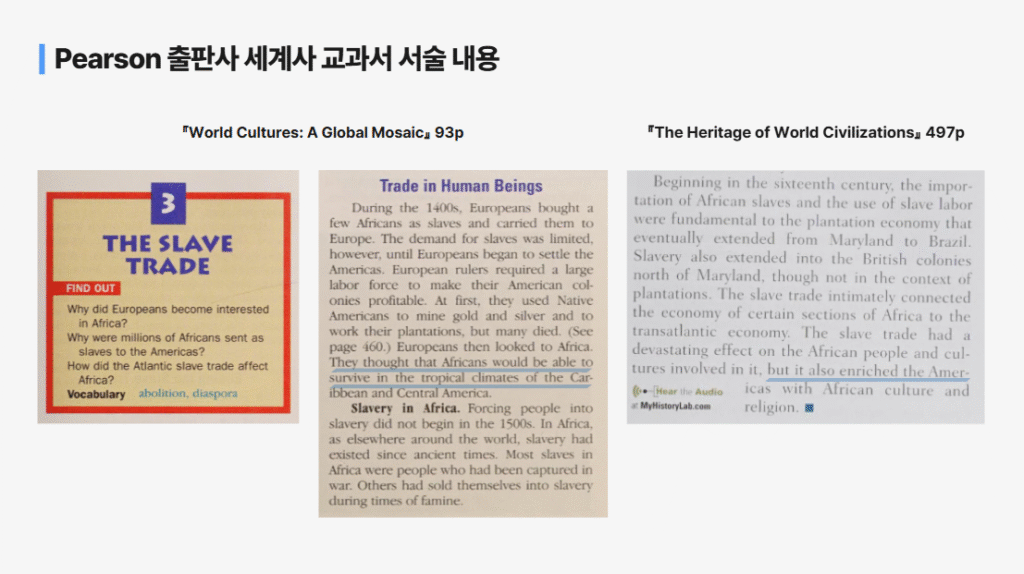
For example, Pearson’s World Cultures: A Global Mosaic explains the African slave trade by asking, “Why did Europeans become interested in Africa?” placing the starting point of the narrative from a European perspective. The book also states that Europeans enslaved Africans because “they thought that Africans would be able to survive in the tropical climates of the Caribbean and Central America,” but does not sufficiently explain that this perception was part of a colonial justification.
In another Pearson textbook, The Heritage of World Civilizations, the slave trade is described as having a “devastating effect” on African societies while also repeatedly stating that the cultures of the Americas were “enriched” through the slave trade. VANK pointed out that such wording could soften the violent historical nature of the slave trade.
VANK organized the specific pages and passages containing problematic descriptions and sent them to the publishers, suggesting several improvements. These included expanding narratives about political thought, resistance movements, and intellectual leadership within Africa; explaining African-led struggles in the abolition of slavery and the process of decolonization; reviewing terms and narrative structures that frame historical events from an external perspective; and expanding contemporary content on policy, regional cooperation, and development efforts by modern African states.
Pearson responded that its content team is reviewing the suggestions and that corrections will be made in future editions. VANK noted in particular the use of the word “fixes,” saying it suggests a high possibility that revisions will appear in upcoming editions. The organization added that the positive response could become an important reference case in promoting similar correction efforts with other overseas textbook publishers.
Meanwhile, VANK has previously worked to correct errors about Korea in international textbooks and world maps. Global publishers and mapmakers such as DK, WorldAtlas, and National Geographic Society have responded to VANK’s requests by adding the name East Sea alongside the Sea of Japan in later publications. VANK has also succeeded in adding Korean cultural heritage such as Jikji to foreign textbooks.
In August 2025, VANK requested corrections to a place-name error found at the Crow Museum of Asian Art in Texas, and the institution officially acknowledged the issue and promised to adopt the name “East Sea.”
According to VANK, the proportion of world maps and databases showing the name East Sea alongside Sea of Japan was about 3 percent when the organization first began its campaign, but has now expanded to more than 40 percent.
Based on these experiences, VANK said it plans to respond more actively to biased narratives about Africa in the international community.
Lee Sei-yeon, a youth researcher at VANK who carried out the textbook review, said that analyzing the textbooks made her realize how much the choice of a single word can influence readers’ perceptions and worldview. She added that the way Africa is described mainly from an external perspective reminded her of how Korea was once introduced with distorted images in the international community, and stressed that it is important to continue reviewing textbook narratives so that students can gain a balanced understanding of different regions when they first study world history.
Park Gi-tae, head of VANK, said that receiving a positive response from an overseas publisher after improving Africa-related descriptions in Korean textbooks is a meaningful beginning. He added that the organization will expand its public diplomacy efforts to correct various prejudices and distortions in the international community based on the experience it has accumulated while promoting a correct understanding of Korea.
VANK said it will continue to promote the “Promoting Africa Correctly Project,” targeting overseas textbooks, educational materials, and digital platforms.