
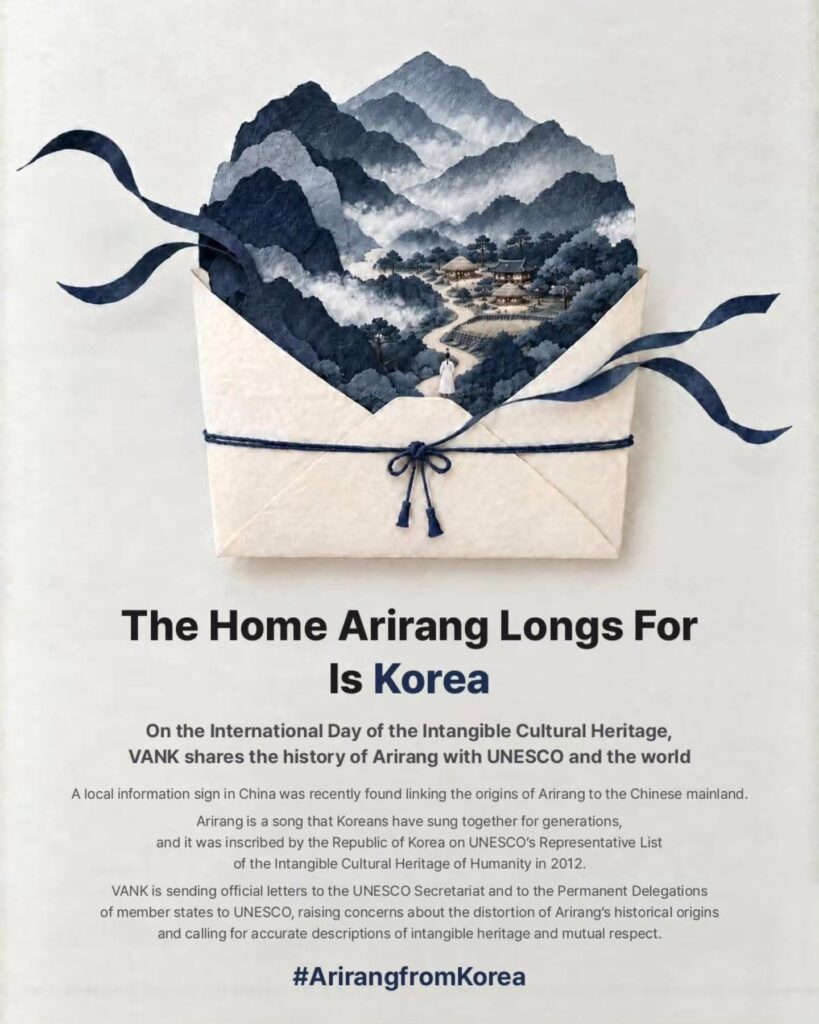
VANK is stepping up efforts to promote the history and cultural significance of Arirang internationally, combining a public social media campaign with plans to appeal to UNESCO and national delegations over concerns about how the folk song’s origins are described in China.
On October 19, 2026, VANK released digital posters, informational graphics and videos as part of its ongoing “#ArirangfromKorea” campaign, encouraging people around the world to share content about Arirang on social media using the hashtag. The initiative builds on activities launched in observance of the International Day of the Intangible Cultural Heritage on October 17.
The campaign’s central message is “The homeland that Arirang longs for is Korea.” VANK aims to highlight Arirang as a traditional Korean folk song that has been passed down through generations, with distinctive melodies and lyrics reflecting the lives and experiences of communities across the country.
Regional versions include Jeongseon Arirang, Jindo Arirang and Miryang Arirang. In 2012, Arirang was inscribed on UNESCO’s Representative List of the Intangible Cultural Heritage of Humanity. UNESCO recognized the song’s role in fostering community identity and solidarity across generations.
The campaign follows the discovery of an information panel at an exhibition facility in Zhongxing Village, Wudanjang, Heilongjiang Province, China, that reportedly attributes Arirang’s origins to songs sung by people who migrated from the Chinese mainland to the Korean Peninsula after the Han Dynasty established the Four Han Commanderies, expressing longing for their homeland.
A related report by the Korea Heritage Service found that China has designated 24 elements associated with Korean traditional culture, including Arirang, as national-level intangible cultural heritage.
VANK is concerned that such explanations could create misunderstandings internationally about Arirang’s historical origins and cultural identity. The organization plans to prepare a letter in English, drawing on materials related to the information panel and UNESCO’s official records, and send it to the UNESCO Secretariat and national delegations of various countries.
The letter will call for greater attention to the accurate representation of intangible cultural heritage and respect for the cultural identities and diversity of the communities that preserve and transmit it. VANK intends to draw on UNESCO’s Ethical Principles for the Safeguarding of Intangible Cultural Heritage, adopted in 2015, to seek international cooperation.
VANK stressed, however, that it does not question the right of ethnic Koreans in China to preserve and pass down Arirang. Rather, it argues that the shared transmission of cultural heritage by different communities must be distinguished from explanations that misrepresent the history of its origins and development.
“Arirang is a song our people have sung together for generations,” said Jeon Hye-rin, a youth researcher at VANK who participated in the campaign. She emphasized the need to distinguish between different communities sharing a cultural tradition and inaccurate accounts of how that tradition originated and was passed down.
VANK Director Park Gi-tae said promoting cultural heritage internationally must go hand in hand with ensuring that people understand its history and identity accurately.
The organization plans to continue its social media campaign and encourage greater public participation, while pursuing appeals through international organizations. Through these efforts, VANK aims to broaden global awareness of Arirang and strengthen understanding of the historical context behind Korea’s traditional culture.