
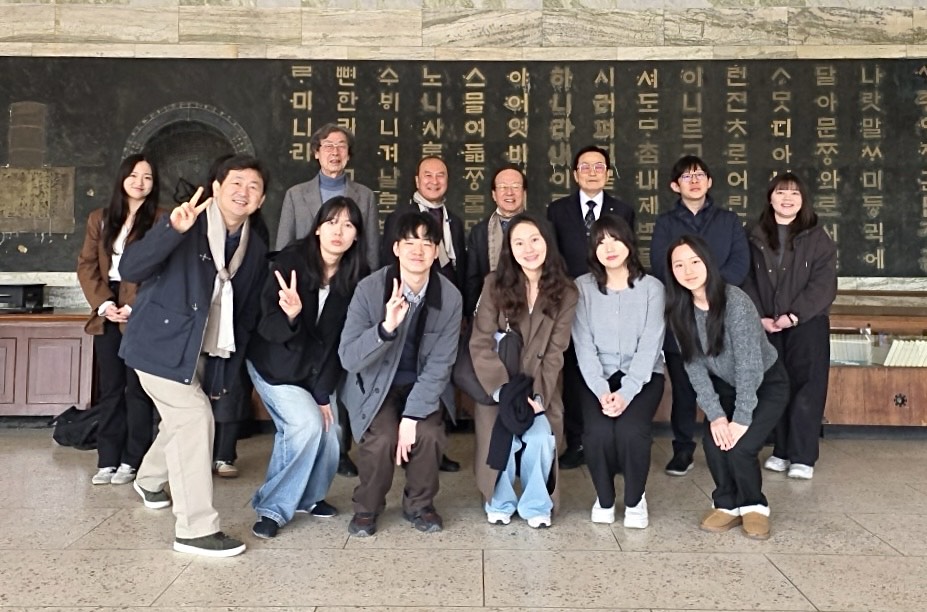
VANK, led by Director Park Gi-tae, and Sejong Korea, headed by Chairman Choi Hong-sik, held a “Global Hangeul Promotion Strategy Seminar” on March 12, 2026.
Sejong Korea is a nonprofit organization established to honor the achievements and spirit of Sejong the Great, preserve and carry forward his legacy, and contribute to the development of Korean culture.
In December 2023, VANK and Sejong Korea signed a memorandum of understanding to pursue various cooperative projects. The goal is to help foreigners around the world not only learn the Korean language and Hangeul but also understand the spirit and values of King Sejong, who created the writing system out of compassion for the people.
At the start of the seminar, VANK researcher Kwon So-young introduced the organization’s national policy platform and its ongoing campaigns promoting King Sejong and Hangeul.
Kwon shared the results of VANK’s research on the distortion of information about Korean cultural heritage in the generative AI environment. The organization conducted a systematic analysis of information on 34 topics—including Hangeul, King Sejong, major Korean cultural heritage items, territory, and cities—across major generative AI platforms such as ChatGPT, Microsoft Copilot, and DeepAI. According to VANK, many platforms were found to contain inaccurate or distorted explanations related to Korean cultural heritage.
In response, VANK explained that it is monitoring errors about Korea within AI systems through initiatives such as Global AI Ambassador and Global AI Cultural Heritage Ambassador programs. The organization is also encouraging citizens to act as “AI Republic of Korea Ambassadors” who help correct information and promote Korea’s history and culture.
VANK also introduced a campaign launched to mark the first year that “King Sejong’s Birthday” was officially designated as a national commemorative day. The campaign sought to present King Sejong not simply as a monarch but as “a teacher for all of us.” May 15 is widely known as Teachers’ Day, but it is also the birthday of King Sejong, the fourth king of the Joseon Dynasty and one of Korea’s greatest rulers. To highlight Sejong as the “true teacher of the people” who provided the linguistic foundation for communication among the public, VANK created a campaign poster inspired by the design of idol birthday billboard displays to commemorate the 628th anniversary of the king’s birth and introduce “King Sejong’s Birthday” in a friendly way.
VANK also produced 10,000 copies of a comprehensive promotional poster titled “Hello – Discover Korea at a Glance,” which presents Korea’s history and culture at a glance, and distributed them both in Korea and overseas. The poster is designed as an integrated educational resource that presents Korean history from Gojoseon to the present, along with key cultural elements such as Korea’s documentary heritage, World Heritage sites, and cultural content including Hansik, Hanbok, and Hangeul. It is being used to introduce Korea to 7.5 million overseas Koreans and 200 million fans of the Korean Wave around the world.
Kwon explained that the materials were distributed to about 1,000 weekend Korean schools across the United States through more than 350 Korean language teachers who attended the 43rd academic conference and general meeting of the National Association for Korean Schools held in the United States last year. She added that they are also being shared with Korean Wave fans and overseas educational institutions worldwide through about 2,000 VANK members who serve each year as digital diplomats and Korea promotion ambassadors.
VANK also carried out a campaign to reintroduce Homer Hulbert, who contributed to the global spread of Hangeul along with King Sejong. While Sejong laid the foundation for Hangeul by creating and promulgating the script through the Hunminjeongeum, Hulbert played an important role in researching and promoting the excellence of Hangeul internationally. He introduced the scientific structure and superiority of the writing system to the world and supported Korea’s independence movement, and he is regarded as a foreign independence activist. Through such historical examples, VANK highlights the meaning of international solidarity and empathy in the development and global spread of Hangeul.
In addition, VANK conducted a “Create Your Hangeul Name” experience campaign with the House of Korea (HOK) for foreign visitors to the Korean Pavilion at Balboa Park in the United States. The campaign used the Hangeul name recommendation service “Ilhum,” a platform that suggests native Korean and Hangeul names and has accumulated more than 100,000 users. Participants answered simple questions and received native Korean name recommendations tailored to their personalities and interests. They then combined Hangeul consonants and vowels to create their own name tags, allowing them to experience the originality and structural beauty of the script.
Finally, Kwon introduced the “2026 Korea National Brand Up Exhibition.” Under the theme “Hallyu Becomes Global Culture,” the first section of the exhibition, titled “THE ORIGINAL: Becoming a Masterpiece,” emphasized that today’s global popularity of the Korean Wave is not simply a trend but the result of cultural foundations accumulated over 5,000 years of Korean history. The exhibition also introduced Hangeul as one of the cultural heritages forming the original foundation of the Korean Wave, providing an opportunity to inform domestic and international visitors to the National Museum of Korea about the historical value and global significance of Hangeul.
During the following presentations, VANK youth researchers proposed a variety of ideas for promoting Hangeul, including digital campaigns, global participatory content, and strategies using generative AI.
Youth researcher Choi Ju-eun proposed a participatory digital campaign that reinterprets and shares Worin Cheon-gang Jigok (Songs of the Moon’s Reflection on a Thousand Rivers) in a modern way. Using a quiz platform, participants would enter their names and receive one randomly selected verse from the 583 verses of the work in the form of a result card in a campaign titled “Draw One Verse of Today’s Worin Cheon-gang Jigok.” She explained that participants could interpret the meaning of their verse or translate it into their native language and share it on social media, creating participatory content that allows global citizens to share the work together.
Youth researcher Lee Hyun-woo proposed the “Worin Cheon-gang Jigok Gothic Form-Based Calligraphy Copying Challenge.” He suggested reinterpreting the creative spirit of King Sejong—who personally carved printing type—through the format of copying texts by hand, allowing participants to experience the structural beauty and visual order of Hangeul in a modern way.
The campaign consists of a “design copying” activity in which participants write passages that match the geometric structure of the script used in Worin Cheon-gang Jigok, followed by “Worin meditation,” a brief reflection period recalling King Sejong’s spirit of compassion for the people. Lee presented the concept with the catchphrase, “Just 5 minutes and 15 seconds—time to follow the moonlight inside the square that Sejong created,” proposing that it be developed into a digital participatory campaign that allows people to experience both the artistic beauty of Hangeul and the spirit of Sejong.
Youth researcher Ma Ji-yoon proposed an AI-based social media campaign to expand Hangeul calligraphy culture. She explained that AI image generation technology makes it easier for anyone to create calligraphy-style content, lowering barriers to participation. She also emphasized that as more Hangeul calligraphy content accumulates online, the amount of Hangeul data that AI can learn from will also expand.
She proposed a challenge campaign in which participants select their favorite K-pop lyrics and use AI image-generation tools to create Hangeul calligraphy-style images and share them on social media.
Youth researcher Kim Ryung-eun proposed an SNS promotion campaign using Hangeul calligraphy and letter-writing culture. She noted that Hangeul calligraphy represents not only the visual expression of writing but also a “culture of writing with one’s heart.”
She suggested creating content based on actual Hangeul letters from the Joseon period, introducing the stories of the people who wrote them and the contents of the letters. Participants would then write a handwritten Hangeul letter to someone and share a verification photo on social media. Through this campaign, she aimed to introduce the records of life and emotion preserved in historical Hangeul letters and highlight Hangeul calligraphy as a cultural record that has preserved people’s stories.
VANK Director Park Gi-tae said that Worin Cheon-gang Jigok is a comprehensive cultural heritage combining language, art, religion, and literature, and that it embodies King Sejong’s spirit of compassion for the people. “In that sense, it is not simply the story of a single king of Joseon but a universal value that people around the world can relate to,” he said.
He added that in the age of AI, when anyone can compose music and write lyrics to create their own songs, it would be possible to create a 21st-century version of Worin Cheon-gang Jigok and develop it into a participatory cultural campaign in which 200 million K-pop fans create and share their own lyrics.
He also suggested exploring global campaigns to have Worin Cheon-gang Jigok recognized more widely around the world, including possible inclusion in dictionaries or textbooks and even registration in the Guinness World Records, noting that the work is an important cultural asset capable of generating global resonance.
Choi Hong-sik, chairman of Sejong Korea, said that Worin Cheon-gang Jigok, which symbolizes King Sejong’s compassion for the people, should no longer remain simply an object of preservation and management but should be widely recognized as a cultural heritage shared by humanity. He added that the society will work with VANK to build public support and expand international interest in order to pursue the inscription of Worin Cheon-gang Jigok on the UNESCO Memory of the World Register.