
Voluntary Agency Network of Korea, led by Park Gi-tae, announced on April 2, 2026, that it had achieved revisions to biased descriptions in the “African race” entry of the Naver Knowledge Encyclopedia.
The achievement is part of VANK’s “Promote Africa Correctly” project, launched in 2025. After reviewing encyclopedia content that appears at the top of search results for the keyword “Africa” on Naver, the country’s most widely used portal site, the organization identified common patterns of bias in how Africa is described and requested corrections to a total of 10 entries.
The review covered a wide range of materials, including elementary and secondary school educational content as well as general dictionaries. Specifically, the entries included “Africa” in the Elementary Social Studies Concept Dictionary, “Africa” in the World Place Name Origins Dictionary, “African race” in the Basic Geography Terminology Dictionary for high school students, and “Negro race” in the Basic Social and Science Knowledge for middle school students, among others.
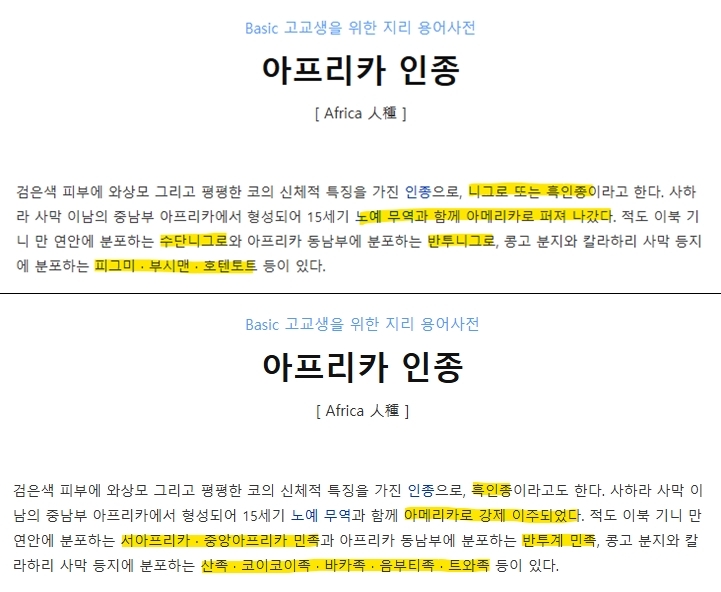
In the “African race” entry in the high school geography dictionary, African people were described as “Negro or Black race,” with “Negro” presented as a synonym. The text also used terms such as “Sudan Negro,” “Pygmy,” “Bushmen,” and “Hottentot” without explanation, and descriptions of the slave trade did not clearly reflect its coercive nature.
VANK explained that “Negro” originated from a race classification system based on skin color and is now widely recognized as a term with racist connotations that should be avoided. It also pointed out inconsistencies in usage standards, noting that the same platform’s Korean dictionary defines the term as “derogatory,” while the encyclopedia presented it as a neutral synonym without critical context.
Following VANK’s request, the entry was revised. The term “Negro” was removed, and expressions such as “Sudan Negro,” “Bantu Negro,” “Pygmy,” “Bushmen,” and “Hottentot” were replaced with terms reflecting geographical and cultural context, including “West and Central African peoples,” “Bantu-speaking peoples,” and “San, Khoikhoi, Baka, Mbuti, and Twa peoples.” In addition, descriptions of the slave trade were changed from “spread” to “forcibly relocated,” clearly reflecting the coercive nature of the historical events.
The “Negro race” entry in the middle school-level knowledge dictionary was also revised, with the term replaced by “Black race,” addressing the discriminatory expression embedded in the original terminology.
VANK assessed that the case goes beyond a simple change in terminology, highlighting broader issues in how knowledge content shapes perceptions of specific regions and people. It emphasized that the revisions mark a shift toward reflecting self-identification and historical context, rather than externally imposed labels, and provide an opportunity to improve awareness.
However, VANK noted that some entries, including “Africa” in the Dictionary of Religious Studies and the World Place Name Origins Dictionary, cannot be immediately revised due to copyright and content provider policies. Naver stated that it would pass on the requested changes to content providers for review during future database updates, expressing hope that the need for more balanced descriptions of Africa will continue to gain traction.
Earlier analysis by VANK found recurring structural bias in descriptions of Africa, often presenting the continent through a simplified framework of “poverty in the present and potential in the future.” Many entries emphasized poverty, disease, and desertification before concluding with “development potential,” while failing to adequately reflect contemporary changes such as urbanization, industrial growth, and the expansion of cultural industries.
Some entries also reinforced distorted perceptions. For example, an elementary social studies text introduced “people suffering from hunger and disease” as the first image associated with Africa. Another entry described Africa as having “rich resources and strong development potential but facing difficulties in modernization due to long colonial rule, economic dependence, conflict, and food shortages,” without sufficiently addressing current development or regional cooperation.
The use of terms originating in the colonial era without critical context was also identified as a key issue. Expressions such as “Black Africa,” “Pygmy,” “Bushman,” and “Hottentot” were used without explanation, despite growing recognition that such externally imposed labels should be replaced with community-based terms such as “San” and “Khoikhoi.”
Of the 10 requested corrections, some entries—including those in the Dictionary of Religious Studies, the World Place Name Origins Dictionary, and the Basic High School Geography Dictionary’s “African cultural region”—remain under review due to policy constraints. However, further updates are expected as discussions on improving related content continue.
VANK has continued to push for improvements in how Africa is described across textbooks and dictionaries both in Korea and abroad. In May 2025, it requested corrections to biased descriptions in domestic school textbooks, resulting in expanded coverage of contemporary Africa and international exchange in eight elementary textbooks. The same year, overseas dictionaries added warning labels such as “dated” to certain Africa-related terms, and on March 16, 2026, VANK also received responses from foreign textbook publishers following its inquiries.
Lee Sei-yeon, a youth researcher who led the project, said, “The issue is not denying the existence of poverty or conflict in some parts of Africa, but the way an entire continent of 54 countries is reduced to a single image.” She added that while narratives about Africa’s past and future are repeated, there is a lack of balanced content addressing present-day realities and changes, emphasizing that the project aims to accurately document and convey “Africa today.”
Park Gi-tae said, “Building on our experience of promoting accurate information about Korea, we are now creating tangible changes in how Africa is described,” adding that “establishing a balanced view of Africa is an important foundation for building a global community based on mutual respect.” He also stressed that as generative AI becomes a major channel for information distribution, ensuring the accuracy and context of digital knowledge is increasingly important, calling for continuous monitoring and improvement to prevent the repetition of misinformation and biased narratives.
VANK said it will continue reviewing Africa-related descriptions across digital platforms, including encyclopedia content, and carry out correction efforts to ensure more balanced and accurate information. Additional revisions are expected as other pending requests are currently under review.