
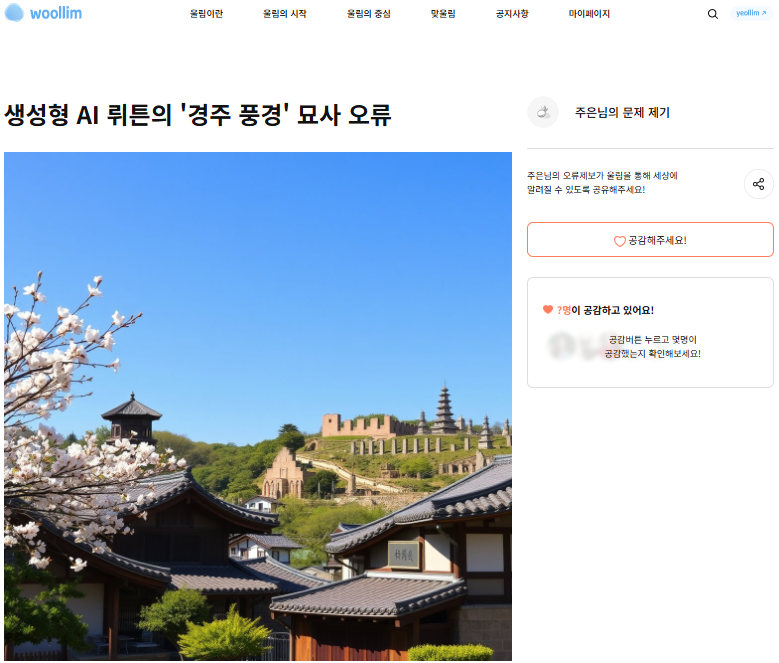
VANK has officially launched a project to systematically identify and analyze generative AI errors related to the history and cultural heritage of Gyeongju.
Through the national policy proposal platform Woollim, VANK revealed various AI-generated inaccuracies about Gyeongju that were discovered by youth participants, and jointly presented policy ideas aimed at preventing and correcting such issues.
This initiative carries significant meaning as a proactive measure to counter the distortion and diminishment of Gyeongju’s historical and cultural information amid the global expansion of AI services. It also seeks to ensure the spread of accurate information and to strengthen what VANK calls “AI sovereignty.” The timing of the project is particularly notable, coming ahead of the Asia-Pacific Economic Cooperation (APEC) Summit to be held in Gyeongju later this month. As artificial intelligence emerges as a core topic at the summit, South Korea is presenting its vision to rise as one of the world’s top three AI powerhouses, alongside the United States and China.
VANK emphasized that for Korea to truly establish itself as a global AI leader, it must go beyond technological competition and sovereignty in the technical sense, and instead secure what it calls “identity sovereignty”—ensuring that the histories and cultures of individual regions are accurately represented and protected within AI systems. Given that generative AI data is currently dominated by U.S. and Chinese sources, it is crucial that Korea’s unique historical and cultural narratives are preserved without distortion.
Examples reported by participating youth illustrate the seriousness of the problem.
A participant in the VANK Korea Ambassador program, who identified herself by the nickname Jueun, discovered that the AI platform Wrtn generated completely inaccurate images when she requested a depiction of Gyeongju’s scenery. Despite asking for an image that would allow foreigners visiting Korea for the first time to appreciate the beauty and history of Korean culture, the AI produced results disconnected from Gyeongju’s historical identity. Notably, some generated images featured unrealistic stone structures resembling Japanese-style pagodas. She stressed that “AI-generated images can be used in tourism promotion and educational materials, so they must be based on accurate historical references.”
Another participant, Wi Seo-yeon, found that when she asked Google’s AI Gemini to generate an image of Cheomseongdae Observatory, it produced a distorted version resembling a furnace rather than the authentic 27-tiered fan-shaped stone structure. She cautioned that “if such a representative heritage site is inaccurately portrayed, it could lead foreigners to develop a false understanding,” and suggested that “AI systems should be trained using authentic images provided by the Cultural Heritage Administration.”
Participant Jang Seo-hyun requested an image of Dabotap at Bulguksa Temple via ChatGPT, but the result resembled Seokgatap, the nearby three-story pagoda, instead of Dabotap itself. She emphasized that “while they may appear similar, each cultural heritage site has distinct architectural structures and artistic characteristics that AI must be able to distinguish.”
Another participant, Hong Hye-won, found that when she asked ChatGPT for an image of the Seokguram Grotto, the AI rendered the Buddha statue incorrectly—with its right hand facing upward instead of toward the ground—and omitted the eight guardian deities that should be positioned behind the main Buddha. Although she attempted to correct the output by providing accurate information, she noted the limitations of individual efforts and called for a national-level system to regularly inspect and rectify such errors.
These cases highlight the urgent need for a structured verification and correction system to prevent the distortion or marginalization of Gyeongju’s historical and cultural heritage in generative AI. Based on the findings of this investigation, VANK plans to release a comprehensive Gyeongju AI Policy Report outlining detailed measures to detect and improve AI inaccuracies. The organization also intends to expand the project nationwide, progressively addressing AI distortions in other regions. Having already published a Gyeonggi Province AI Policy Report, VANK aims to establish “identity sovereignty” by ensuring that local histories and cultures are faithfully represented within AI systems, and ultimately to extend this initiative across the entire country.
VANK Director Park Ki-tae emphasized that the project marks not only an effort focused on Gyeongju but also a first step toward building a nationwide framework for verifying and correcting AI-generated information. “When AI monitoring begins at the regional level and evolves into an integrated management system encompassing the identities and heritage data of each municipality, it will lay a crucial foundation for improving the reliability of AI information across our society,” he said. “As Korea strives to become one of the world’s top three AI powers ahead of the APEC Summit, it must demonstrate its ability not only in technological competition but also in safeguarding our history, culture, and identity within AI.”
He added, “This project is meaningful not simply because it corrects errors, but because it engages young people and citizens directly in monitoring and improving the accuracy of AI-generated information. The data and experience accumulated through this process will evolve into a nationwide AI information management system, helping Korea establish itself not just as a technological powerhouse, but as a responsible AI leader in the global era.”
VANK researcher Kwon So-young noted, “The errors uncovered during this review reveal that AI is not merely a technical issue—it reflects what data it learns from and how it perceives the world. Given that current generative AI training data is heavily skewed toward the U.S. and China, it’s deeply concerning that Gyeongju’s rich history and heritage are being replaced by Japanese architectural styles or distorted forms. This is not just a simple mistake—it’s a serious violation of cultural identity.”
Researcher Koo Seung-hyun added, “If we begin with Gyeongju and work to ensure that each region’s history and culture are accurately reflected through improved AI training data, this could develop into a new AI cultural policy model led by Korea. Ultimately, Korea’s path to becoming a global AI leader that preserves both technology and cultural identity starts with small, local-level efforts like this.”