
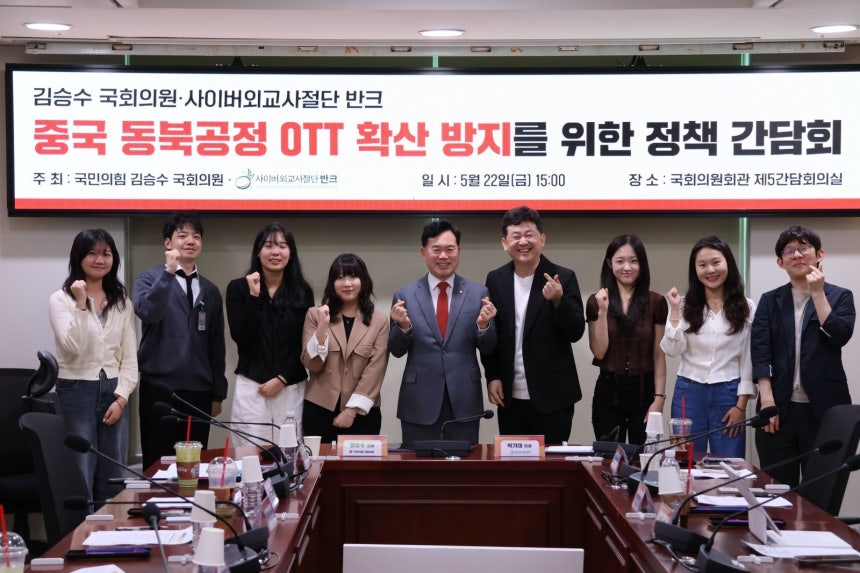
The Voluntary Agency Network of Korea (VANK) and the office of Rep. Kim Seung-soo held a policy forum at the National Assembly Members’ Office Building on May 22, 2026, to discuss the growing spread of historical and cultural distortions through global OTT platforms and response strategies for protecting cultural sovereignty in the era of generative AI.
The forum was organized amid growing concerns over the influence of global streaming and AI platforms on international perceptions of Korean history and culture, following the recent controversy surrounding historical inaccuracies in the drama Perfect Crown. Participants discussed the need to establish institutional response systems to address such issues.
During the event, VANK researchers delivered presentations on strategies for safeguarding Korea’s cultural sovereignty in the OTT and AI era, real-world correction campaigns, and analysis results related to generative AI systems.
Kwon So-young, a researcher at VANK, presented a proposal titled “Public-Private Cooperation Measures for Strengthening Cultural Sovereignty in K-Content.” She analyzed the growing influence of global OTT platforms in shaping international perceptions of Korea in an era with more than 200 million Hallyu fans worldwide, emphasizing the urgent need for systematic policy responses.
Kwon stated, “As seen in the case of Perfect Crown, historical inaccuracies in OTT content are not merely production issues but matters that directly affect national image and identity.” She added that global streaming platforms currently face structural limitations due to massive content distribution systems and automated translation-based operations, increasing the risk of repeated distortions related to Korean history and culture.
She proposed several policy measures, including the establishment of historical and cultural expression guidelines for broadcasting and OTT content; a formalized reporting and review system for Korea-related inaccuracies; cooperation frameworks linking the Ministry of Culture, Sports and Tourism, the Ministry of Foreign Affairs, the Ministry of Education, and private experts; the introduction of historical consultation checklists during production and translation stages; and subtitle and dubbing localization review standards.
Koo Seung-hyun, another VANK researcher, presented a case study titled “Responding to Historical Distortions in the Global OTT Era: Focusing on Perfect Crown.”
Koo explained how VANK analyzed the use of the term “Cheonse” and the depiction of the “guryu myeollyugwan” crown in the drama, publicized the issue through social media, and formally requested corrections from Disney+, MBC, and Wavve.
“This case demonstrated that citizens’ voices can bring about tangible changes on global platforms,” Koo said, adding that VANK’s continued monitoring confirmed that Korean-language audio and subtitles, as well as portions of Japanese subtitles on Disney+, had been revised.
However, she noted differences in the platforms’ responses. “Wavve responded relatively quickly with official explanations and corrective measures, whereas Disney+ implemented partial revisions without providing any formal notice or explanation regarding its review process,” she said. “VANK itself had to repeatedly monitor the platform directly to confirm whether corrections had actually been made.”
Lee Sei-yeon, a VANK researcher, presented an evaluation index analyzing narrative accuracy in generative AI systems and examined issues surrounding distortions of Korean history and culture in the AI era.
Lee revealed findings from an analysis of seven major global generative AI platforms — ChatGPT, Gemini, Claude, Perplexity, Grok, Copilot, and DeepSeek — evaluating the accuracy of historical and cultural descriptions related to 10 Korean topics, including Dokdo, the East Sea, kimchi, hanbok, Hangeul, Gyeongbokgung Palace, and Seokguram Grotto.
The analysis found that some AI platforms linked bibimbap to the Chinese Confucian concept of “harmony without uniformity” and described Gyeongbokgung Palace using terms such as a “vassal-state format” or the “Little China concept,” raising concerns over China-centered historical interpretations. The study also uncovered numerous inconsistencies in official English terminology for hanbok and gat, as well as errors in basic historical information.
Ma Ji-yoon, a youth researcher, pointed out that content containing discriminatory portrayals of specific races or religions would likely trigger immediate international criticism and become a major global issue. “However, when Korean history and culture are distorted or inaccurately portrayed, international awareness and global pressure for corrections remain relatively weak,” she said.
Youth researcher Choi Ju-eun noted that the Korea Heritage Service currently requires prior approval and applies guidelines when dramas and films are shot at designated national heritage sites. “Likewise, in the global OTT era, there is a need for public guidelines and consultation systems capable of reviewing and preventing possible historical distortions during the production and distribution process of historical and cultural content,” she said.
Another youth researcher, Lee Hyun-woo, emphasized the need to expand policy support in ways that strengthen both the quality and historical authenticity of content. He said the Korea Creative Content Agency, as a key institution supporting content production, should establish a permanent communication system enabling young people to identify, report, review, and quickly address historical and cultural inaccuracies in Korean content.
Kwon Soon-gyu, a researcher at VANK, stressed that the controversy surrounding Perfect Crown had not remained solely a domestic issue.
“Major overseas media outlets, including the UK newspaper The Independent, also highlighted the controversy while drawing attention to the sensitivity of Korea’s historical and cultural sovereignty,” he said.
“This demonstrates that in the global OTT era, the way Korean history and culture are portrayed in content — and the accuracy of those portrayals — has become an international issue directly affecting Korea’s national image and cultural credibility,” he added.
Closing the forum, VANK Director Park Gi-tae emphasized the need to establish a regular communication and cooperation channel involving government ministries and affiliated agencies, global OTT platforms, the content industry, and VANK at the National Assembly level.
“We need to hold policy discussions and consultative meetings at least once or twice a year to continuously discuss joint response measures and prevention systems regarding historical and cultural distortions,” Park said.
He also stressed that government agencies with expertise in technology and media policy, including the Ministry of Science and ICT and the Korea Communications Commission, should play leading roles in building more systematic responses to the spread of historical and cultural distortions in the AI and OTT era.
Park further noted that controversies such as the Perfect Crown case should not end merely with criticism, but instead serve as an opportunity to strengthen both historical verification and creative expression in future K-content productions.
“It is important to create an environment where verification systems, advisory mechanisms, and policy support are linked from the earliest stages of production so that future K-content introduced to the global market can balance historical accuracy with cultural identity,” he said.
Rep. Kim Seung-soo also emphasized the need to systematically analyze recurring patterns of historical and cultural inaccuracies, as well as cultural similarities frequently confused among Korea, China, and Japan, in order to establish preventive review systems based on reliable data.
“In particular, the role and responsibility of historical consultants in the content production process must be further strengthened,” Kim said.
He added that government ministries and affiliated agencies should examine whether dedicated response systems are in place to address issues of historical distortion swiftly, stressing that the nature of such controversies requires not isolated institutional responses but an organic inter-ministerial cooperation system.
Kim further warned that repeated distortions of history and culture could fuel emotional conflicts between countries and contribute to the spread of anti-Korean and anti-Chinese sentiment, underscoring the need for more proactive and systematic responses.
VANK said it will continue monitoring cases of distorted Korean history and culture on global OTT and generative AI platforms while advancing policy proposals aimed at building public-private governance systems involving the government, National Assembly, and civil society.