
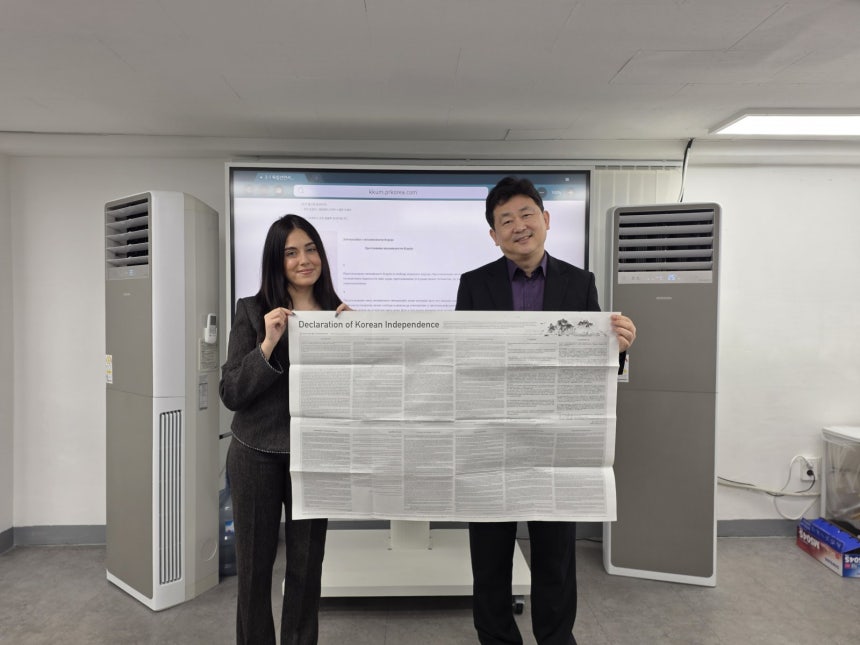
VANK has released Serbian-language and Serbian Latin-script versions of the Proclamation of Korean Independence ahead of the upcoming March 1 Independence Movement Day.
The translation was carried out with the participation of Milica Gavrilović, a Serbian youth researcher working with VANK this winter. Milica is a linguistics student at Alfa BK University in Serbia and has a strong interest in linguistics and translation.
While serving as a youth researcher at VANK, she has developed a growing interest in Korean history and culture and has produced a range of related social media content. In particular, she has shown strong interest in Jikji, the world’s oldest surviving book printed with movable metal type and listed as a UNESCO Memory of the World. She said she first learned about Jikji through VANK and wanted to make its existence known in her home country.
A short-form promotional video on Jikji produced by Milica drew more than 8,000 views and around 40 comments, drawing attention from social media users around the world.
Based on her translation skills and content-production experience, Milica took part in translating the Proclamation of Korean Independence into Serbian and Serbian Latin script and in producing a video sharing her reflections on the work. By providing both versions, she aimed to help not only Serbian readers but also audiences across the wider Balkan region easily understand the declaration. The translation was also reviewed by her university professor to ensure accuracy and professionalism.
During the translation process, Milica noted that Serbia, like Korea, has experienced painful historical periods and resistance. She said this shared historical perspective helped her better understand the background and significance of the March 1st Declaration. She sought to reflect that understanding faithfully in the translation so that the declaration’s historical meaning and spirit could be effectively conveyed.
With the addition of the Serbian and Serbian Latin versions, the foreign-language editions of the Proclamation of Korean Independence are now available in a total of 14 languages, including English, French, Spanish, Chinese, Japanese, Russian, Arabic, Mongolian, Vietnamese, Italian, Indonesian and Dutch.
A short-form video featuring Milica’s reflections on the value of the declaration and her experience during the translation process will be released on VANK’s official social media channels.
VANK director Park Gi-tae said that while global interest in Korean culture has grown with the spread of the Korean Wave, Korea’s history and independence activists are still not widely known. He emphasized that the spirit of peace and dignity contained in the Proclamation of Korean Independence, written in 1919, can also be seen as a form of the “Korean Wave” of its time.
He added that, ahead of March 1 Independence Movement Day, VANK worked with a Serbian youth researcher to produce the Serbian translation in order to once again share the values and authenticity of the declaration with the world. He said the group will continue translating and distributing the March 1st Declaration in languages around the world and will work to build global peace in solidarity with 200 million Korean Wave fans worldwide.
Milica said the March 1st Declaration presents independence not simply as a political demand but as a moral right and defines freedom as a value already achieved through history and human dignity. She said she was deeply impressed that, despite the severe suffering Koreans experienced at the time, the declaration was written in a tone of dignity and restraint rather than anger, revenge or hatred.
“As a linguistics student at Alfa BK University in Serbia, translating this declaration was an emotional experience,” she said. “I felt that I was not just translating words but conveying the meaning, history and human courage contained in the March 1st Declaration from one language to another.”
Lee Jeong-woo, another youth researcher who took part in the project, said that explaining the declaration to Milica gave her an opportunity to reflect again on the spirit of resistance of people who sought to raise a voice for peace despite invasion and repression. She added that, like the figures highlighted in VANK’s “Eulsa Heroes Campaign,” there were many individuals who consistently delivered messages of resistance against Japanese imperial aggression.
She said the fact that the Proclamation of Korean Independence, written during the Japanese colonial period, carries a message of peace and respect rather than hatred and revenge is a value the world should remember. He added that it was meaningful to share the declaration’s significance with Milica and with social media users in Korea and abroad.
VANK also plans to involve Milica of Serbia and Nana, a youth researcher from Indonesia, in a “Global Eulsa Heroes Awareness Campaign,” an expanded international version of last year’s Eulsa Heroes campaign. The two researchers, who share the campaign’s goal of highlighting figures who resisted imperialism and invasion, plan to produce short-form videos introducing traditions of resistance in their respective countries and sharing them with global audiences.