
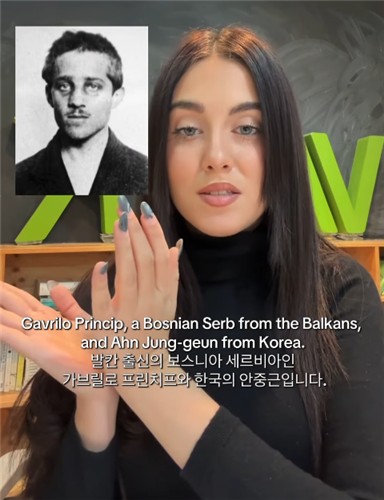
The Voluntary Agency Network of Korea (VANK) has released a new video as part of its campaign to change global perceptions of “Eulsa heroes,” featuring a young Serbian researcher introducing a resistance figure from her own country.
The video was filmed and produced by Milica Gavrilović, a Serbian university student currently active as a youth researcher with VANK this winter. Gavrilović, who studies linguistics at Alfa BK University in Serbia, has broadened her interest in Korean history and culture through her work with the organization, producing a range of social media content.
She previously gained attention online with videos supporting VANK’s “Correcting Misconceptions About Africa” campaign. Her content highlighted textbook revisions achieved through VANK’s efforts and pointed out the limitations of the Mercator projection. One such video recorded more than 736,000 views and 831 likes, drawing significant international interest.
Gavrilović also produced three promotional videos about Korea under the title “Have You Ever Heard of This Country?” The clips, posted on VANK’s official Instagram account (@vank_prkorea), interpreted South Korea’s economic growth after the Korean War and the “Miracle on the Han River” from a foreigner’s perspective. Each video drew around 700,000 views and about 500 likes.
In her latest project, Gavrilović turned to her own country’s history of resistance. As part of VANK’s global campaign, she introduced Gavrilo Princip (1894–1918) as a figure representing Serbia’s spirit of resistance.
Serbia gained independence from the Ottoman Empire in 1878 but later faced mounting tensions with Austria-Hungary, which sought to expand its influence in the Balkans. In particular, Austria-Hungary’s annexation of Bosnia and Herzegovina in 1908 sparked strong opposition among Serbs and Bosnian Serbs who supported Slavic self-determination.
In 1914, Princip, a member of the nationalist group Young Bosnia, assassinated Archduke Franz Ferdinand and his wife in Sarajevo. Austria-Hungary’s subsequent declaration of war on Serbia set off World War I.
Today, many historians acknowledge that the Sarajevo assassination served as the immediate trigger for the war, but note that deep-rooted rivalries and accumulated tensions among European powers had already made large-scale conflict structurally likely.
In the video, Gavrilović explains that World War I did not begin solely because of one individual’s actions, but unfolded in a Europe already burdened by escalating tensions. She says the Sarajevo incident can also be interpreted as the act of a young man responding to imperial rule based on the concerns of his time.
The video also introduces Korean independence activist Ahn Jung-geun, drawing a parallel between the two figures. Gavrilović explains that Ahn, like Princip, acted under imperial domination out of a strong sense of historical responsibility. She adds that Ahn is remembered not as someone driven by hostility toward a particular nation, but as a thinker who sought peace and coexistence in East Asia.
Park Gi-tae, head of VANK, said that working with foreign youth researchers this winter to share the stories of those who fought to reclaim freedom, respect and the right to self-determination in colonial societies helped build international empathy. He described the campaign as an effort to reflect on cases in which individuals raised their voices against imperial power structures and to consider how such histories should not be repeated.
Gavrilović emphasized that her video was not intended to glorify violence, but to shed light on how resistance can emerge when injustice reaches a point that can no longer be ignored. Looking back at such history, she said, not only allows for a more honest understanding of the past but also serves as a reminder of why efforts to stand against oppression and imperialism remain important today.
Lee Jeong-woo, the youth researcher who planned the campaign, said the project invites participants to rediscover and highlight figures around the world who resisted imperial rule, much like Korea’s own Eulsa heroes. He added that collaborating with a Serbian researcher to share Serbia’s resistance history made the initiative especially meaningful.
Meanwhile, ahead of the March 1 Independence Movement anniversary, VANK translated the March 1 Declaration of Independence into Serbian, including a version in the Serbian Latin alphabet, and released it online. Gavrilović completed the translation herself and also produced a video sharing her reflections on working with the historic document.