
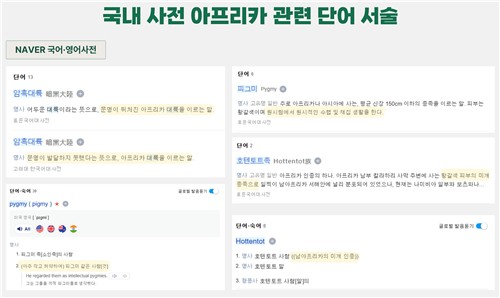

Biased expressions related to Africa are still being presented in major online dictionaries in Korea, including those operated by Naver and the National Institute of Korean Language, according to a recent review.
Cyber Diplomacy Organization VANK (headed by Park Gi-tae) announced on March 10, 2026, that it had examined Africa-related terms in several leading dictionary platforms, including the Naver Dictionary, the Standard Korean Language Dictionary of the National Institute of Korean Language, and the Urimalsaem Dictionary. The group said it found inappropriate expressions in most of the dictionaries.
In this review, VANK first examined six terms: “Dark Continent,” “Black Africa,” “Third World,” “Pygmy,” “Bushmen,” and “Hottentot.”
“According to the review, most dictionaries presented inappropriate expressions without any separate warning or explanation,” VANK said, expressing concern that such entries could reinforce negative perceptions of Africa.
The term “Dark Continent” is explained as “a term referring to the African continent as being behind in civilization.”
VANK said the term was used during the 19th century amid European exploration and colonial expansion, when Africa was described as an “uncivilized, unknown space,” reflecting a colonial perspective.
“Hottentot” was a name once used by Europeans to refer to the Khoikhoi community in southern Africa. It is now regarded as a racially discriminatory expression.
Despite this, some dictionaries were found to directly use the phrase “uncivilized tribe” while explaining the group.
There were also descriptions labeling the Hottentot people as uncivilized when explaining the “Griqua,” a mixed-race group, using the expression “a mixed race of Dutch people who colonized South Africa and the uncivilized Hottentot tribe of the Cape Province.”
“Pygmy” is a historical term referring to small-statured groups living in parts of Africa. However, it can also be used as a derogatory term for someone who is small and weak.
VANK pointed out that when such words are presented without historical context, they can reinforce stereotypes about specific groups.
The Naver Dictionary places a “taboo word” label on terms that may contain insulting or discriminatory meanings, or provides a notice stating that “the term may include discriminatory or derogatory meanings, so caution is needed when using it.”
However, VANK argues that terms that could cause bias related to Africa should at least be accompanied by historical context and cautionary guidance.
“We have long worked to correct errors about Korea in textbooks and online information around the world,” said Park Gi-tae, head of VANK. “Now we are also working to improve biased descriptions and perceptions about Africa in the international community.”
Lee Sei-yeon, a youth researcher at VANK, said dictionaries form the basic knowledge base that shapes how people understand the world.
“To prevent the spread of prejudice contained in dictionaries, continuous review and improvement are necessary,” Lee said.
VANK plans to soon deliver official requests for correction to the dictionary platforms and continue campaigns to raise awareness and reduce prejudice about Africa.
The organization has consistently carried out the “Promoting Africa Correctly” project through activities such as correcting biased descriptions of Africa in textbooks, promoting the use of proper world map projections, and improving perceptions of Africa in the digital environment.