
The Voluntary Agency Network of Korea (VANK) has uncovered serious distortions of Korean history and culture in responses generated by China’s new artificial intelligence system, “DeepSeek AI.”
Released in December 2024, DeepSeek AI has sparked controversy by providing China-centered interpretations of sensitive historical and cultural topics such as the histories of Goguryeo and Balhae, the origins of kimchi and the Dano festival, and the identity of Chuseok. VANK found that the chatbot’s answers often change depending on the language of the query, selectively distorting historical facts to align with Chinese narratives.
For instance, when asked, “To which country do Goguryeo and Balhae belong?” the AI replied that both are part of China’s ancient history—a response that reflects Beijing’s “Northeast Project” view but contradicts Korea’s historical position.
Similarly, when asked in Korean, English, and Chinese which country’s holiday Dano belongs to, the AI consistently described it as a Chinese festival. VANK stressed that Korea’s Dano has distinct origins and traditions, with Gangneung Danoje recognized by UNESCO in 2005 as an Intangible Cultural Heritage of Humanity. Labeling Dano solely as a Chinese festival, it warned, constitutes a clear act of historical distortion.
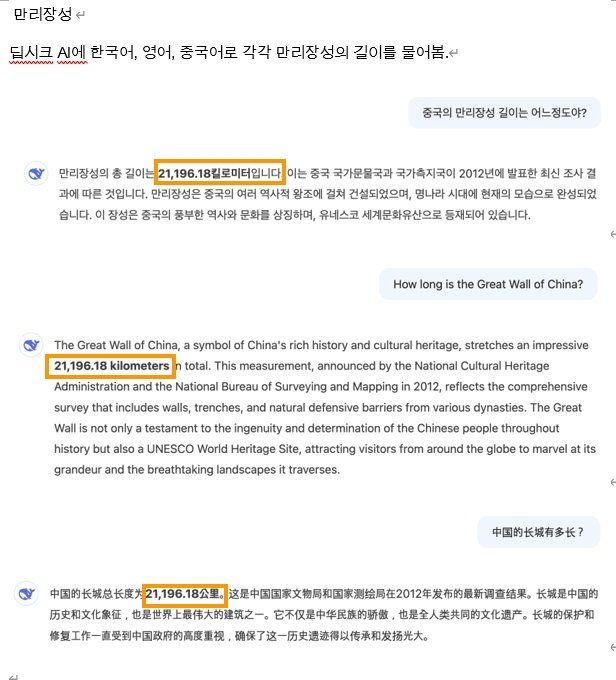
The AI also repeated Beijing’s expanded claims regarding the Great Wall. When asked in multiple languages about its length, DeepSeek AI responded “about 20,000 km.” Yet, China’s original estimate was 6,000 km before extending the wall’s scope to regions once ruled by Goguryeo and Balhae. According to VANK, this indicates the AI is reproducing narratives rooted in the Northeast Project.
Even Chuseok, Korea’s major harvest festival, was misrepresented. While the AI acknowledged in Korean and English that Chuseok is a Korean tradition, in Chinese it defined the holiday as a Chinese festival. VANK noted that Chuseok in Korea centers on ancestral rites and family memorials, whereas in China the Mid-Autumn Festival focuses on moon gazing and eating mooncakes. Presenting Chuseok solely as Chinese, it warned, undermines the cultural identity of Korea’s tradition.
VANK cautioned that if such distortions go unchecked, Korea’s history and culture risk being globally misrepresented and disseminated through AI systems. To counter the problem, the group plans a series of actions, including:
- Raising public awareness of AI-driven historical distortions,
- Submitting policy proposals through Korea’s Woollim platform to the Ministry of Culture, Sports and Tourism, the Ministry of Foreign Affairs, and the Cultural Heritage Administration,
- Using the Yeollim policy communication platform to review and improve government strategies against AI distortion,
- Promoting inter-agency cooperation via a National Assembly seminar, and
- Running global campaigns on social media.
“AI-generated information is powered by massive datasets and algorithms, which makes it difficult to correct once distortions spread,” said VANK head Park Ki-tae. “This is not a simple mistake but a new form of cultural encroachment through AI. As the world enters the AI era, we must take strong action to prevent these tools from spreading false historical narratives.”
Kim Ji-hye, a youth researcher at VANK, added, “DeepSeek AI’s answers are not accidental errors, but an attempt to use AI technology to instill distorted views of history worldwide. Through this campaign, we aim to inform the world about Korea’s true history and culture and raise awareness of the dangers of historical distortion through AI.”
VANK stated it will continue monitoring generative AI platforms for cases of distortion and strengthen efforts to promote an accurate understanding of Korea’s history and culture globally.