
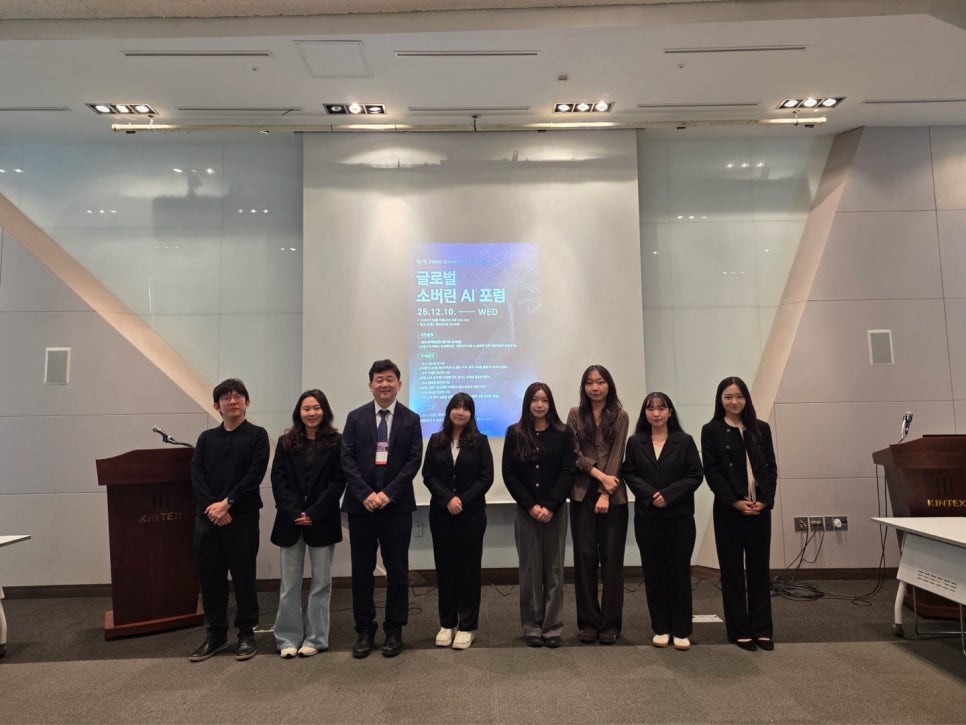
Cyber Diplomacy Organization VANK, led by Director Park Gi-tae, officially launched the Global Sovereign AI Forum and held a seminar titled “South Korea’s Global Contribution Projects for AI Sovereignty and National Strategy” at the Gyeonggi International Forum on Dec. 10, 2025, at KINTEX in Ilsan, Gyeonggi Province.
The event took place in Room 307A of Exhibition Hall 2 and featured a keynote address, thematic presentations, and a panel discussion.
For more than 20 years, VANK has worked to correct errors about Korea found in textbooks, encyclopedias, and online platforms worldwide, practicing public diplomacy to protect national culture and identity in the digital age.
VANK is now expanding this mission to address the challenges of the AI era, presenting a vision of South Korea as an “AI Contributor to Humanity.” The organization warns that if AI systems dominated by major powers are trained on biased data, Korea’s language, culture, and history could be distorted and spread globally, leading to a form of invisible “digital colonization.” VANK argues that building sovereign AI systems that reflect a nation’s own values and identity is therefore essential.
As a starting point for global contribution, VANK is focusing on Africa. The organization is working to correct distortions of African history and culture found in primary and secondary school textbooks and encyclopedias, while promoting a fair data ecosystem based on diversity and inclusion so that AI does not learn only from the perspectives of a single cultural sphere. VANK says these efforts offer a practical response to a new form of information colonialism in the digital age and form the basis of Korea’s international contribution strategy in the era of sovereign AI.
In his keynote address, Park spoke on the theme “Completing Ahn Jung-geun’s Unfinished Vision of Peace in East Asia through Korea’s Sovereign AI Global Contribution Project,” stressing that in the AI era, sovereignty no longer comes from borders but from data.
He warned of the risks of information distortion and deepening digital colonialism driven by algorithms centered on powerful countries, and proposed an “AI Peace Theory” that extends Ahn Jung-geun’s vision of peace in East Asia into the 21st-century AI era.
“South Korea, which has overcome the pain of colonization and grown into a partner nation, has a unique experience,” Park said. “We must stand in solidarity with countries in Africa, ASEAN, Latin America, and India that suffer from data dependency, and build a new international peace community based on sovereign AI.”
The thematic sessions that followed addressed the problem of historical and cultural distortion on AI platforms and outlined strategies to protect Korea’s national identity.
Kwon So-young, a researcher at VANK, presented on “The Current State, Causes, and Pathways of Distortion of Korean History and Culture in AI,” analyzing cases of Korea-related inaccuracies found in global AI systems.
She explained that the root causes include the overwhelming dominance of English-language sources, lingering narratives from Japanese imperial history, information distortions tied to the “One China” principle, and low accessibility of official Korean materials. These structural imbalances, she said, are directly reflected in AI training data and undermine Korea’s information sovereignty.
Lee Sei-yeon, a youth researcher, spoke on “A New Horizon for Sovereign AI: The Gyeonggi Province Model Led by Local Governments and Its Global Expansion.” She noted that generative AI has become an “invisible administrative partner,” explaining not only national but also local government policies, culture, and daily life. However, verification of AI responses on local government issues revealed frequent cases in which nonexistent policies or incorrect administrative procedures were presented as fact.
She described this as “an infringement on data sovereignty,” warning that distorted regional information could eventually become a national burden. As countermeasures, she proposed a local government–centered data correction system and a resident-participation “regional data verification ecosystem.” “Residents are the first line of oversight and modern-day data defenders who know local information best,” she said.
Kim Ye-rae, another youth researcher, presented on “APEC Gyeongju: Distortions of Historical, Cultural, and International Event Information and Response Strategies,” analyzing how global AI platforms perceive Gyeongju, the host city of the 2025 APEC summit.
She reported that even key information most likely to be encountered first by international participants—such as major heritage sites including Cheomseongdae Observatory and Seokguram Grotto, visitor information, and the APEC schedule—was repeatedly distorted or incorrectly presented.
Kim stressed that such AI errors cannot be resolved through individual correction requests alone, calling for structural responses at the national level. These include standardizing public cultural heritage data, building open AI data systems, establishing authoritative verification datasets, and linking international cultural diplomacy with AI governance.
Baek Si-eun, a youth researcher, spoke on “Korea’s Sovereign AI and Global Contribution: Lessons from Bias and Distortion in AI Narratives on Africa,” arguing that the core value of Korean-style sovereign AI should lie in reducing global inequalities in perception.
She said Korea is uniquely positioned to lead an “AI Contributor to Humanity” model as a non-Western country with both technological capacity and experience overcoming historical marginalization. Africa, she added, is the region most affected by AI bias and should therefore be the first beneficiary of Korean sovereign AI, through joint dataset development and the provision of “sovereign AI packages” based on lightweight Korean AI models.
Baek emphasized that sovereign AI is fully realized only when it goes beyond protecting domestic data and expands into a global AI ecosystem in which countries and citizens worldwide are respected.
During the panel discussion, participants shared a common concern that AI training structures dominated by major powers can distort the history, culture, and values of partner countries. They discussed concrete strategies to correct such distortions and ensure accurate global dissemination.
Koo Seung-hyun proposed establishing an “AI model verification system” and jointly developing AI education content. She stressed the need for an “AI error monitoring network” that works with Global South countries to continuously identify and correct inaccuracies, expanding into a citizen-participation AI oversight system involving international NGOs, youth networks, and academia.
She also emphasized the importance of co-developing AI training and educational content that reflects each country’s unique history and culture, and releasing it as a public asset through international education platforms or public AI data hubs.
Lee Jeong-woo proposed regularizing the Global AI Sovereignty Solidarity Forum, suggesting that AI-advanced countries should cooperate with those lacking sovereign AI capacity. Through regular forums and quarterly progress reports, countries could share cases of data decolonization and build a sustainable international cooperation model.
She also stressed the need for a trusted international standard system for datasets that can be relied upon by all AI companies and countries.
Kwon Soon-gyu called for the creation of “national data repositories” that organize each country’s unique historical, linguistic, and cultural resources in AI-readable formats, as well as the development of an “AI Coexistence Index” to assess how fairly AI systems represent global cultures.
Starting with this forum, VANK plans to incorporate sovereign AI topics into training programs for government officials and local administrators, as well as AI education programs for elementary, middle, and high school teachers, to spread these concepts throughout the education system.
Through these efforts, VANK aims to help public officials and educators understand AI not simply as a technology, but as a tool for expressing national identity and shared human responsibility, laying the groundwork for embedding the vision of “South Korea as an AI Contributor to Humanity” across society.
In closing, Park said that distrust and prejudice lie at the root of many global conflicts, and that imbalances and bias in AI-generated information could worsen these problems.
“We must go beyond simply learning how to use AI and also build the ability to identify and correct errors in the content AI produces,” he said. “Just as Ahn Jung-geun envisioned peace in East Asia, 21st-century Korea should complete a global sovereign AI contribution project based on national sovereignty through worldwide cooperation in AI technology and culture.”
VANK also announced plans to distribute the forum’s materials worldwide through its official website, sharing Ahn Jung-geun’s vision and spirit embedded in the concept of global sovereign AI with a global audience.
See the forum material down below.