
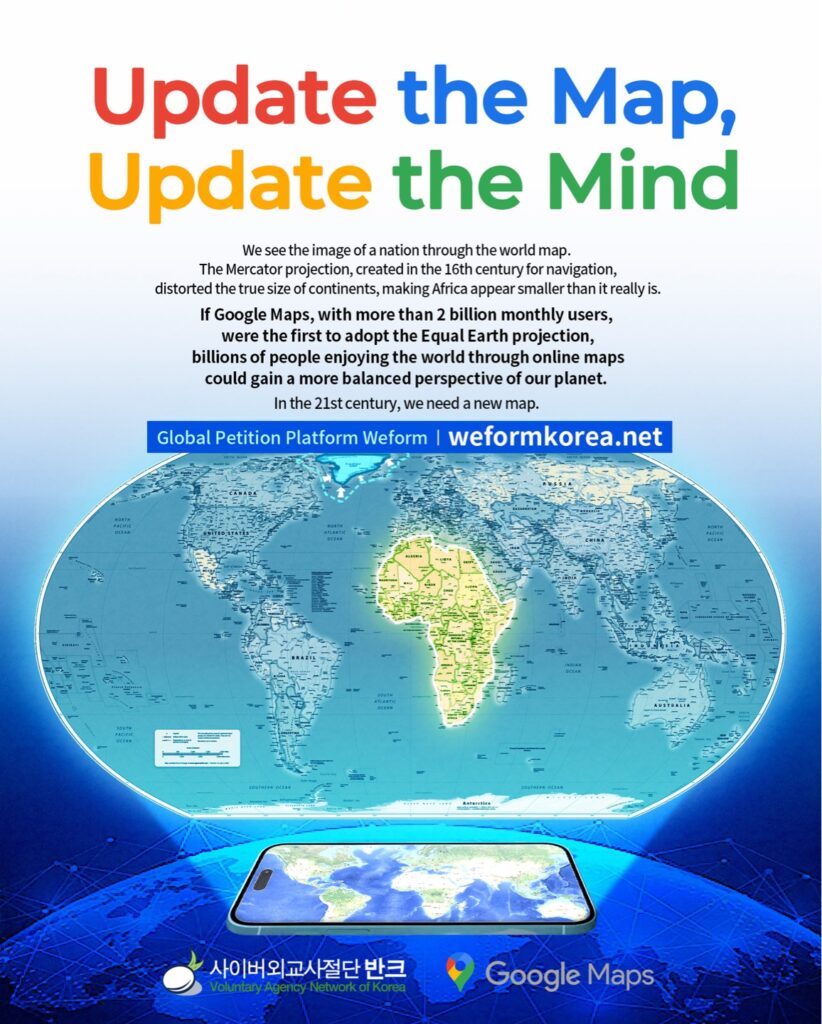
The Voluntary Agency Network of Korea (VANK) has launched a global campaign urging the use of more balanced world maps on online mapping platforms such as Google Maps, following its previous initiatives with domestic government agencies and international organizations. VANK is the first private organization in Korea to join the “Correct the Map” campaign, which has been endorsed by the African Union (AU). With over 200 million K-pop fans around the world joining the effort alongside young Koreans, the campaign is expected to have a significant global impact.
The “Correct the Map” campaign began with concerns that the Mercator projection—created in the 16th century for navigation—depicts continents in the southern hemisphere, such as Africa and South America, as much smaller than they actually are, reinforcing global inequality and bias. Developed by Dutch cartographer Gerardus Mercator, the cylindrical projection enlarges areas farther from the equator while shrinking those near it, resulting in major distortions of size and proportion.
For example, Greenland, which is only one-fourteenth the size of Africa, appears almost the same size as the African continent on Mercator maps. While the projection remains useful for navigation and educational purposes, critics have long argued that its distortions lead to the underestimation of Africa’s true geographic scale and importance, influencing international perceptions and even global power dynamics.
Building on these concerns, VANK examined how major online platforms such as Google Maps and Apple Maps use world map projections. The review found that Google Maps still uses the Mercator projection in both its mobile application and 2D desktop version.
Google Maps introduced its “3D Globe Mode” in 2018 to display a more accurate representation of the Earth and minimize subtle distortions. Apple Maps, too, allows users to zoom out to view a round, globe-shaped Earth. However, Google Maps has yet to apply the 3D Globe feature to its mobile app and 2D desktop maps, and unlike Apple, it does not automatically switch from flat to globe mode when zooming out.
Given that Google Maps has over two billion monthly users worldwide, continued use of the Mercator projection on its 2D maps raises concerns about unconsciously perpetuating geographic bias among digital generations. As one of the most widely used platforms among multinational corporations and international organizations, advocates argue that immediate corrective action is necessary.
Moreover, since Google’s 2D maps are frequently used in classrooms, news articles, and travel guides around the world, the public’s first impression of the world often comes from distorted map images, even if more accurate 3D options exist.
Baek Si-eun, a youth researcher leading the campaign at VANK, said, “Google Maps is one of the most influential platforms in shaping how we see the world. As global voices calling for fair and accurate world maps grow louder, Google should go a step further and apply balanced projections such as the Equal Earth projection to its 2D maps, just as it has already done with its 3D Globe.”
VANK Director Park Ki-tae added, “Google and Google Maps have become platforms that shape how humanity perceives the world. As such, they bear the responsibility to offer a fair and balanced worldview. We hope Google will take the next step beyond the 3D Globe and improve its 2D world maps.” He also emphasized that such efforts could mark the beginning of a new era in which all countries, not just Africa, are equally respected, calling on organizations and individuals around the world to participate in the campaign to correct map distortions.
VANK has proposed several measures for Google Maps: adopting a projection such as Equal Earth for 2D maps to reduce distortion, adding warning labels to existing Mercator maps, and producing educational materials for users. The organization will also create and distribute bilingual digital posters in Korean and English to encourage global users to sign a petition for Google Maps’ improvement, while expanding international collaboration through its global policy platform, “Weform.”