
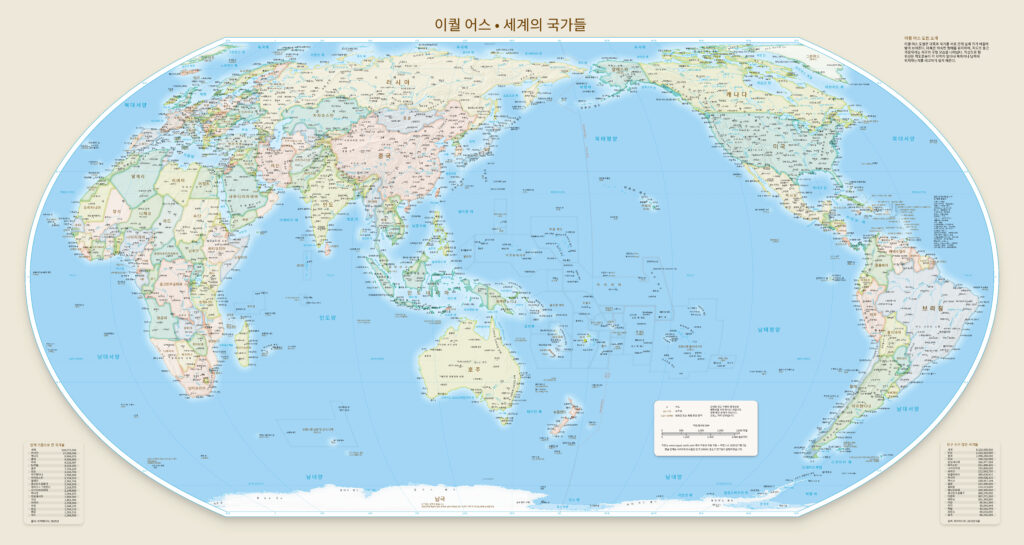
VANK said Sept. 14, 2026, that it has launched a campaign to digitally distribute Equal Earth world maps to 10,000 elementary, middle and high schools across Korea after the United Nations recommended wider use of the Equal Earth projection.
VANK has launched a dedicated website for the campaign, equalearth.one, where anyone can download the maps free of charge in a range of sizes and formats, including small, medium and large versions, high-resolution original files and print-ready PDFs, for use in education, promotional materials and other settings.
The website also provides guides for schools and institutions, classroom activity sheets, and teacher materials, including answer sheets and instructions, to help schools use the maps in classroom lessons. Information on the relevant U.N. General Assembly resolution is also available on the site.
On Sept. 4, 2026, the UN General Assembly adopted a resolution recommending that governments, educational institutions, international organizations and technology companies adopt and use world maps using the Equal Earth projection. The projection more accurately represents the relative size of continents while keeping overall shape distortion relatively low.
VANK has produced both Korean- and English-language versions for the campaign. The English-language map labels the sea solely as “East Sea” and the island as “Dokdo.”
The campaign builds on VANK’s longstanding efforts to address distortions in world maps and correct inaccurate information in educational materials. The organization has particularly highlighted the limitations of the Mercator projection, which makes areas at higher latitudes appear significantly larger than they are in reality.
Focusing particularly on the inaccurate representation of the size of continents such as Africa, VANK produced its own Korean-language Equal Earth world map. The map was subsequently officially added to the Equal Earth website.
VANK plans to track the number of downloads and shares through the campaign website as it works toward its goal of digitally distributing the maps to 10,000 elementary, middle and high schools in Korea. It plans to expand the campaign to schools and educational institutions overseas after establishing distribution in Korea.
Hwang In-seon, a VANK youth researcher who planned the campaign, said she wanted to make Equal Earth maps easier to use in places where people regularly encounter world maps, such as classrooms, educational materials, websites and promotional content.
“I wanted to make Equal Earth maps easier to use in places where people regularly encounter world maps, such as classrooms, educational materials, websites and promotional content,” Hwang said. “I hope the Korean- and English-language maps will lead to more opportunities for them to be used in a wide range of settings both in South Korea and abroad.”
Park Gi-tae, head of VANK, said the organization had made the maps available in various sizes and formats so that anyone could use them immediately for their specific needs.
“VANK produced and made Equal Earth maps available in various sizes so that anyone can use them immediately for their specific needs,” Park said. “The next step is to expand their actual distribution and use.”
Park also emphasized that the English-language map produced by VANK labels the sea solely as “East Sea” and the island as “Dokdo.”
“As the digital distribution of Equal Earth world maps expands, we hope that accurate information about the East Sea and Dokdo will also reach people around the world,” Park said.
VANK said it will continue expanding the digital distribution of Equal Earth world maps, first to schools in Korea and eventually to elementary, middle and high schools around the world.