
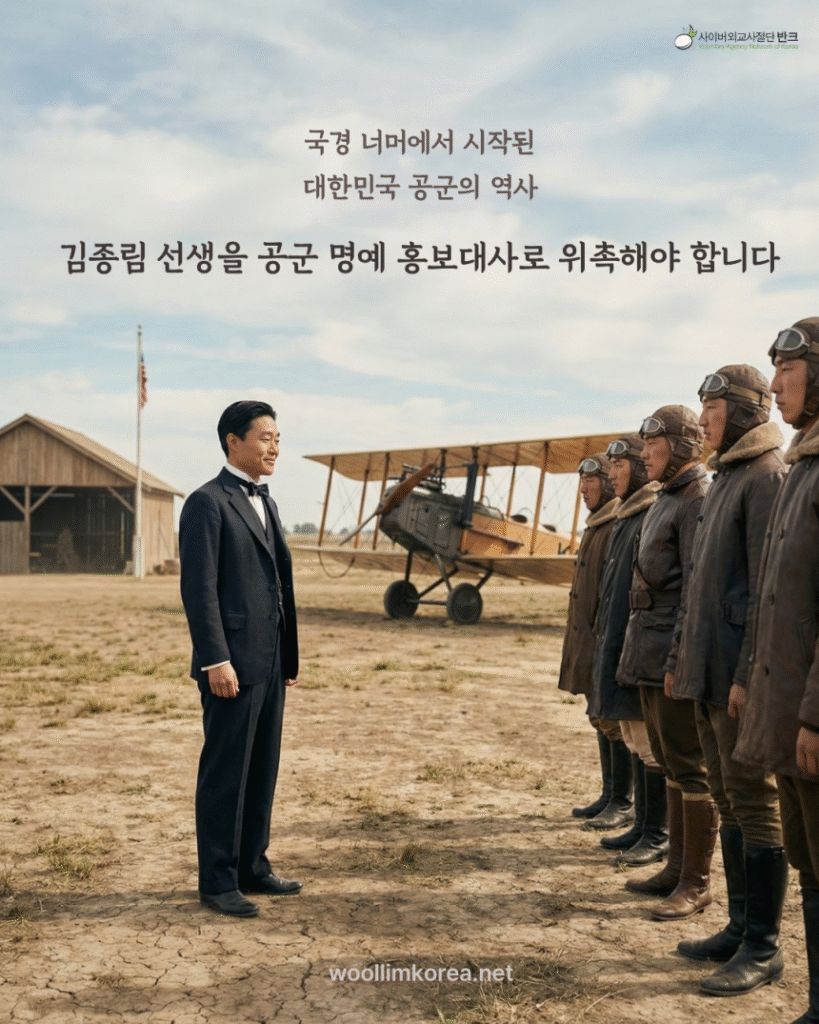
The Voluntary Agency Network of Korea (VANK), led by Park Gi-tae, said on February 18, 2026, that it is launching a campaign urging the Republic of Korea Air Force to appoint independence activist Kim Jong-rim (1886–1973) as an honorary ambassador.
VANK argues that Kim laid the human and ideological foundations of the Republic of Korea Air Force when he established a training school for Korean pilots in 1920 in Willows, California. The group says honoring him would help complete the Air Force’s historical identity and carry on the spirit of the aviation independence movement.
Although the Republic of Korea Air Force was officially founded on Oct. 1, 1949, VANK maintains that its roots go back to July 5, 1920, when the Korean Aviation School was established in Willows during Japan’s colonial rule of Korea. The school was created as part of the Provisional Government of the Republic of Korea’s preparations for an independence war, with the clear aim of training pilots for that struggle.
The Air Force has already recognized the school as its origin. In 2019, then-President Moon Jae-in referred to it as the beginning of the Korean Air Force in a speech marking Armed Forces Day. In July 2020, the National Aviation Museum of Korea opened to mark the school’s 100th anniversary, and related exhibits are also held at the Air Force Academy Museum. In August 2025, descendants of those involved in founding the school were officially invited by the Ministry of Defense and the Air Force to attend events marking the 80th anniversary of Korea’s liberation.
Despite such recognition of the school, VANK says the man who made it possible has received far less attention.
According to the group, Kim provided 40 acres of land, purchased three aircraft and paid for the construction of a runway, gasoline tanks and tents—covering all major facilities needed to build and operate the airfield. He also spent most of the school’s monthly operating costs, about $3,000, from his own personal funds.
VANK describes his role as going far beyond simple financial backing, saying he built the physical foundation for training aviation personnel for independence.
Kim’s support for the independence movement began even earlier. In 1919, he donated $3,400—then the largest single contribution—during a fundraising drive among Koreans in the United States to support the independence cause. The amount accounted for roughly 10 percent of the total funds raised by the Korean community in the Americas. In recognition of his contribution, he received an official letter of appreciation from the Provisional Government.
A set of regulations announced on July 25, 1920, for the pilot training school stated that its purpose was “to train aviators for the independence war of the motherland.” Although the school closed in April 1921 due to financial difficulties following severe flooding, before completing its planned two-year program, VANK says its historical significance in Korean aviation and military history remains clear.
Park said that while the Air Force has formally acknowledged the Willows Korean Aviation School as its starting point, “attention to Kim Jong-rim, who supported the school from beginning to end with his own resources, has been relatively lacking.”
He added that appointing Kim as an honorary ambassador would be more than a symbolic gesture. “It would formally declare, both at home and abroad, that the roots of the Republic of Korea Air Force lie not only in its 1949 founding, but in the 1920 independence movement in Willows,” he said.
Kwon So-young, a researcher at VANK, said the appointment could deepen the Air Force’s understanding of its own history and help active-duty service members take pride in the idea that “our Air Force began in preparations for the independence war in 1920.” She expressed hope that the move would not be a one-time event but would be reflected in education and training programs.
Kim Han-il, head of the San Francisco & Bay Area Korea Center, said the Willows Korean Aviation School showed that Korean immigrants in the United States went beyond forming a simple immigrant community and made real contributions to their homeland’s independence. Appointing Kim as an honorary ambassador, he added, would be a source of pride for the broader Korean American community.