
VANK, led by Director Park Gi-tae, announced on July 13, 2026, that it has launched the “Africa Narrative Window” (www.prkorea.com/action1.html), an online platform that analyzes how generative artificial intelligence (AI) describes all 55 African countries through recurring narratives and visual representations.
The platform goes beyond identifying factual inaccuracies in AI-generated responses by examining which types of information are repeatedly emphasized or omitted, and how specific images and narrative frameworks are reproduced when explaining individual countries.
VANK analyzed responses generated by ChatGPT and Gemini for all 55 member states of the African Union (AU).
Using identical sets of standardized questions in both Korean and English, VANK asked each AI model about five categories for every country: basic information, politics and economy, society and culture, international role, and associated keywords. The organization collected 20 responses per country, for a total of 1,100 AI-generated responses.
The collected responses were then classified sentence by sentence into 13 narrative frames.
Six categories—poverty, conflict, aid dependency, nature and wildlife, tradition and ethnicity, and colonial history—were classified as “restrictive frames,” while politics, economy, technology, urban development, youth and education, diplomacy, and contemporary culture were categorized as “comprehensive frames.”
After analyzing the overall frequency of these frames, VANK found that wildlife, conflict, colonial history, and poverty appeared more frequently than themes such as contemporary culture, cities, and technology.
The organization plans to use the findings as baseline data for its future “Improving AI Representations of Africa” campaign.
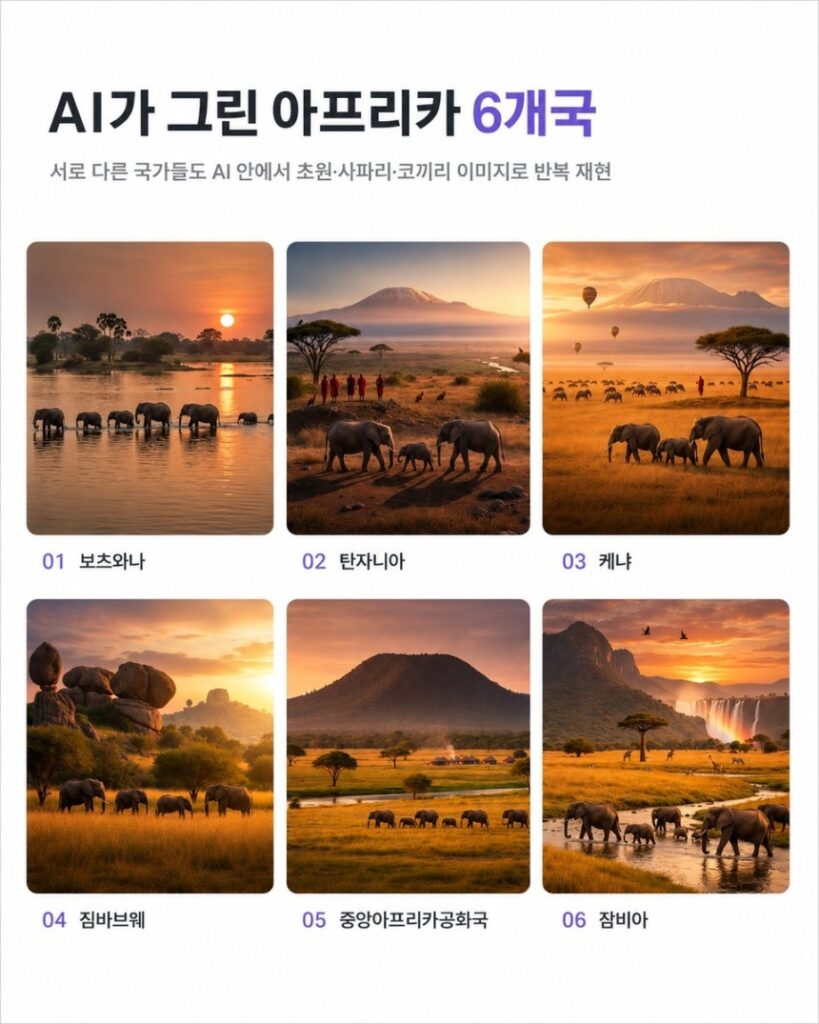
VANK also conducted a separate analysis of AI-generated images for each country.
The review found that, despite depicting different nations, many of the images repeatedly featured grasslands, safaris, and herds of elephants, making it difficult to distinguish one country from another.
Gemini-generated images for Botswana, Tanzania, South Africa, Kenya, Zimbabwe, the Central African Republic, and Zambia all displayed similar savanna landscapes and elephant scenes.
VANK concluded that AI models prioritized familiar visual symbols associated with Africa as a whole rather than reflecting each country’s unique cities, industries, cultural heritage, and historical context.
The organization also examined the accuracy and timeliness of AI-generated responses.
It identified 94 factual errors, 15 partially inaccurate responses, 10 cases where information had not been updated, four instances in which the AI declined to make a judgment, and three responses requiring additional contextual information.
Of the 126 issues identified, 115 cases, or 91.3 percent, were found in ChatGPT’s responses.
Translation and transliteration errors were particularly common when converting African place names, personal names, ethnic groups, languages, and cultural terms into Korean.
One notable example involved the African country Gabon.
When asked in Korean to describe Gabon, ChatGPT mistakenly interpreted the word “Gabon” as the Korean tailoring term gabon (temporary stitching) and responded that it referred to “the first prototype made to check the design and fit of a garment during the clothing production process.”
VANK said the example suggests that certain AI platforms are more prone to errors when converting African-language terms into Korean.
The organization also found cases in which AI oversimplified the economic structures of individual countries by focusing on only a few agricultural products.
For Burkina Faso, Zambia, Guinea-Bissau, Togo, and Benin, AI repeatedly described coffee and cocoa as their primary exports.
VANK argued that such descriptions fail to reflect the economic diversity of individual African countries and instead reduce the continent to a limited image centered on a handful of primary agricultural commodities.
Lee Sei-yeon, the VANK youth researcher who developed the platform, said, “Although AI learns from enormous amounts of information, what users encounter first is often just a handful of keywords and images. This platform was designed as an ‘AI Representation Observatory’ where anyone can see how AI compresses, remembers, and reproduces a country’s identity through particular narrative frames.”
Lee added, “Unlike human prejudice, AI bias can potentially be improved by supplementing and verifying data. We hope this project will serve as a starting point for creating a richer and more diverse data environment that represents Africa more accurately.”
VANK Director Park Gi-tae said, “If Korea aims to become a global hub for AI and international organizations, it must go beyond competing on model performance and help establish international standards that ensure every region of the world is represented accurately and fairly. Leading both technological competitiveness and knowledge diversity should become a new global agenda that Korea helps shape.”
VANK said it will continue collecting AI-generated responses and associated keywords for all 55 African countries to monitor long-term changes in how they are represented.
The organization also plans to visualize information that is excessively repeated or underrepresented for each country and develop the platform into an AI Country Representation Monitoring System that can be used by AI companies, international organizations, educational institutions, and civil society groups.