
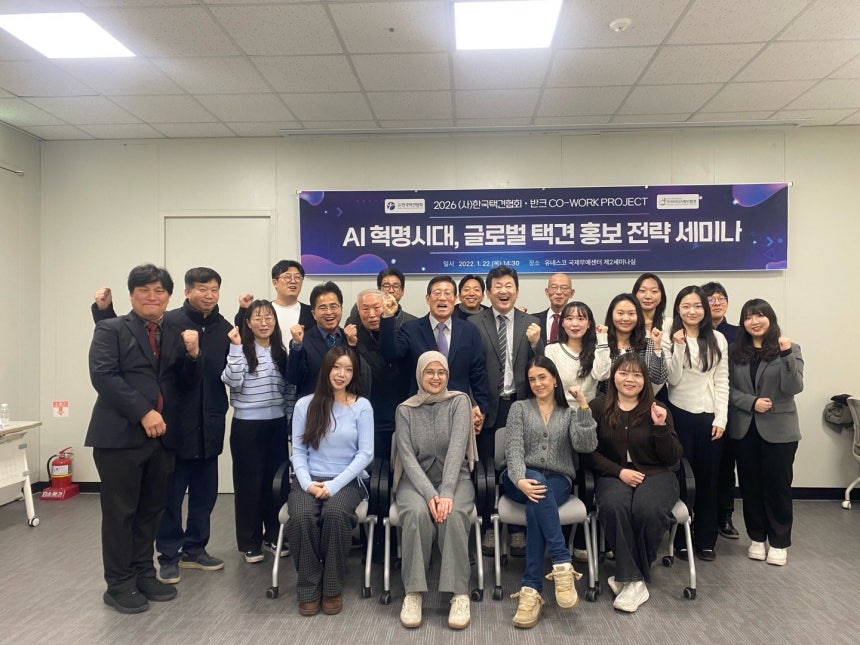
VANK held the Global Taekkyeon Promotion Strategy Seminar in the Age of the AI Revolution on January 22, 2026, at the International Centre of Martial Arts for Youth Development and Engagement under the auspices of UNESCO in Chungju, North Chungcheong Province, in partnership with the Korea Taekkyeon Association.
Since signing a memorandum of understanding (MOU) in 2023, VANK and the Korea Taekkyeon Association have continuously pursued joint projects aimed at popularizing and globalizing Taekkyeon. The two organizations are also carrying out a global Taekkyeon promotion initiative together with the Korea Culture Foundation, chaired by Kim Joon-il.
At the seminar, Yang Jae-sik, Director of Planning and Operations at the Korea Taekkyeon Association, shared key achievements from the past year and outlined plans for 2026, presenting the association’s overall strategy for expanding Taekkyeon worldwide.
Yang highlighted the establishment of overseas training infrastructure as a major achievement, noting that 53 local instructors were trained through 22 Taekkyeon training centers across Central and South America, while 12 instructors were trained at two centers in the Philippines. He also cited participation in the World Congress of Korean Martial Arts Instructors held in Spain and the United Kingdom as a key factor in strengthening the association’s global network.
Building on these results, the association plans to further strengthen the global foundation of Taekkyeon this year by continuing to host international Taekkyeon competitions and supporting the dispatch of instructors abroad. Domestically, it will expand the number of practitioners by operating designated Taekkyeon schools, promote Taekkyeon as a community sports activity through “visiting civic Taekkyeon classes,” and foster a culture in which citizens can enjoy Taekkyeon in their daily lives.
Kwon So-young, a researcher at VANK, then introduced the organization’s AI-related initiatives and delivered a presentation titled “The Current State, Causes, and Pathways of AI Distortion of Korean History and Culture.” Her presentation focused on analysis of distorted representations of Korean cultural heritage and history, the structural causes and pathways of information bias, and the spread of digital imperialism and the need for countermeasures.
Kwon presented cases of distortions found in AI-generated images and texts, explaining the seriousness of the issue. Examples included Gyeongbokgung Palace being confused with Osaka Castle in Japan, or the Seokguram Buddha being depicted outside the grotto rather than inside. Such inaccuracies, she said, were appearing frequently.
“These errors are not simple technical mistakes, but the result of biases and distortions already embedded in AI training data,” Kwon said, adding that foreign textbooks, encyclopedias, media outlets, websites, and social media sources used by AI systems contain widespread inaccuracies related to Korea.
She also warned that this imbalance in information is distorting how Korea is presented to global audiences through AI, calling it a form of “21st-century digital imperialism.” “In the past, dominance was achieved by occupying territory with military force,” she said. “Today, hegemony operates by controlling information and securing cultural superiority.”
Koo Seung-hyun, another VANK researcher, followed with a presentation on the results of VANK’s Taekkyeon promotion projects and the current state of errors related to Taekkyeon in generative AI systems.
To promote the social value and global potential of Taekkyeon, VANK has pursued five major campaigns: adoption as an official Olympic sport, inclusion as an official Asian Games sport, enactment of a Taekkyeon Promotion Act, inclusion in school curricula, and designation of a legal “Taekkyeon Day.”
In particular, VANK has emphasized that Taekkyeon’s philosophy of harmony and peace among humanity aligns with the Olympic spirit, highlighting its cultural value and symbolic potential as a future Olympic sport on the international stage.
To present these messages in an accessible way, VANK produced a series of card news and video content under the title “Taekkyeon to the World.” The card news used illustrations to visually explain Taekkyeon’s history and philosophy, while short-form video reels naturally blended Taekkyeon’s values with the Olympic spirit and the global K-culture trend. As a result, two “Taekkyeon to the World” reels posted on VANK’s official Instagram account recorded a combined 7.47 million views, while five card news posts garnered about 93,000 views, for a total of approximately 7.57 million views.
VANK also conducted research into cultural distortions caused by generative AI, identifying them as a potential obstacle to the global spread of Taekkyeon. The study found two main types of errors: text-based errors and image generation errors. Text errors commonly included confusion between Taekkyeon and Taekwondo, or the invention of techniques that do not exist. Image generation errors were also repeatedly observed. Grok generated an image of a woman in hanbok making hand gestures when asked for a “Taekkyeon demonstration,” while Bing produced unrelated East Asian pattern images. Gemini generated relatively accurate demonstration images, but mixed in Japanese elements such as cherry blossoms or displayed spelling errors, such as rendering “Taekkyeon demonstration” incorrectly.
The study also found inconsistency, with AI systems producing different answers and images each time the same question was asked, revealing weaknesses in the consistency and accuracy of AI’s cultural knowledge systems.
“Before unique cultural heritage like Taekkyeon becomes distorted, we must proactively build accurate data,” Koo said. “Beyond technological competition, it is crucial to establish sovereignty over cultural identity. Accurate information must be continuously accumulated to prevent distortion of Korean culture in AI, and cultural sovereignty must be strengthened around traditional heritage.”
VANK’s youth researchers then presented concrete action ideas for promoting Taekkyeon.
Lee Jeong-woo proposed a digital campaign titled “What’s Wrong? Taekkyeon Through the Eyes of AI” as a response to the spread of AI-generated misconceptions. The concept is an interactive, quiz-style short-form video based on incorrect information and images produced by generative AI. Each video features five multiple-choice options, four correct and one containing an AI hallucination. After viewers select an answer, the video explains the correct information and corrects the AI’s error. “What matters in promoting Taekkyeon is not only pointing out AI’s mistakes, but also teaching people how to distinguish them,” she said.
Lee Sei-yeon suggested building an official English-language information platform as a key task for Taekkyeon’s global expansion. She noted that the association’s official website currently lacks a dedicated English URL, making it difficult for non-Korean speakers to accurately understand Taekkyeon’s concepts and movements. This information gap, she explained, can lead to distortions or confusion with other martial arts in generative AI environments and leaves international users without clear reference standards for AI-based content creation. “An official English website would provide a trusted reference base for the international community and is an essential step in accurately conveying Taekkyeon’s identity to the world,” she said.
Kim Ye-rae proposed establishing an official Taekkyeon description for distribution to AI platforms. She argued that if the association prepares an official standards document reflecting Taekkyeon’s identity and current status, it would enable more systematic digital promotion and correction requests directed at AI platforms. “Information about Taekkyeon should not rely on personal interpretations or unofficial sources, but be built around an officially approved standard description,” she said.
Baek Si-eun suggested building an authoritative Taekkyeon data set and producing AI comparison and verification content. Pointing out that many users today trust AI-generated summaries more than original sources, she said incorrect descriptions often become people’s first impression of Taekkyeon. “The real problem is not just the errors themselves, but the lack of a reference point to judge them,” she said. Baek proposed creating a database website systematically organizing Taekkyeon’s history, techniques, philosophy, and terminology, along with “AI vs. Real Taekkyeon” comparison content that visually contrasts AI-generated images, videos, or scripts with actual Taekkyeon demonstrations. Such content, she said, would clearly reveal common AI errors, including distorted movements, cultural confusion in costumes and backgrounds, and excessive simplification into a purely sports-oriented form.
Ivana Clarissa, a youth researcher from Indonesia, suggested that Taekkyeon, as an artistic intangible heritage combining rhythm and flexibility, should be spread through short-form content targeting Generation Z on global platforms such as Instagram, TikTok, and X. She emphasized that given the strong popularity of Korean culture in Indonesia, a strategy focusing on Taekkyeon’s unique appeal could help global audiences naturally connect with its philosophy and aesthetics.
Milica Gavrilović, a youth researcher from Serbia, described Taekkyeon as an impressive heritage that combines artistry and martial skill from a foreigner’s perspective. She called for participatory content strategies that go beyond competition, incorporating music, performance, and community culture. Drawing on her experience as an influencer, she said she hopes to share Taekkyeon’s beauty and philosophy in ways that resonate globally, including dance challenge-style social media content that combines Taekkyeon’s fluid movements with music, promoted through a global #MoveLikeTaekkyeon hashtag campaign.
Park Gi-tae, head of VANK, noted that VANK’s activities to correctly introduce Korean history and culture, including Dokdo and Jikji, are featured in domestic textbooks. “Taekkyeon is also a representative heritage symbolizing Korea’s 5,000-year history,” he said. “Promoting Taekkyeon to the world is no different from promoting our history itself.”
Park added that just as Taekkyeon is being inaccurately represented in generative AI, many traditional martial arts from other countries are likely being distorted as well. He suggested that if the Korea Taekkyeon Association were to investigate and present such overseas cases together, it could become a meaningful opportunity for countries to work in solidarity to correct distortions of traditional martial arts in AI, paving the way for a global sovereign AI alliance.
He further proposed that the two organizations jointly host an “AI Taekkyeon Grand Challenge” before and after major Taekkyeon events and establish an “AI Taekkyeon Ambassador” award to ensure sustained momentum in promotion efforts. Park said VANK is preparing educational projects to help all citizens grow into diplomats in the AI era, with plans to incorporate Taekkyeon and other traditional cultural heritage into the initiative.
Moon Dae-sik, President of the Korea Taekkyeon Association, emphasized that while accurate standards for Taekkyeon are still lacking in the current AI environment, now is a critical moment for the association to take the lead in building reliable data and distributing it across global platforms.
“We will work with VANK to develop official content reflecting Taekkyeon’s history, techniques, and philosophy, and to correct inaccurate AI-generated images and descriptions,” Moon said. “Through these efforts, we aim to deliver Taekkyeon’s true value to the world without distortion and set a model case for protecting cultural sovereignty in the AI era.”